













Deep-sea squid mom carries dazzling pearl-like string of eggs
The mesmerizing footage was captured more than 4,500 feet below the sea surface.

Extremely rare footage of a squid mom carrying a gelatinous string of glimmering pearl-like eggs in her arms has been captured in the dark ocean depths off the coast of California.
Researchers from Monterey Bay Aquarium Research Institute (MBARI) recently spotted the deep-sea squid (an unknown species in the genus Bathyteuthis.) around 56 miles (90 kilometers) off the coast at a depth of 4,560 feet (1,390 meters), a depth roughly three times the height of the Empire State Building. The team used a remotely operated vehicle (ROV) to capture high-definition footage of the squid and her still-developing offspring, allowing researchers to "examine the pelagic [open-water] parent in astounding detail," MBARI representatives wrote in a description of the video, which they shared July 6 on the MBARI YouTube channel.
It is extremely unusual for female squids to be seen carrying their eggs along with them; such behavior is known as brooding. "Most squids reproduce by depositing egg cases on the seafloor or releasing eggs in a gelatinous mass that drifts in open water," and then abandon their unhatched larva to fend for themselves, researchers wrote in a statement.
Sometimes "these nurturing mothers will carry the eggs until they hatch to improve their babies' chances for survival," the researchers wrote. But carrying eggs is also likely to be energetically expensive for the mom and increases her risk of being predated, which is why it is uncommon to see this behavior in action.
Related: Weird-eyed strawberry squid spotted in 'twilight zone' off California's coast
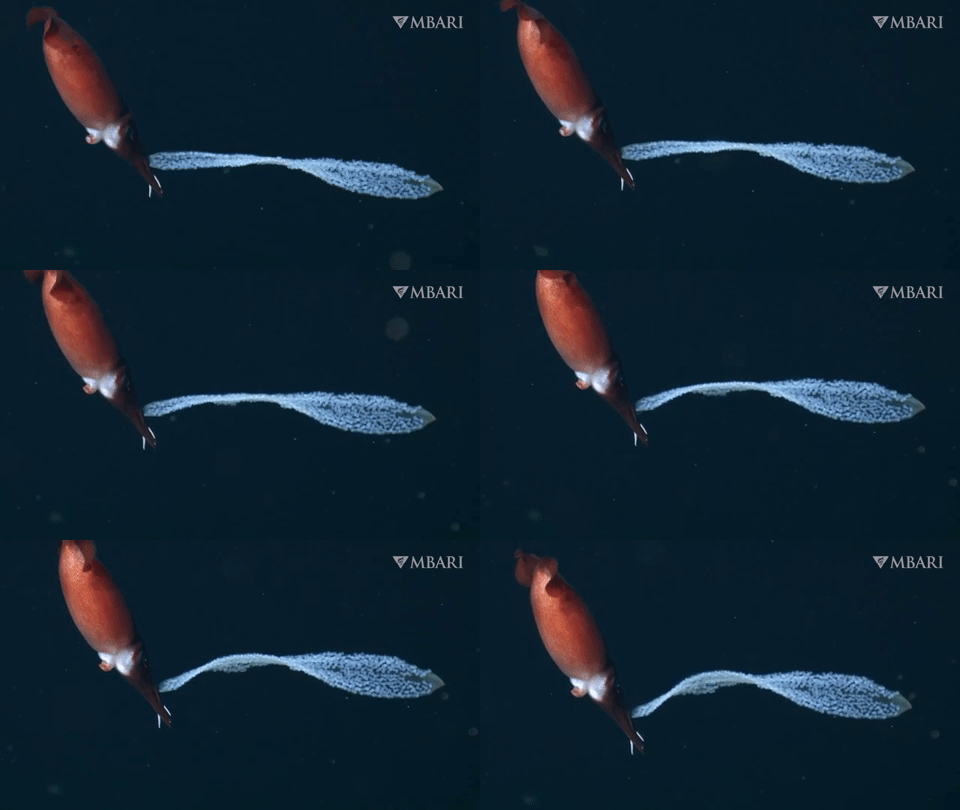
A close-up of the squid mom holding onto her eggs.
This is only the second time MBARI researchers have observed this brooding behavior in Bathyteuthis squid, after first glimpsing it in 2005. Only two other species of brooding squid, both from the deep sea, have ever been spotted carrying their eggs in this way. However, the researchers suspect that "other deep-dwelling squids may also turn out to be brooders," according to the statement.
RELATED STORIES
The overprotective mom in the video appears deceptively large alongside her tiny eggs, but in reality, her mantle — the main part of a squid's body containing all the major organs — can only grow to a maximum length of 3 inches (7.5 centimeters), according to MBARI.
Get the world’s most fascinating discoveries delivered straight to your inbox.
Researchers say that videos like this one show the importance of continuing to explore deeper waters. "The deep ocean is challenging to study and we only get brief glimpses into the behaviors of deep-sea animals," the researchers wrote. "Each observation logged by our ROVs provides another piece of the puzzle and helps improve our understanding of life in the deep."
Originally published on Live Science.

Harry is a U.K.-based senior staff writer at Live Science. He studied marine biology at the University of Exeter before training to become a journalist. He covers a wide range of topics including space exploration, planetary science, space weather, climate change, animal behavior and paleontology. His recent work on the solar maximum won "best space submission" at the 2024 Aerospace Media Awards and was shortlisted in the "top scoop" category at the NCTJ Awards for Excellence in 2023. He also writes Live Science's weekly Earth from space series.