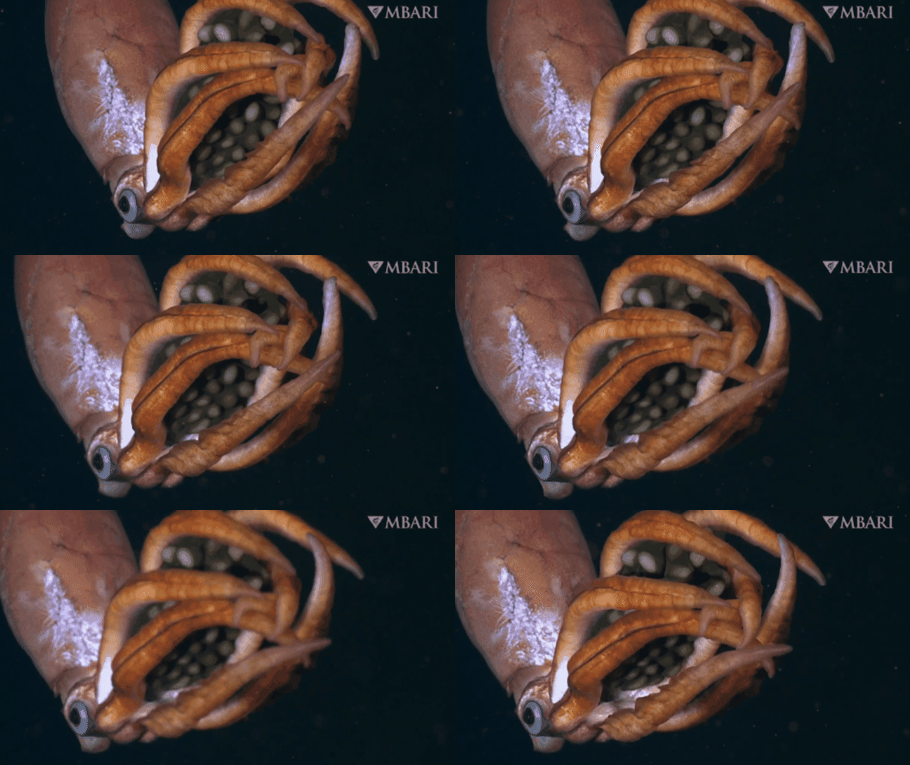
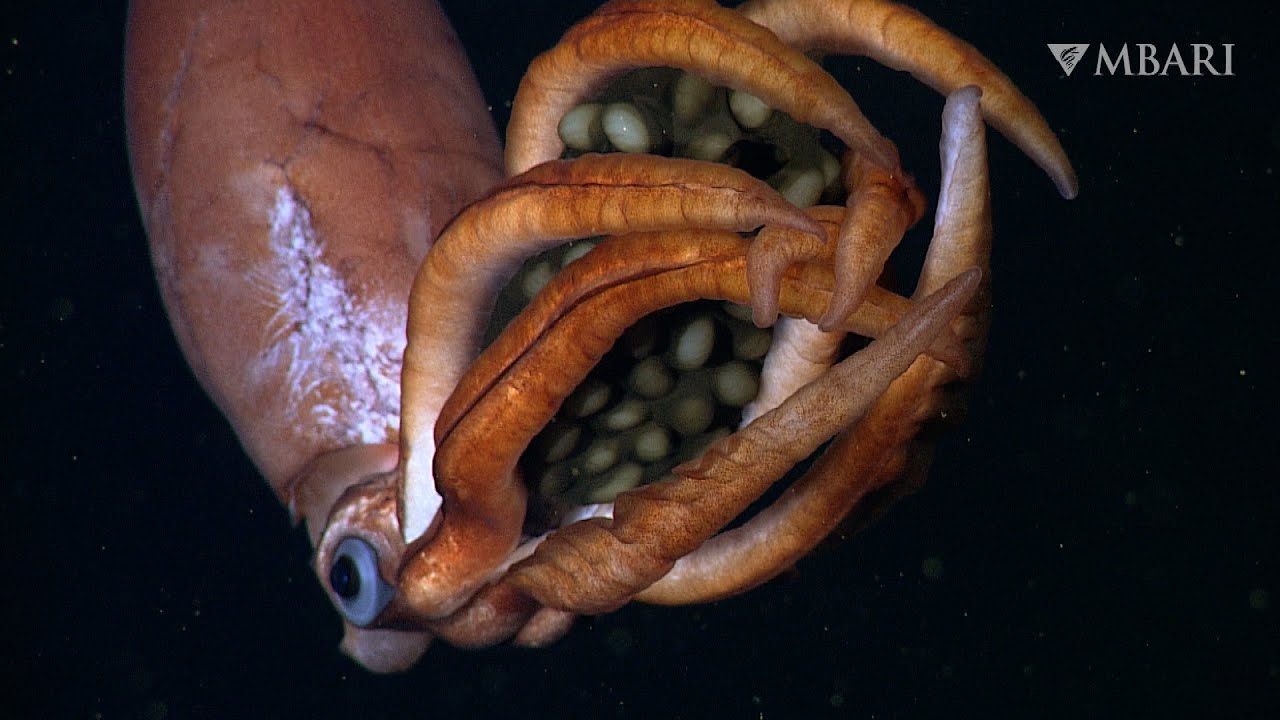
Scientists at MBARI encountered a female squid brooding giant eggs at a depth of more than 8,000 feet (2,400 meters) during an expedition to the Gulf of California. The squid was from an unknown species in the family Gonatidae.
Scientists have captured stunning video of a female deep-sea squid cradling unusually large eggs in her tentacles. The footage, taken by the team via a remotely operated vehicle (ROV) off Mexico's coast, reveals that the mother squid was carrying about 40 eggs, each around twice as large as those of previously encountered squid.
The new video reveals additional details about the life cycle of deep-dwelling squid. These animals are rarely seen alive at depth and little is known about how they reproduce in a dark and cold environment, where oxygen and food is limited.
"The deep sea is the largest living space on Earth and there is a lot left to be discovered," Steven Haddock, a senior scientist and expedition leader at the Monterey Bay Aquarium Research Institute (MBARI), said in a statement. "Our unexpected encounter with a squid brooding giant eggs caught the attention of everyone in the ship’s control room." The findings were published in May in the journal Ecology.
Seeing a deep-sea squid brooding, or protecting eggs after laying them, is especially rare. Most squids leave their eggs drifting in the water column or attached to the seafloor, according to the statement. Brooding is extremely arduous for female squid. This process often leads to the mothers dying after the eggs hatch, Henk-Jan Hoving, a deep-sea biologist at the GEOMAR Helmholtz Centre for Ocean Research in Germany and lead author of the paper, said in the statement.
The researchers encountered the brooding squid in 2015 during an expedition to the Gulf of California to study animals that live in an extremely oxygen-poor environment. As the scientists launched ROVs into the deep basin, they spotted the mother, at around 8,418 feet (2,566 meters) deep. The species identity of this squid has never been described, but likely belongs to the family Gonatidae which is common in the Pacific Ocean.
While capturing video of a squid brooding is rare, it isn't unprecedented. MBARI scientists first spotted a female squid, of the species Gonatus onyx, — also from the family Gonatidae — brooding in Monterey Bay in 2002. In 2005, they filmed a brooding deep-sea squid (Bathyteuthis berryi) from a different family in the same geographic area. Over 37 years of exploration, MBARI scientists have observed 17 squid mothers cradling their eggs.
Female deep-sea squid brooding eggs that are twice as large as previously found.
(Image credit: MBARI)
The mother squid they encountered in 2015 had far fewer eggs than the brooding squid in 2002, which carried 3,000 small eggs. Having many small eggs can be advantageous when food is limited and predators are abundant. Meanwhile, larger eggs are better for a less-threatening, stable environment, the researchers wrote in the study.
The squid the scientists encountered in the Gulf of California was about 3,000 feet (900 m) deeper than the one seen in Monterey two decades ago. The move into deeper territory with extremely low oxygen levels may be a strategic choice made to avoid predators such as sharks and seals, the researchers wrote in the study.
"This remarkable sighting underscores the diversity of ways that animals adapt to the unique challenges of living in the deep," Haddock said.
Sign up for the Live Science daily newsletter now
Get the world’s most fascinating discoveries delivered straight to your inbox.
Kristel is a science writer based in the U.S. with a doctorate in chemistry from the University of New South Wales, Australia. She holds a master's degree in science communication from the University of California, Santa Cruz. Her work has appeared in Drug Discovery News, Science, Eos and Mongabay,among other outlets. She received the 2022 Eric and Wendy Schmidt Awards for Excellence in Science Communications.