













A slave was brutally crucified in Roman Britain 1,700 years ago. Now, his face has been brought back to life.
A new facial approximation of a man who was crucified in Roman Britain finally "puts a face to his story."
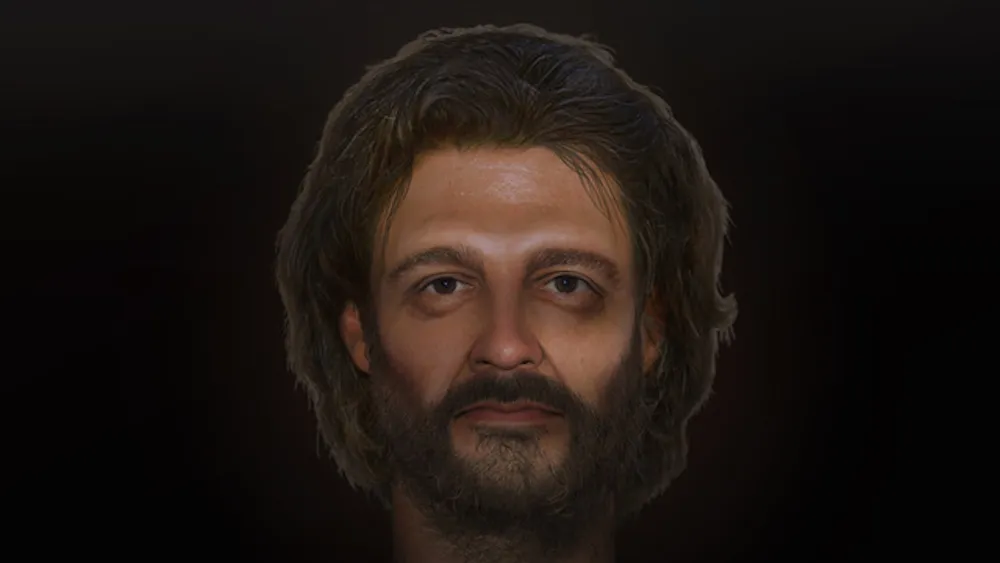
In 2017, archaeologists in England found the ancient skeleton of a man with a nail hammered through his heel. Further analysis revealed he was a Roman slave who had been brutally crucified during the third or fourth century A.D.
Now, a new digital facial approximation presented as part of a BBC Four program offers a first glimpse at what he may have looked like in life, according to the BBC.
"This man had such a particularly awful end that it feels as though by seeing his face you can give more respect to him," osteoarchaeologist Corinne Duhig, director of studies in archaeology and anthropology at Lucy Cavendish College at the University of Cambridge, who was part of the project, told the BBC.
Related: Battered Roman-era skull with signs of violent trauma and a possible brain tumor unearthed in Spain
Based on the initial analysis, researchers already knew that the man died between age 25 and 35, and his "battered skeleton" revealed his leg bones were thinning — evidence that he was likely chained to a wall for a long time. His remains were found in a cemetery in Cambridgeshire alongside more than 40 other individuals whose skeletons also showed signs that they undertook hard manual labor.
The man's skeleton was buried with a dozen iron nails and a "bier" — a wooden board that may have been used to form a cross that his hands and legs were nailed to. It is considered the best-preserved example of a Roman-era crucifixion in the world, according to the University of Cambridge.
For the facial reconstruction, researchers enlisted the help of forensic artist Joe Mullins, an adjunct faculty member in the Forensic Science Program at George Mason University in Virginia, who regularly creates reconstructions for law enforcement. Mullins used CT scans of the man's skull and computer software to create the framework of the enslaved man's face.
Get the world’s most fascinating discoveries delivered straight to your inbox.
"It was like putting an ancient jigsaw puzzle together," Mullins told Live Science.
Once the man's bone structure was in place, Mullins said he "sculpted his facial muscles" using biomarkers to determine thickness.
Researchers also provided a genetic profile compiled from the man's DNA, which helped Mullins determine details of some of the man's features, including the color of his skin and his dark eyes. Having this additional layer of information from the man's genetic profile helped inform his final reconstruction. Studies have shown that having DNA helps increase an approximation's accuracy.
RELATED STORIES
"With all of this information in front of me, the ancient puzzle came together pretty easily," Mullins said. "It's like creating a portrait from the inside out."
Mullins said that he feels a facial approximation is complete "when he sees a person staring back at him" on his computer screen.
"One of the biggest surprises I always have while working on this kind of case is that this person was once a living human being," Mullins said. "Even though he was alive more than 1,000 years ago and died under horrible circumstances, he was still just a man. Although he wasn't a pharaoh or a king, he was just an everyday person, and I'm able to finally put a face to his story."
Jennifer Nalewicki is former Live Science staff writer and Salt Lake City-based journalist whose work has been featured in The New York Times, Smithsonian Magazine, Scientific American, Popular Mechanics and more. She covers several science topics from planet Earth to paleontology and archaeology to health and culture. Prior to freelancing, Jennifer held an Editor role at Time Inc. Jennifer has a bachelor's degree in Journalism from The University of Texas at Austin.