It's quick and easy to access Live Science Plus, simply enter your email below. We'll send you a confirmation and sign you up for our daily newsletter, keeping you up to date with the latest science news.
Efforts to completely contain the new coronavirus — the pandemic responsible for infecting hundreds of thousands of people in 130 countries with the disease, called COVID-19 — have failed.
In less than a month, the global number of confirmed COVID-19 cases doubled from about 75,000 cases on Feb. 20 to more than 153,000 on March 15. That infection rate, scary as it sounds, hides just how much the out-of control virus has spread, especially in the hardest-hit communities. In Italy, for example — the country with the worst COVID-19 outbreak outside of China — confirmed cases doubled from 10,000 to 20,000 in just four days (March 11 to March 15).
This rapid growth rate in Italy has already filled some hospitals there to capacity, forcing emergency rooms to close their doors to new patients, hire hundreds of new doctors and request emergency supplies of basic medical equipment, like respirator masks, from abroad. This lack of resources contributes, in part, to the outsize COVID-19 death rate in Italy, which is roughly 7% — double the global average, PBS reported.
Health officials take for granted that COVID-19 will continue to infect millions of people around the world over the coming weeks and months. However, as the outbreak in Italy shows, the rate at which a population becomes infected makes all the difference in whether there are enough hospital beds (and doctors, and resources) to treat the sick.
In epidemiology, the idea of slowing a virus' spread so that fewer people need to seek treatment at any given time is known as "flattening the curve." It explains why so many countries are implementing "social distancing" guidelines — including a "shelter in place" order that affects 6.7 million people in Northern California, even though COVID-19 outbreaks there might not yet seem severe.
Here's what you need to know about the curve, and why we want to flatten it.
Sign up for the Live Science daily newsletter now
Get the world’s most fascinating discoveries delivered straight to your inbox.
What is the curve?
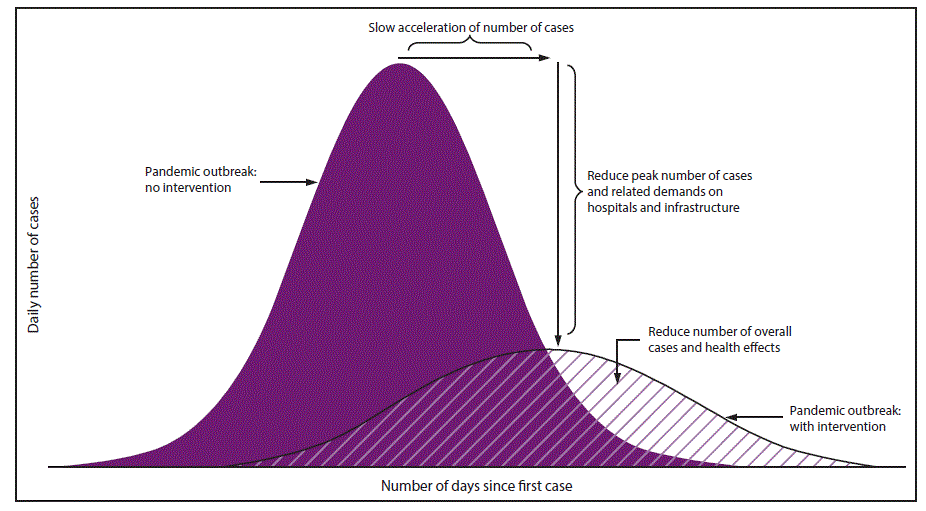
The "curve" researchers are talking about refers to the projected number of people who will contract COVID-19 over a period of time. (To be clear, this is not a hard prediction of how many people will definitely be infected, but a theoretical number that's used to model the virus' spread.) Here's what one looks like:
A sample epidemic curve, with and without social distancing.
(Image credit: Johannes Kalliauer/ CC BY-SA 4.0)
The curve takes on different shapes, depending on the virus's infection rate. It could be a steep curve, in which the virus spreads exponentially (that is, case counts keep doubling at a consistent rate), and the total number of cases skyrockets to its peak within a few weeks. Infection curves with a steep rise also have a steep fall; after the virus infects pretty much everyone who can be infected, case numbers begin to drop exponentially, too.
The faster the infection curve rises, the quicker the local health care system gets overloaded beyond its capacity to treat people. As we're seeing in Italy, more and more new patients may be forced to go without ICU beds, and more and more hospitals may run out of the basic supplies they need to respond to the outbreak.
A flatter curve, on the other hand, assumes the same number of people ultimately get infected, but over a longer period of time. A slower infection rate means a less stressed health care system, fewer hospital visits on any given day and fewer sick people being turned away.
For a simple metaphor, consider an office bathroom.
"Your workplace bathroom has only so many stalls," Charles Bergquist, director of the public radio science show "Science Friday" tweeted. "If everyone decides to go at the same time, there are problems. If the same number of people need go to the restroom but spread over several hours, it's all ok."
How do we flatten the curve?
As there is currently no vaccine or specific medication to treat COVID-19, and because testing is so limited in the U.S., the only way to flatten the curve is through collective action. The U.S. Centers for Disease Control and Prevention (CDC) has recommended that all Americans wash their hands frequently, self-isolate when they're sick or suspect they might be, and start "social distancing" (essentially, avoiding other people whenever possible) right away.
To comply, many states have temporarily closed public schools, and many businesses have advised employees to work from home if possible. On March 15, the CDC advised that all events of 50 people or more should be canceled or postponed for the next eight weeks. On Monday (March 16), six counties in the Bay Area — encompassing some 6.7 million people — gave "shelter in place" orders, meaning that people should not leave their house except to get essentials like food or medicine.
So, does flattening the curve work?
It did in 1918, when a strain of influenza known as the Spanish flu caused a global pandemic. To see how it played out, we can look at two U.S. cities — Philadelphia and St. Louis — Drew Harris, a population health researcher at Thomas Jefferson University in Philadelphia, told NPR.org.
In Philadelphia, city officials ignored warnings from infectious disease experts that the flu was already spreading in the community. The city instead moved forward with a massive parade that gathered hundreds of thousands of people together, Harris said.
"Within 48, 72 hours, thousands of people around the Philadelphia region started to die," Harris said. Ultimately, about 16,000 people from the city died in six months.
In St. Louis, meanwhile, city officials quickly implemented social isolation strategies. The government closed schools, limited travel and encouraged personal hygiene and social distancing. As a result, the city saw just 2,000 deaths — one-eighth of the casualties in Philadelphia.
The city, now known for its towering Gateway Arch, had successfully flattened the curve.
Brandon is the space / physics editor at Live Science. With more than 20 years of editorial experience, his writing has appeared in The Washington Post, Reader's Digest, CBS.com, the Richard Dawkins Foundation website and other outlets. He holds a bachelor's degree in creative writing from the University of Arizona, with minors in journalism and media arts. His interests include black holes, asteroids and comets, and the search for extraterrestrial life.

 Live Science Plus