 Live Science Plus






Night-Shining Clouds Show Up Early Over South Pole
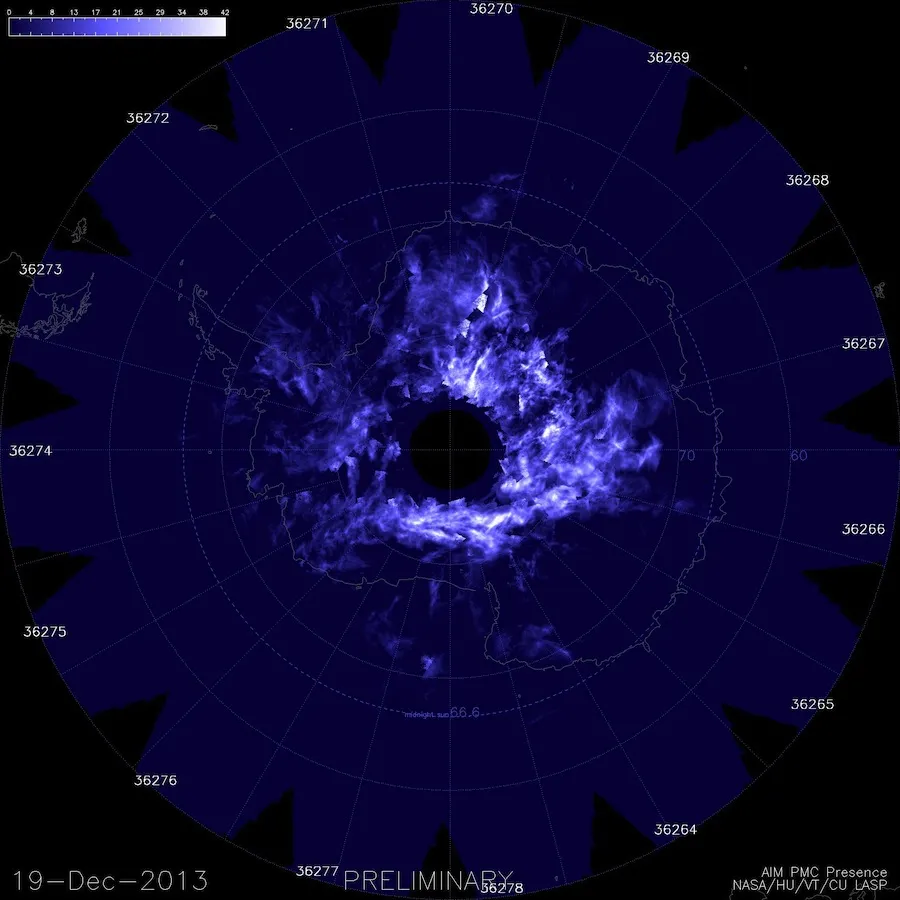
Night-shining clouds started glowing high above Antarctica earlier than usual this year, observations from a NASA satellite show.
These rare types of wispy blue-white clouds are called noctilucent clouds, or NLCs. They form when water molecules freeze around "meteor smoke" close to the edge of space, typically about 50 to 53 miles (80 and 85 kilometers) above Earth's surface — so high that they can reflect light after the sun sets.
The phenomenon looks spectacular from the ground, but scientists also have watched these night-shining clouds from above with NASA's AIM (Aeronomy of Ice in the Mesosphere) satellite since 2007. Data from AIM indicate that noctilucent clouds started forming around the South Pole on Nov. 20 this year as a tiny spot of electric blue that quickly expanded to cover the entire frozen continent, as this NASA video shows. [Photo Gallery: Reading the Clouds]
AIM's observations over the past few years helped scientists discover a key ingredient in night-shining clouds: "smoke" from meteoroids that bombard Earth's atmosphere. The falling space rocks leave behind a cloud of tiny particles that hovers about 43 to 62 miles (70 to 100 kilometers) above the ground.
Summer is primetime for noctilucent clouds. Because of global wind and humidity patterns, more water molecules are lifted up from the atmosphere during summer. It's also the season when the upper atmosphere is coldest, meaning more water vapor condenses into tiny ice crystals that latch onto the dust particles of disintegrated meteoroids, according to NASA. Accordingly, noctilucent clouds typically flare up over the South Pole from November to February (summer in the Southern Hemisphere), and then shift to the North Pole from May to August.
In all the years that AIM has been observing the clouds, only the 2009 noctilucent season got off to an earlier start in the South Pole, according to NASA. The 2013 season above the North Pole also started quite early (around May 13).
Though night-shining clouds are typically associated with Earth's poles, they have been spotted in recent years at latitudes as low as Colorado and Utah, NASA officials say. Some scientists studying noctilucent clouds think this shift could be an effect of increased methane emissions, since the greenhouse gas is known to boost the abundance of water at the top of Earth's atmosphere.
AIM launched on April 25, 2007. In August 2103, NASA officials announced that the mission was being extended for two years.
Follow Megan Gannon on Twitter and Google+. Follow OurAmazingPlanet @OAPlanet, Facebook and Google+. Original article on LiveScience's OurAmazingPlanet.

