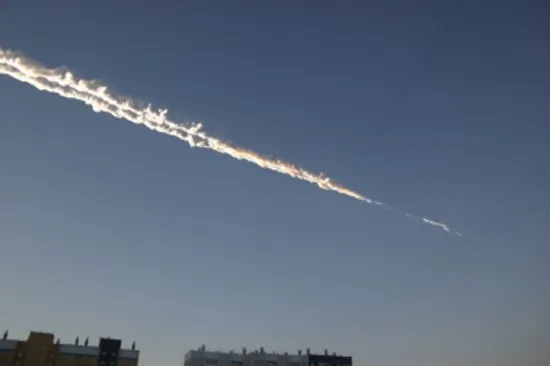
The terms asteroid, meteor, meteorite and meteoroid get tossed around recklessly, especially when two of them threaten the Earth on the same day. Here's a quick explainer:
An asteroid is a rocky object in space that's smaller than a planet — they're sometimes called minor planets or planetoids, according to NASA. Other sources refer to them loosely as "space debris," or leftover fragments from the formation of the solar system (like the extra pieces that remain after constructing a build-it-yourself bookcase from IKEA).
There are millions of asteroids orbiting the sun, some 750,000 of which are found in the asteroid belt, a vast ring of asteroids located between the orbits of Mars and Jupiter. Asteroids can be as large as hundreds of kilometers wide: The asteroid Ceres, sometimes referred to as a dwarf planet, is 940 km (584 miles) wide.
Latest Videos From
Asteroids have no atmosphere, but many are large enough to exert a gravitational pull — some, in fact, have one or two companion moons, or they form binary systems, in which two similarly sized asteroids orbit each other.
Scientists are eager to study asteroids because they reveal so much information about the early formation of our solar system some 4.6 billion years ago. One way to study them is to observe them when they come close to Earth, as 2012 DA14 will today (Feb. 15).
A meteor is an asteroid or other object that burns and vaporizes upon entry into the Earth's atmosphere; meteors are commonly known as "shooting stars." If a meteor survives the plunge through the atmosphere and lands on the surface, it's known as a meteorite.
Meteorites are usually categorized as iron or stony. As the name implies, iron meteorites are composed of about 90 percent iron; stony meteorites are made up of oxygen, iron, silicon, magnesium and other elements.
And meteoroids? That's a general term describing small particles of comets or asteroids that are in orbit around the sun. There's no universally accepted, hard-and-fast definition (based on size or any other characteristic) that distinguishes a meteoroid from an asteroid — they're simply smaller than asteroids.
Only when these objects enter the atmosphere are they referred to as meteors, like the meteor that was seen over Russia today. Because that meteor exploded in the atmosphere, the resulting fireball is known as a bolide. Again, there's no precise definition of a bolide — most astronomers understand a bolide as simply a very bright fireball.
Follow LiveScience on Twitter @livescience. We're also on Facebook & Google+.

 Live Science Plus