














Before and After: Deadly Fungus Wipes Out Amphibians

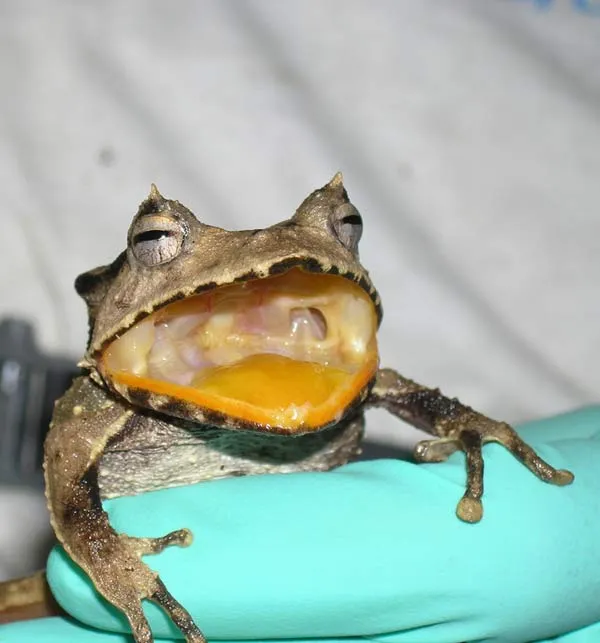
A deadly fungus has been wiping out the world's amphibian populations, but just how many species are being lost to the disease onslaught wasn't fully known. A new study that documented a Panamanian amphibian community before and after the fungus swept through shows the significant impact on species diversity.
Dramatic declines in amphibian numbers have been reported for more than 40 years now from four continents; the culprit behind the collapse is a fungus called Batrachochytrium dendrobatidis, which causes the disease chytridiomycosis in amphibians. The rapid spread of the disease — about 19 miles (30 kilometers) per year in the Central American highlands — has led to species extinctions and extirpations (the local extinction of a species).
Scientists had studied areas devastated by the disease after it swept through and conducted dramatic rescues of frogs in areas that had yet to be hit, but no systematic before-and-after snapshots of a particular area had been taken to document what amphibian species were present before the arrival of the fungus and what species survived the wave of disease.
In the 1980s, after the disappearance of Costa Rica's golden frogs, herpetologist Karen Lips, an associate professor at the University of Maryland in College Park, set up a monitoring program at as-yet untouched sites in neighboring Panama's Omar Torrijos National Park in El Copé.
Before-and-after shots
Lips and her colleagues conducted seven years' worth of surveys before the arrival of the fungus in El Copé in 2004, as well as surveys after the disease had wiped out many frogs.
The pre-decline surveys identified 63 species of amphibians within just a 1.5-square-mile (4-square-kilometer) area. After 2004, 25 of those species had disappeared from the site. As of 2008, none had reappeared.
Get the world’s most fascinating discoveries delivered straight to your inbox.
An additional nine species saw an 85 percent to 99 percent decline in their abundance.
To augment the surveys and identify any so-called "cryptic species" — those that look very similar to a recognized species but are in fact a separate species, meaning they don't reproduce with the known species — scientists used a genetic technique called DNA barcoding.
This technique finds DNA sequences unique to a given species. With it, scientists estimated that another 11 unnamed species had been present at the site, five of which were wiped out by the arrival of the fungus.
"It's sadly ironic that we are discovering new species nearly as fast as we are losing them," said study team member Andrew Crawford, a former postdoctoral fellow at the Smithsonian Tropical Research Institute in Panama and a member of the Círculo Herpetológico de Panamá, now at the University of the Andes in Colombia.
"Our DNA barcode data reveal new species even at this relatively well-studied site, yet the field sampling shows that many of these species new to science are already gone here," he added.
Crawford, Lips and other researchers recently published a detailed description of two previously unknown species of frogs in Panama, which are threatened by the fungus.
Huge loss
Because El Copé is one of the better-studied sites and so many species that were lost had been undescribed, it is likely that the loss of undescribed species in other areas is far greater, the researchers noted.
The loss of so many frog species, known and unknown, not only threatens the rich biodiversity of a given area and the functioning of the local ecosystem, but it also destroys the genetic data that helps scientists learn how species have adapted to change and evolved in the past.
The researchers compared this loss to the great fire that destroyed the famous ancient library of Alexandria and the priceless, one-of-a-kind texts it held.
Their findings are detailed in the July 19 edition of the journal Proceedings of the National Academy of Sciences.
- 8 of the World's Most Endangered Places
- 10 Species You Can Kiss Goodbye
- How Many Species Exist on Earth?
This article was provided by OurAmazingPlanet, a sister site to LiveScience.

Andrea Thompson is an associate editor at Scientific American, where she covers sustainability, energy and the environment. Prior to that, she was a senior writer covering climate science at Climate Central and a reporter and editor at Live Science, where she primarily covered Earth science and the environment. She holds a graduate degree in science health and environmental reporting from New York University, as well as a bachelor of science and and masters of science in atmospheric chemistry from the Georgia Institute of Technology.