













Fungus Sex Is Threat to Frogs

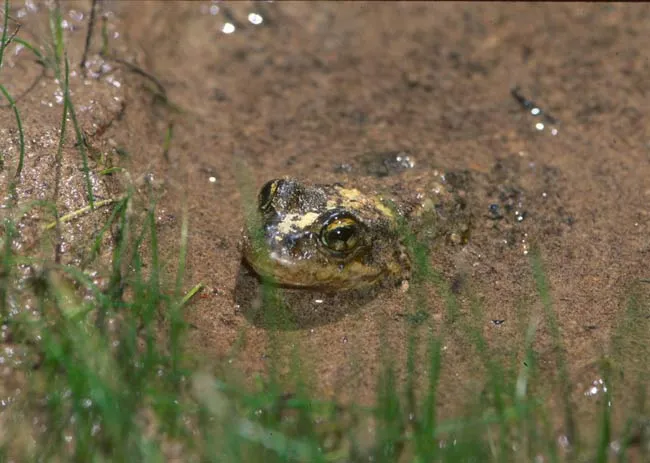
A fungus that is wiping out frogs and other amphibians all over the world can probably reproduce sexually, a new study finds, which could make it even deadlier to frogs by allowing it to travel longer distances and hang around longer in the environment.
The pathogen, called a chytrid fungus, has decimated frog populations on every continent (except Antarctica where no frogs live), even in protected highland rainforests in Central America.
Though scientists have been following the spread of the fungus, they know little about exactly how it kills off the frogs (though it is thought to clog their skin, essentially suffocating them) and how it has spread to places as distant from one another as Australia and the United States.
Sierra Nevada analysis
The fungus has spread rapidly in the United States, racing west to east across the Sierra Nevada at the pace of about one mile per year. Mountain yellow-legged frogs, once the most abundant amphibians in that mountain range, have disappeared from 95 percent of their range in the last 30 years, prompting the U.S. Fish and Wildlife Service to consider listing them as an endangered species.
Researchers studying the dramatic decline of these frogs conducted a genetic analysis of the fungus in that region to see whether the fungus was new to the area or had been lurking in the environment for awhile.
If the fungus had just arrived in the neighborhood, there would be only one genotype (an organism's genetic makeup) that spread by cloning itself. If the fungus were endemic to the region (found only there), it would have had time to mutate and recombine its DNA into more diverse genotypes.
Get the world’s most fascinating discoveries delivered straight to your inbox.
The new study, detailed in the Aug. 6 issue of the journal Proceedings of the National Academy of Sciences, found evidence of both.
"We found sites dominated by a single fungal genotype, which suggests recent spread of the pathogen through clonal reproduction," said co-author Jess Morgan, a biologist at the University of California, Berkeley, when the study was conducted.
Resistant spores
But other sites showed evidence of multiple, related genotypes that suggest that the fungus is reproducing sexually, which could create extremely resistant spores. (Asexual reproduction only takes one parent, which makes a copy of itself, usually by dividing in half. Sexual reproduction combines the genes of two parents, which allows for increasing genetic diversity.)
"This group of fungi, when it reproduces sexually, can create spores that can last for a decade," said study leader John Taylor of UC Berkeley. "That could make this pathogen a harder problem to defeat. As a resistant spore, the fungus could be transported by animals, including humans or birds, or lay dormant in an infected area until a new host comes along."
"This is huge," said frog biologist Karen Lips of Southern Illinois University, who was not involved in the study. "This is really bad news for the frogs."
Finding regions where the fungus is endemic is important because the frogs there are likely to be less affected by the fungus, having co-evolved with it. If researchers can find out how the frogs ward off the fungus, they may be able to help other populations.
- Top 10 Mysterious Diseases
- Warming Kicks Frogs While They're Down
- Images: Snakes, Frogs and Lizards

Andrea Thompson is an associate editor at Scientific American, where she covers sustainability, energy and the environment. Prior to that, she was a senior writer covering climate science at Climate Central and a reporter and editor at Live Science, where she primarily covered Earth science and the environment. She holds a graduate degree in science health and environmental reporting from New York University, as well as a bachelor of science and and masters of science in atmospheric chemistry from the Georgia Institute of Technology.