














Inner Earth Moves Mountains, Study Reveals
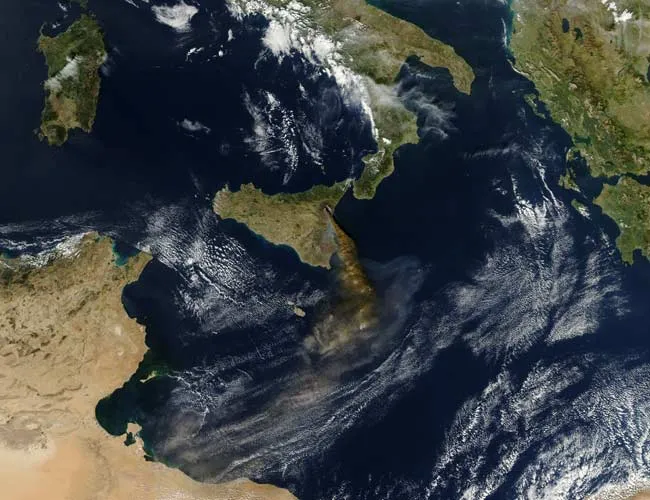
The volcanoes of the Mediterranean, such as the explosive Mount Etna, technically shouldn't exist, at least according to the old model of how volcanoes grow. A new study reveals how they got there.
Enormous sections of the Earth's crust — the rocky plates floating on the scorching, molten rock inside the Earth, known as the mantle — can collide and trigger volcanic eruptions, earthquakes and generate mountain ranges. These collisions are the culprits that created many of the world's volcanoes, including those along much of the Pacific "Ring of Fire."
However, some volcanic eruptions happen far from these crash sites. The new study, detailed in the June 3 issue of the journal Nature, suggests that the mantle pushes up on the Earth's crust in some areas, creating extreme pressure that can cause volcanoes — and mountains — to grow, said the researchers who studied these areas. It is this shoving of the mantle that created the volcanoes of the Mediterranean, they said.
"The rise and subsidence of different points of the Earth is not restricted to the exact locations of the plate boundary. You can get tectonic activity away from a plate boundary," said study co-author Thorsten Becker of the University of Southern California in Los Angeles.
The Mediterranean is part of what geologists call a mobile belt — fragments of the Earth's crust that float between the much larger continental plates. The research team believes their model can help predict volcanic hotspots in these mobile belts. Other mobile belts include the North American Cordillera, which includes the Rocky Mountains and Sierra Nevada, and the Himalayas.
Mantle material can sink at a plate boundary, and then flow back upward farther away, pushing on the crust — a process called small scale convection. The slow but inexorable motions can move mountains — both gradually and through earthquakes or eruptions. The researchers were able to detect these crustal motions with a global positioning system (GPS).
The study identified two mountain ranges raised almost entirely by mantle flow, according to the authors: the southern Meseta Central plateau in Spain and the Massif Central in France.
Get the world’s most fascinating discoveries delivered straight to your inbox.
Processes similar to those in the Mediterranean may also have indirectly caused the intense 19th-century New Madrid intraplate earthquake, which occurred in the middle of a tectonic plate rather than at the edge, Thorsten told LiveScience.
Volcanic hotspots like the one that created Hawaii, though, are associated with a deeper upwelling, and not with the study's model, Thorsten said. However, there are other volcanic sites, such as Mt Etna, and volcanoes in China, that may fit the researchers' model.
- 10 Wild Volcano Facts
- Have There Always Been Continents?
- Image Gallery: Wild Volcanoes