Human Bite Force Compares to Chomp of Chimps

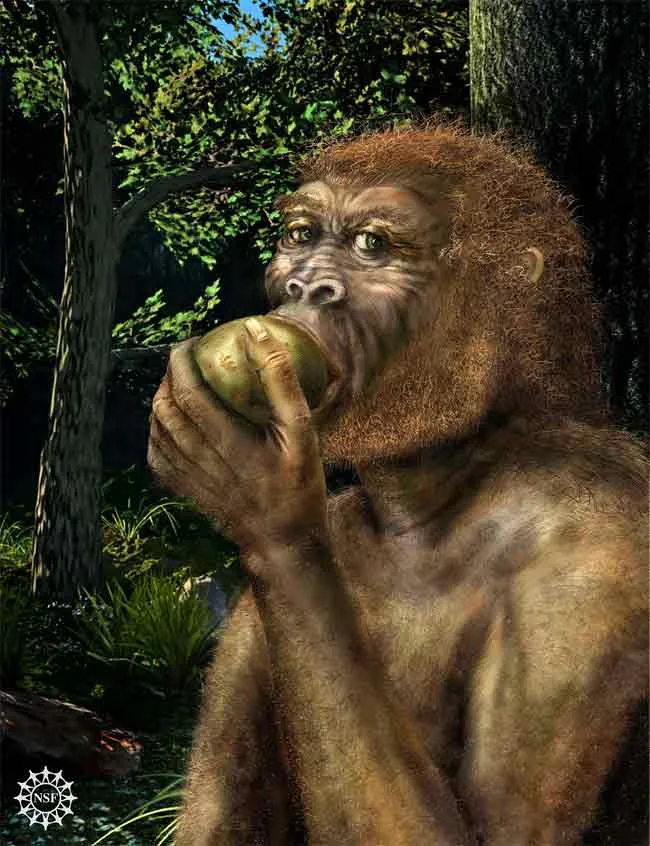
Humans are often considered wimps compared with our strong-jawed relatives, but now scientists find that our bites might be far mightier than before thought. Relative to our size, humans could chomp down with as much force as a chimpanzee or even the so-called huge-jawed extinct "nutcracker man."
One of the key traits that mark the beginning of the human lineage, other than upright postures and larger brains, are smaller teeth. Still, oddly, we possess very thick tooth enamel, a feature typically linked with strong bites.
Now researchers find that although modern humans possess smaller teeth and jaws than our closest relatives, both living and extinct, we have surprisingly powerful bites.
Although the human skull is relatively lightly built, Australian scientists found that our jaws are at least 40 percent more efficient than those of the chimp, gorilla and orangutan, and of two prehistoric members of our family, Australopithecus africanus and Paranthropus boisei — the latter nicknamed "the nutcracker man" for its especially massive skull and jaw muscles.
"For our size, we humans are comparable in terms of maximum bite force to these fossil species," said researcher Stephen Wroe, a biomechanist and paleontologist at the University of New South Wales in Sydney, Australia. "Size matters, but efficiency matters more, and humans are very efficient biters."
The scientists developed sophisticated 3-dimensional computer models from actual skulls they CAT-scanned, including one from an African bushman hunter-gatherer that might better reflect what ancient humans might have been like than a living person. These simulations provided highly detailed views of where stresses occur in materials in scenarios designed to mimic real life, a technique Wroe and his colleagues have previously used to study the jaws of a number of living and extinct species, such as the great white shark.
The efficiency of human jaw muscles explains why our skulls are not as robust as our relatives, since our skulls undergo much less stress. Our powerful bites also help explain why our tooth enamel is so thick.
Get the world’s most fascinating discoveries delivered straight to your inbox.
Although our bites are more efficient overall, some of our relatives nevertheless had stronger bites than us simply because they are larger — for instance, gorilla bites could generate forces 30 percent to more than 50 percent greater than ours. Also, while human bites are comparable to our relatives in terms of being able to quickly bite down to crack open hard items like nuts, we may be less capable of consuming tough foods, "such as leaves or bamboo, which require sustained chewing over a long period," Wroe said.
These findings shed new light on how we might interpret the evolution of human diet and growth. Some possibilities that scientists had suggested in the past for our small teeth and jaws included a switch to softer foods, more processing of foods with tools and cooking, or a shrinking of our jaw muscles to make way for larger brains.
"However plausible, those ideas may seem they have been based on very little by way of comparative data — for example, there are no actual records of bite force collected from living members of any other ape species," Wroe said. "We've done detailed 3-D comparisons here for the first time and, as it turns out, modern humans don't have a wimpish bite at all — it is very efficient and powerful."
The scientists detailed their findings online June 22 in the journal Proceedings of the Royal Society B.