













Walking DNA Robots Pave Way for Microscopic Factories
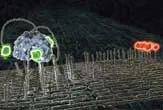
New DNA-based machines that can perform more complex tasks with greater autonomy than ever before are helping to lay the foundation for microscopic factories and nano-sized robots of the future.
In two papers published today in the journal Nature, scientists give DNA walkers—motile molecules composed of DNA “legs”—new abilities.
In one study, researchers programmed DNA walkers to pick up specific cargo from programmable DNA machines that they pass.
Study author Nadrian Seeman, a chemist at New York University and head of the school’s Structural DNA Nanotechnology lab, likens the entire process to a traditional automobile assembly line, where a basic car frame, or chassis, rumbles down a track and picks up parts along the way.
In this case, the DNA walker is the chassis. But rather than adding a steering wheel or side-view mirror to its frame, the DNA walker can pick up a five-nanometer gold particle, a 10 nanometer gold particle, or a pair of joined 5-nanometer gold particles — all invisible to the human eye.
By the end of its journey, the DNA walker can take on one of eight different configurations, depending on what cargo it picked up.
Seeman envisions nano-sized machines similar to the DNA walker functioning as microscopic factories, pumping out useful products in high yields.
Get the world’s most fascinating discoveries delivered straight to your inbox.
“It’s a couple years out, but I would like to add a longer assembly line and make more complex products,” he told TechNewsDaily.
In a separate Nature paper, Milan Stojanovic, a chemical engineer at Columbia University in New York, and his team describe DNA-based robots that can perform tasks on their own.
The team showed that a type of DNA walker called a "molecular spider" — named for its three DNA legs — can act as an autonomous robot by following instructions programmed into a "DNA track" that it walked upon.
The spider's legs are DNA enzymes, molecules that can snip a strand of DNA at very specific points. So as the spider walks down the DNA track, the track is modified by its passing. The spider stops when it encounters a "stop" command, essentially a region of track that contains an uncleavable sequence of DNA.
In the future, Stojanovic thinks molecular robots like the one his team created could
traverse natural surfaces, such as body tissue, to perform tasks such as repairing broken ligaments.
“It’s really far away,” Stojanovic said, “but the door seems now partially open.”
- Image Gallery: Micromachines
- 10 Profound Innovations Ahead
- Top 10 Disruptive Technologies