













Bees Get Buzz From Caffeine and Nicotine

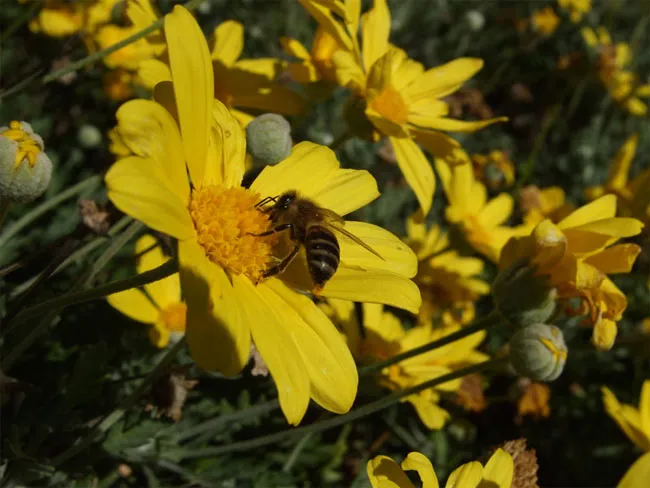
Like humans, bees enjoy a little caffeine and nicotine, according to a study announced last week.
The bees don't get their buzz from coffee and cigarettes, but rather, from nectar that naturally contains these potentially addictive substances — a tool nature may have employed to keep the insects coming back for more.
"This could be an evolutionary development intended, as in humans, to make the bee addicted," said study-researcher Ido Izhaki, of the University of Haifa in Israel.
But the bees aren't the bug-world equivalent of caffeine junkies or pack-a-day smokers, the researchers say. Too much of these substances, and the bugs turn up their noses at the stuff.
Scientists have known bees are attracted to a flower's nectar. In fact, that's how many plants reproduce. While lapping up the mostly sugar substance inside a flower, a bee inadvertently picks up pollen (essentially sperm cells) on its hairy body. When that bee hits up another flower, the pollen gets transferred to the flower's female part and pollination is complete.
The nectar in some plants, like the citrus flower, includes small quantities of caffeine, while in others, like the tobacco tree, it contain nicotine. But are these substances really present to allure bees?
To find out, Izhaki and his colleagues offered the insects artificial nectar with various levels of caffeine and nicotine, ranging from natural levels to well above what's found in nature, or "clean nectar" that only contained sugar.
Get the world’s most fascinating discoveries delivered straight to your inbox.
The bees preferred the "spiked" nectar over the clean, but only when the caffeine and nicotine levels were at about the levels found in nature.
The researchers still aren't sure if these substances really make pollination more efficient. But plants that survived natural selection are likely those that developed just-right levels of these addictive substances, enabling them to attract and not repel bees, the researchers say.
While this study only reveals a preference, and not an addiction, future studies will look at whether the bees do indeed become addicted to nicotine and caffeine.
The study was published in 2005 in the Journal of Chemical Ecology.
- Bees Know Their Numbers
- Bees See Your Face as a Strange Flower
- Image Gallery: Backyard Bugs
