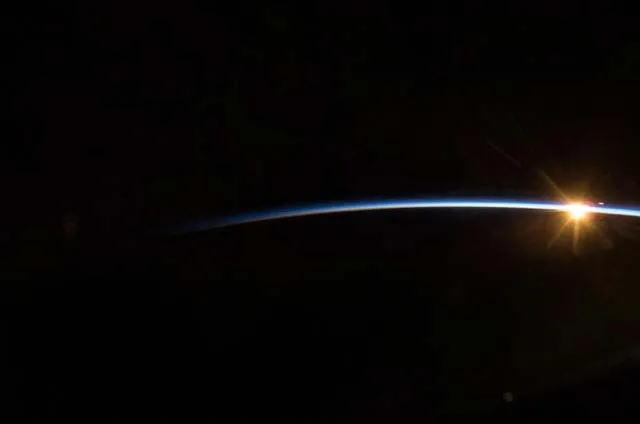
Far-Out Photo: Sunrise in Space
Get the world’s most fascinating discoveries delivered straight to your inbox.
You are now subscribed
Your newsletter sign-up was successful
Want to add more newsletters?
Delivered Daily
Daily Newsletter
Sign up for the latest discoveries, groundbreaking research and fascinating breakthroughs that impact you and the wider world direct to your inbox.
Once a week
Life's Little Mysteries
Feed your curiosity with an exclusive mystery every week, solved with science and delivered direct to your inbox before it's seen anywhere else.
Once a week
How It Works
Sign up to our free science & technology newsletter for your weekly fix of fascinating articles, quick quizzes, amazing images, and more
Delivered daily
Space.com Newsletter
Breaking space news, the latest updates on rocket launches, skywatching events and more!
Once a month
Watch This Space
Sign up to our monthly entertainment newsletter to keep up with all our coverage of the latest sci-fi and space movies, tv shows, games and books.
Once a week
Night Sky This Week
Discover this week's must-see night sky events, moon phases, and stunning astrophotos. Sign up for our skywatching newsletter and explore the universe with us!
Join the club
Get full access to premium articles, exclusive features and a growing list of member rewards.
Astronauts orbiting Earth see a lot more sunrises and sunsets that those of us stranded on the surface. They circle the planet every 90 minutes, and the sun just keeps coming.
A new picture of a sunrise from space was taken with a handheld camera by astronauts Friday on the day the Space Shuttle Endeavour docked with the International Space Station during shuttle mission STS-127.
Earth's atmosphere appears as a thin crescent shape ranging from white to blue to purple, while the planet in the foreground is a black as the void beyond.
From the surface of Earth, the sun rises because of Earths endless, 24-hour rotation. From here, sunrises and sunsets are often orange or red because the light has more atmosphere to pass through to get to your eye when the sun is near the horizon, and only the red light, with a longer wavelength then blue light, can make it.
The astronauts see little of that from their perch more than 200 miles up, but the effect is still beautiful.
Get the world’s most fascinating discoveries delivered straight to your inbox.