













Baby Crocs Cry Inside Eggs
The sounds "umph, umph, umph" might not resonate with you, but for baby crocodiles still in their shells, they are telling mom, "Let us out!"
Biologists have known that shortly before hatching, crocodiles make noises within their eggs. A new study, which involved playbacks of the pre-hatching calls, reveals these calls from the egg tell siblings it's time to hatch and tell moms it's time to uncover the nest.
Researchers Amélie Vergne and Nicolas Mathevon of the Jean Monnet University in France monitored Nile crocodile (Crocodylus niloticus) eggs that were due to hatch within 10 days. The eggs were placed into one of three groups, for which the researchers either played recordings of pre-hatching calls, recordings of noise (other than the calls), or no sound.
The group of eggs that got a dose of real croc calls responded and moved, as the about finger-sized babies jostled about, more often than the "noise" eggs. The eggs incubated in silence showed no movement.
All four of the individuals that successfully hatched in the croc-call group did so during or within 10 minutes of the playbacks. The pre-hatchlings in the noise group broke through their shells no less than five hours after the last playback.
After the eggs hatched, the moms-to-be stuck around to continue their nest guarding. The researchers found the female crocodiles responded to pre-hatching playbacks coming from loudspeakers hidden underground near the now-empty nests.
The female adults more often turned their heads or moved after egg sounds than after noise, and eight of the 10 mothers began digging in response to pre-hatching calls. (The nests are covered with soil during the months-long incubation.)
Get the world’s most fascinating discoveries delivered straight to your inbox.
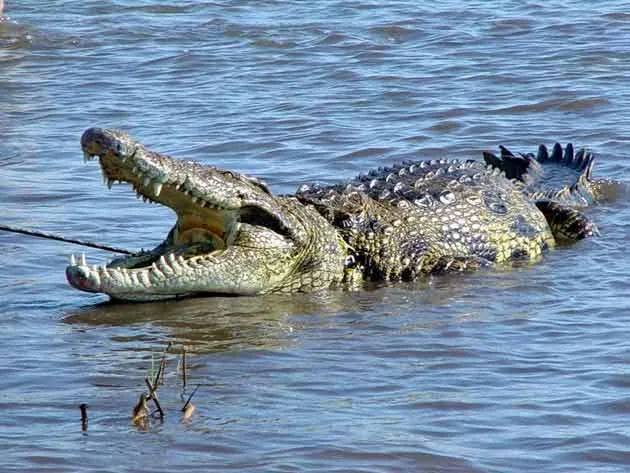
The Nile crocodile, Africa's largest croc can grow to about 20 feet (six meters) long and weigh up to 1,650 pounds (730 kg). Due to lethal human run-ins, the Nile crocodile has been labeled a vicious man-eater, but when it comes to parenting, these predators are nature's nurturers. Unlike many reptiles whose parenting responsibilities end once the mother lays her eggs, Nile croc moms vigilantly watch over their underground nests for about three months and even continue mothering for a period after the eggs hatch.
And so the researchers say the little grunts from inside the egg are likely critical to the early survival of the young crocodiles. The baby calls could attract attention from predators, the researchers say, making it important for all eggs to hatch at once so they receive care and protection from parents.
Some birds also vocalize to mom while inside their eggs, the researchers say. And so they speculate such acoustic communication at an early stage of development may be a shared behavioral feature of past and present archosaurs, a large group of animals that includes today's birds and crocodiles along with the now-extinct dinosaurs, pterosaurs and early croc relatives.
The study, detailed in the June 23 issue of Current Biology, was funded by the French Ministry of Research and the University Institute of France.
- Video: Hot Crocodile Problem
- Top 10 Deadliest Animals
- Are 'Crocodile Tears' Real?
Jeanna Bryner is managing editor of Scientific American. Previously she was editor in chief of Live Science and, prior to that, an editor at Scholastic's Science World magazine. Bryner has an English degree from Salisbury University, a master's degree in biogeochemistry and environmental sciences from the University of Maryland and a graduate science journalism degree from New York University. She has worked as a biologist in Florida, where she monitored wetlands and did field surveys for endangered species, including the gorgeous Florida Scrub Jay. She also received an ocean sciences journalism fellowship from the Woods Hole Oceanographic Institution. She is a firm believer that science is for everyone and that just about everything can be viewed through the lens of science.