













New Tool to Provide Insight on Alzheimer’s, Parkinson’s
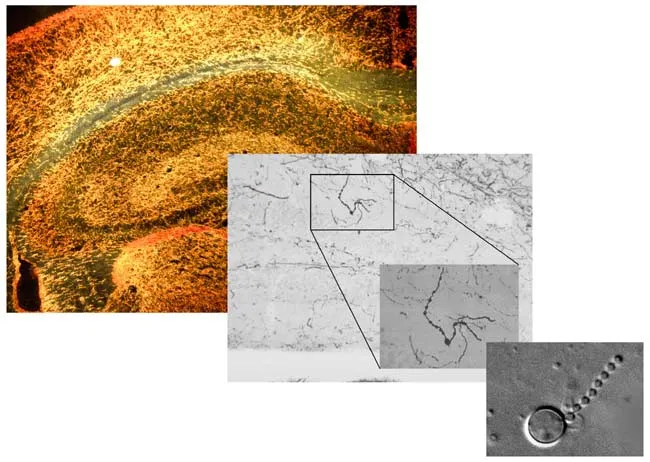
A new simple model of a portion of a brain cell will provide researchers with fresh insight to the destructive processes behind neurodegenerative diseases such as Alzheimer's and Parkinson's, scientists announced today.
"One of the beauties of a simplified model is that it allows you to ask very simple questions, which sometimes are difficult to answer in a complex living system, and sometimes to get surprising answers," said model designer Paul Weiss of Pennsylvania State University.
"It will allow us to test hypotheses of how damage occurs, and importantly, how we might prevent it," Weiss said.
Inside a nerve
The new model is a simplified axon, a branch-like projection that links neurons to one another, allowing them to communicate by releasing and receiving chemical signals called neurotransmitters.
When many axons are bundled together, they form a nerve.
The model replicates the essential features of an axon's shape, including a membrane and interior cytoskeleton scaffolding. The outer membrane contains molecules that react to ultraviolet light, initiating a reaction that produces highly reactive, cell-damaging molecules called free radicals.
Get the world’s most fascinating discoveries delivered straight to your inbox.
Free radicals caused the model axon to collapse into a deformed structure resembling a string of beads—the same shape observed during the degeneration of actual neurons, even though those contain proteins previously thought to be essential for this type of destruction.
The framework for the model is simple, and scientists can swap molecules and structures in and out to study specific disease conditions or a new therapeutic approach.
"We say, 'Okay, of the molecules that make up membrane, which of those accelerate the degeneration that we induce, which ones could decelerate or stop it, what other compounds could we include to prevent that degradation?'" Weiss told LiveScience.
Near death
An axon's shape change is a good indicator that something bad has happened to an axon, and that the cell is near death. Old age and many neurodegenerative diseases, such as Alzheimer's and Parkinson's, have been associated with neuron death, but there is a big debate over whether this symptom is a cause or effect of the diseases. Weiss believes experiments with the new model will help answer this question.
"We can reproduce the shape change without some of the key components that were thought required to do so," Weiss said. "This model allows us to look at good and bad actors for neurodegeneration in the brain and we can include molecules that could be used as therapeutics."
Previous studies have already identified a few molecules that you may have in your medicine cabinet that may slow down the axon degradation process. Vitamins C, E, and K are all antioxidants, molecules that gobble up free radicals.
"These antioxidant vitamins neutralized the free radicals before they had a chance to degrade the model axon," Weiss said.
This research will be detailed in the Apr. 4 issue of the journal Proceedings of the National Academy of Sciences.