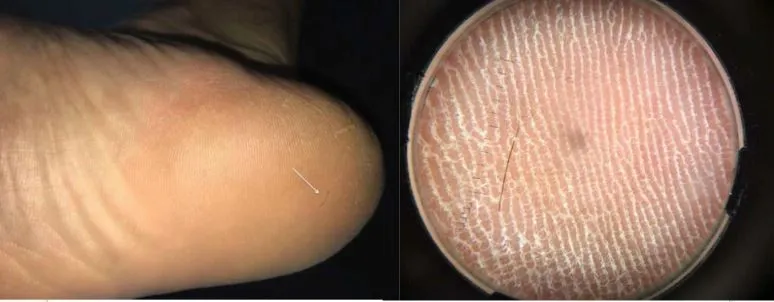
A man's foot pain turned out to be due to a rare condition in which a hair strand becomes embedded in the skin. Above, an image of the hair strand in the man's foot (right, arrow), and a magnified view of the hair (left).
(Image credit: Reprinted with permission of Elsevier (2019).)
Hair — it gets everywhere. But for one man in Brazil, a fallen strand of hair became more than a nuisance when it got embedded in his foot, essentially causing a "hair splinter," according to a new report of the case.
The 35-year-old man went to the emergency room after he experienced a mysterious pain in his right heel that got worse when he walked, according to the report, published June 20 in The Journal of Emergency Medicine.
He hadn't experienced any recent foot or ankle injuries, and when doctors looked at his foot, they couldn't see anything wrong initially.
After doctors had the man walk on his tiptoes and then his heels, he again reported pain when walking on his right heel.
After it was removed, the hair measured 0.4 inches (10 millimeters) long.
(Image credit: Reprinted with permission of Elsevier (2019).)
A closer look at the heel revealed a single strand of hair seemingly attached to his foot, according to the authors, from the University of São Paulo. [27 Oddest Medical Case Reports]
Indeed, an examination with a magnifying lens showed a tiny hair penetrating the man's skin. Doctors removed the hair, measuring 0.4 inches (10 millimeters) long, using tweezers.
The man was diagnosed with cutaneous pili migrans, a rare condition in which a hair shaft or hair fragment becomes embedded in the skin's surface. Only about 26 cases of cutaneous pili migrans have been reported in the last 60 years, according to a 2016 report on the condition published in the Medical Journal Armed Forces India.
Sign up for the Live Science daily newsletter now
Get the world’s most fascinating discoveries delivered straight to your inbox.
Once it penetrates the skin, the hair can migrate in a "creeping pattern" due to movements of the patient's foot, the authors of the new report said. Interestingly, this creeping pattern can resemble the snake-like rash seen in people with so-called cutaneous larva migrans, a skin condition caused by hookworms. But unlike the hookworm rash, which appears red and raised, the hair in this condition typically appears as a black, thread-like line under the skin.
In the current case, the authors speculated that the patient trampled on the hair shaft with his bare feet, causing the hair to become embedded and stimulate nerve endings in the top layer of skin, resulting in pain.
After the hair was removed, the man immediately felt relief from the pain, the report said.
"Physicians should be aware of this unusual foreign-body reaction in patients with discomfort on the soles of the feet," the authors concluded.
Rachael is a Live Science contributor, and was a former channel editor and senior writer for Live Science between 2010 and 2022. She has a master's degree in journalism from New York University's Science, Health and Environmental Reporting Program. She also holds a B.S. in molecular biology and an M.S. in biology from the University of California, San Diego. Her work has appeared in Scienceline, The Washington Post and Scientific American.