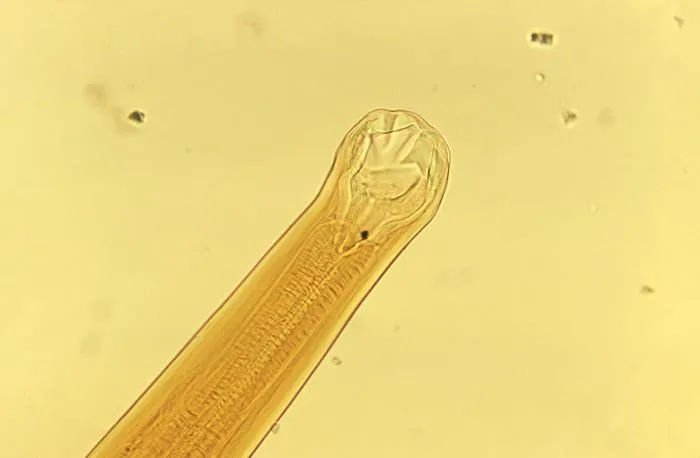
Walking barefoot on a tropical beach may sound idyllic, but a Canadian couple is warning travelers about the risks of going shoeless after the pair returned from a Caribbean trip with hookworms in their feet.
The couple — Katie Stephens, 22, and Eddie Zytner, 25 — recently returned from a weeklong trip to Punta Cana in the Dominican Republic, according to CTV News. Both Stephens and Zytner noticed that their feet were itching during the trip, but the couple assumed the symptoms were due to bug bites.
However, on Jan. 19, Zytner noticed that his feet were swelling, and over the following days, his condition worsened. His feet developed blisters and small bumps; and eventually — as shown in one photo — a raised, red rash formed squiggly, vein-like lines down his foot. Soon, Stephens developed similar symptoms.
The couple saw several doctors who couldn't figure out what was causing the symptoms. But, eventually, the pair was diagnosed with cutaneous larva migrans, a skin condition caused by hookworms.
A photo of Eddie Zytner's foot after he became infected with hookworms.
(Image credit: Eddie Zytner/FaceBook)
Hookworms are parasites that can infect humans as well as other animals. Cutaneous larva migrans is caused by species of hookworms that normally infect cats or dogs. Those hookworm species include Ancylostoma braziliense, A. caninum and A. ceylanicum, according to the Centers for Disease Control and Prevention (CDC). [10 Bizarre Diseases You Can Get Outdoors]
People can become infected with these hookworms when walking or sitting on beach sand or soil in areas where infected dogs or cats have defecated, the CDC said. The hookworm larvae can burrow into unprotected skin, and then crawl around in the top layers of skin. These movements cause red tracks to appear where the parasite has been — a symptom called ""creeping eruption" — and the lines may move from day to day as the hookworm migrates, the CDC said.
However, because humans aren't the normal hosts for these hookworms, the parasites usually don't live more than six weeks in people, the CDC said. The disease can be treated with antiparasitic medicine.
Sign up for the Live Science daily newsletter now
Get the world’s most fascinating discoveries delivered straight to your inbox.
"All this just from walking barefoot on the beach," Zytner wrote in a Facebook post. "Anyone travelling … check with your resort and see if the beaches around you are cleaned regularly. And it's best to wear shoes on the beach as much as possible," Zytner advised.
Rachael is a Live Science contributor, and was a former channel editor and senior writer for Live Science between 2010 and 2022. She has a master's degree in journalism from New York University's Science, Health and Environmental Reporting Program. She also holds a B.S. in molecular biology and an M.S. in biology from the University of California, San Diego. Her work has appeared in Scienceline, The Washington Post and Scientific American.