













Why the Area Around Notre Dame Is Now Coated with Toxic Levels of Lead

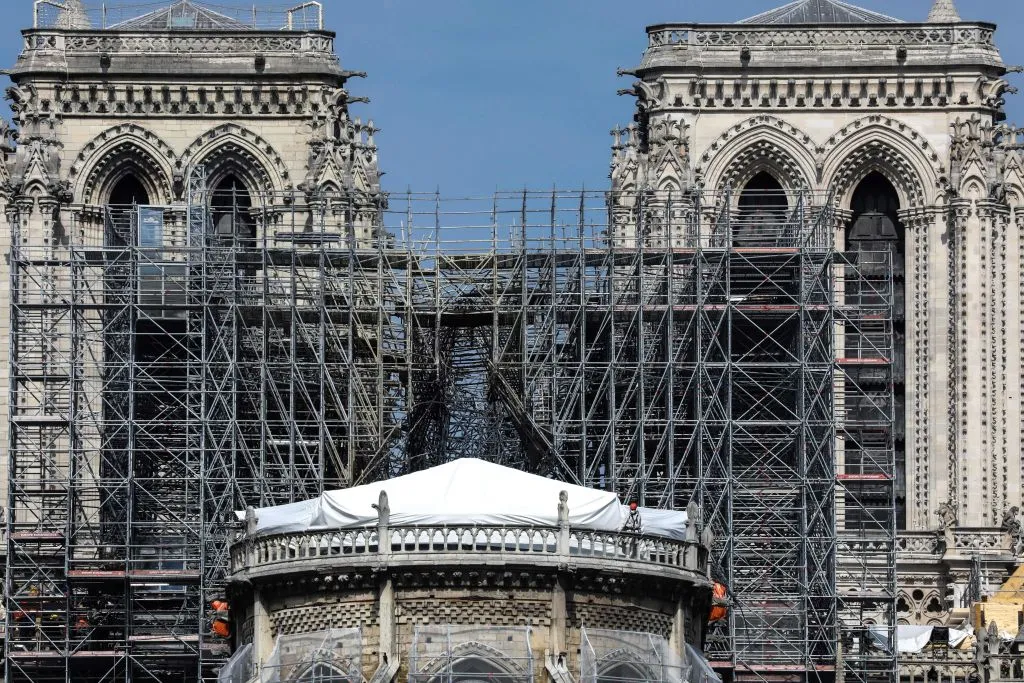
French officials are warning people near Notre Dame Cathedral that lead contamination is high in the closed-off plazas and streets surrounding it.
The reason? Building practices reaching back thousands of years. The medieval structure and its later additions — including the famous spire — contained lead, which fell to the ground during the fire that broke out on April 15.
"Lead was used in roofing since antiquity," said Richard Wittman, a historian of architecture at the University of California, Santa Barbara. "It was really common in medieval buildings." [In Photos: Gazing into a Medieval Church]
Lead and Notre Dame
Lead made for an appealing building material for a few reasons, Wittman told Live Science. First, it is malleable. That made it useful for domes or spires, which have complex shapes, Wittman said. Second, lead is durable. It doesn't rust in the elements, making it a popular roofing material.
"If a lead roof is built correctly, which requires a lot of know-how, it lasts basically forever," Wittman said.
Notre Dame's now-destroyed roof was made of virgin oak cut into timbers in 1160, overlaid with large, thin panels of lead. Media reports on the fire estimate the weight of that lead at 210 tons (182 metric tons). The spire, also made of wood and lead, dated back to a 20-year restoration project started in 1844 and led by architects Eugène Emmanuel Viollet-le-Duc and Jean-Baptiste Lassus. Media reports put the weight of the 300-foot (91.4 meter) spire they designed at 750 tons (680 metric tons).
According to the Associated Press, much of that lead is now contaminating the Notre Dame site. Lead levels in the plaza and in areas closest to the cathedral were between 10 and 20 grams per kilogram, according to the AP — up to 65 times the recommended limit of 0.3 g per kg. Lead can accumulate in body tissues and cause damage to the nervous system.
Get the world’s most fascinating discoveries delivered straight to your inbox.
Hardy material
Cleanup may not be as difficult as those numbers make it sound, because of lead's nearly infinite malleability. If the lead isn't too corrupted, it might even be possible to scrape up the remnants of the panels, melt them down again and recast them into new plates, Wittman said.
Rebuilding Notre Dame's roof out of lead would also be possible, Wittman said, though there are certain things builders have to know. For example, lead contracts and expands with temperature changes, Wittman said, so it can gradually start to shred over time. Even ancient architects learned to install lead roofs with a little extra space for this contraction and expansion, similar to the way that sidewalk panels have gaps between them, he said.
Restoration projects have also been tripped up in the past by lead's quirks. In the 1800s, architects rebuilding Gothic cathedrals often didn't realize that wood sap and lead together can create corrosive chemical reactions. They had to learn to start soaking their timbers to draw out the sap before construction, Wittman said. Medieval builders did this naturally, because they shipped most of their timbers by floating logs downriver, he said, but in the 1800s, most lumber moved by rail.
French authorities are recommending that homes and businesses near Notre Dame Cathedral use damp cloths to clean any possible lead dust from the fire from surfaces and floors. Children and pregnant women in the area should also wash their hands frequently, as children and fetuses are the most sensitive to lead's neurological damage. Construction workers are also at risk of lead exposure, according to the U.S. Occupational Safety and Health Administration (OSHA), which sets safety standards such as exposure time and protective (often disposable) clothing to limit the danger. France also sets limits for occupational lead exposure.
It's unclear whether Notre Dame's roof will be rebuilt with lead panels. Modern buildings typically use lighter, cheaper materials, Wittman said, but lead roofing is still used in historical restorations.
- In Photos: Archaeological Discoveries at Hagia Sophia
- Album: The Seven Ancient Wonders of the World
- Images: The Church of the Holy Sepulchre
Originally published on Live Science.

Stephanie Pappas is a contributing writer for Live Science, covering topics ranging from geoscience to archaeology to the human brain and behavior. She was previously a senior writer for Live Science but is now a freelancer based in Denver, Colorado, and regularly contributes to Scientific American and The Monitor, the monthly magazine of the American Psychological Association. Stephanie received a bachelor's degree in psychology from the University of South Carolina and a graduate certificate in science communication from the University of California, Santa Cruz.