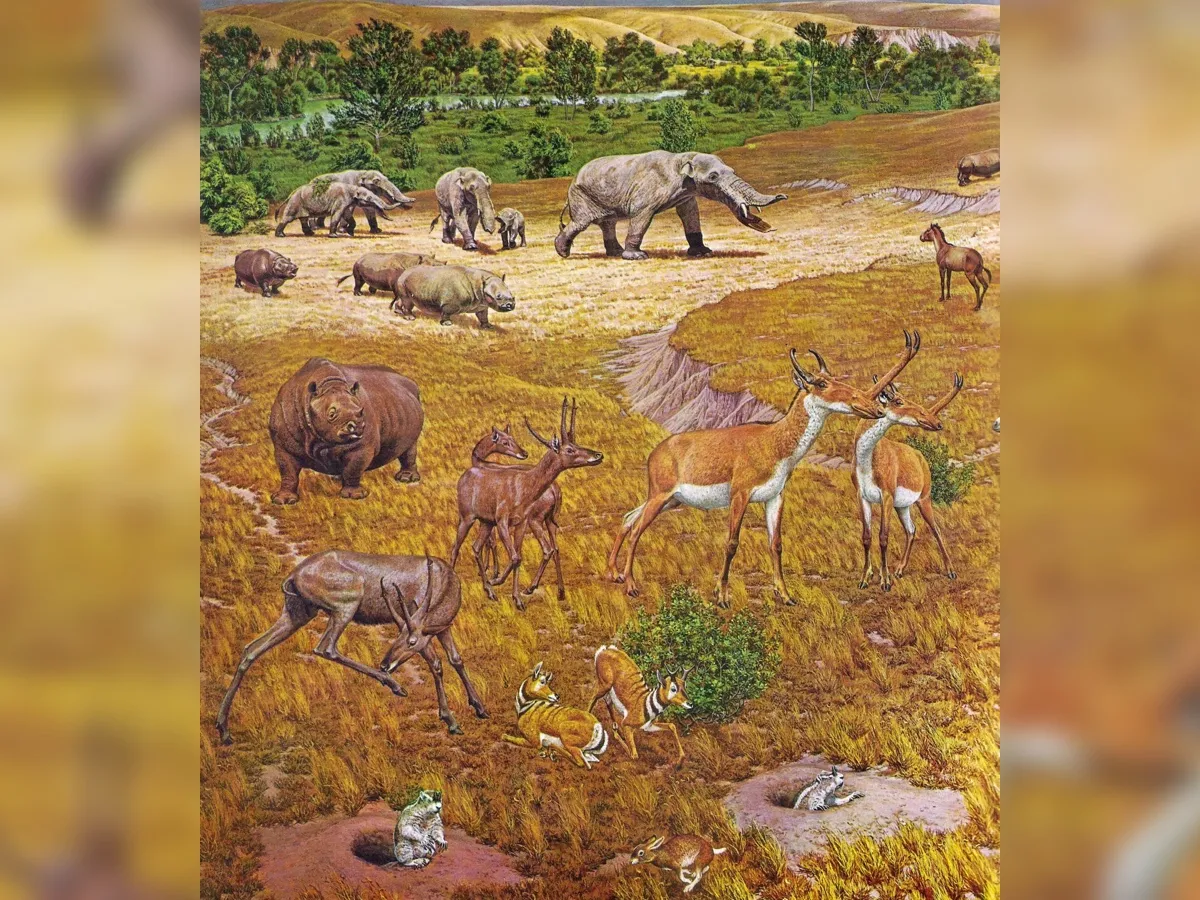
An illustration showing the ancient animals — such as elephant-like gomphotheres, rhinos, horses and antelopes with slingshot-shaped horns — that lived near what is now Beeville, Texas, about 12 million years ago.
(Image credit: Jay Matternes/The Smithsonian Institution)
About 12 million years ago, antelopes with slingshot-like horns and beasts that weren't quite elephants but that had long trunks and tusks tramped across the "Texas Serengeti" searching for food and caring for their babies.
Little was known about this ancient menagerie until, during the Great Depression, the government created the Works Progress Administration (WPA) and tasked some of the organization's employees with finding and preserving thousands of fossils from the Miocene, an epoch that lasted from about 23 million to 5 million years ago.
Now, after more than 80 years in storage at The University of Texas at Austin, these fossils are finally being studied. The fossils have even revealed a previously unknown genus of gomphothere, an extinct elephant relative with a shovel-like lower jaw, and the oldest fossils on record of both the American alligator and an extinct dog relative. [Photos: These Animals Used to Be Giant]
These fossils, collected from 1939 to 1941, are an absolute treasure trove, scientists said. In the nearly 4,000 specimens, found at dig sites near Beeville, a city about 90 miles (145 kilometers) southeast of San Antonio, there are 50 species of fossil vertebrates (animals with backbones), including five species of fish, seven reptiles, two birds and 36 mammals.
During the Great Depression, the Works Progress Administration paid folks to collect and preserve fossils in Texas. Here, Glen Evans (left), who managed much of this WPA project, is shown carrying a fossil in a field jacket with a worker.
(Image credit: The University of Texas at Austin Jackson School of Geosciences)
The selection of animals is mind-boggling, revealing that rhinos, camels, rodents, 12 types of horses and five species of carnivores trekked across what is now the Texas Gulf Coast some 11 million to 12 million years ago.
"It's the most representative collection of life from this time period of Earth history along the Texas coastal plain," study researcher Steven May, a research associate at The University of Texas at Austin's Jackson School of Geosciences, said in a statement.
The skull of a shovel-jawed gomphothere (bottom), collected by Great Depression-era fossil hunters, is still wrapped in its field jacket, along with other skulls from ancient elephant relatives.
(Image credit: The University of Texas at Austin Jackson School of Geosciences)
Though others have examined specific fossils in this collection, May's deep dive into the entire assortment is helping to fill gaps in the state's record of ancient wildlife, Matthew Brown, the director of the museum's vertebrate paleontology collections, said in the statement.
Sign up for the Live Science daily newsletter now
Get the world’s most fascinating discoveries delivered straight to your inbox.
May also returned to the original dig sites to see what smaller fossils, such as rodent teeth, he could excavate, since the collected finds consisted mostly of big, "obvious" fossils, he said. There are so many fossils from the WPA era that the project will likely continue for years. In addition, researchers plan to do isotope analyses of the fossils. (Isotopes are different versions of an element that have different numbers of neutrons in the nucleus.) This will help scientists evaluate the diets and paleoenvironments of some of the ancient animals, May wrote in the study, which was published online yesterday (April 11) in the journal Palaeontologia Electronica.
Laura is the managing editor at Live Science. She also runs the archaeology section and the Life's Little Mysteries series. Her work has appeared in The New York Times, Scholastic, Popular Science and Spectrum, a site on autism research. She has won multiple awards from the Society of Professional Journalists and the Washington Newspaper Publishers Association for her reporting at a weekly newspaper near Seattle. Laura holds a bachelor's degree in English literature and psychology from Washington University in St. Louis and a master's degree in science writing from NYU.