













Why Are These Massive, Baby Stars Orbiting So Close Together?

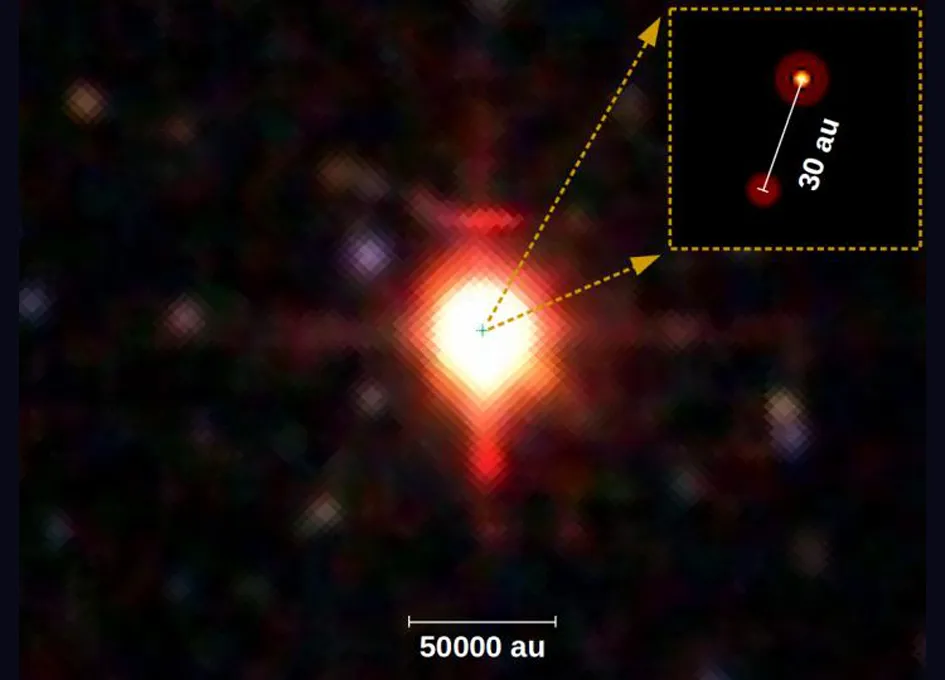
There's a point in space that's 50,000 times as bright as our sun — the signature of a massive star. Scientists already knew about it and named it PDS 27. But it turns out, the dot of light scientists were calling PDS 27 is actually two stars orbiting very close to one another.
The two giant stars are very young and very close together, separated by just 2.8 billion miles (4.5 billion kilometers), or 30 times the distance between Earth and the sun. That finding, published Monday (March 11) in the journal Astronomy & Astrophysics, offers clues about the way in which massive binaries like this form in the first place. [15 Amazing Images of Stars]
"We're not claiming that we found the closest-orbiting massive binary stars," said study lead author Evgenia Koumpia, an astronomer at the University of Leeds in England. But it is very exciting that the two stars were found close together relatively early in their stellar lives, she told Live Science.
Right now, scientists know that massive stars like this (stars at least eight times the size of Earth's sun, up to many thousands of stellar masses) often turn out to be binaries. But researchers don't know why that is, in large part because they don't know how or why massive binaries usually form, Koumpia said.
One hypothesis holds that the stars form separately and then get tugged together by their combined gravities. Another idea holds that the dual stars form after older, giant stars go supernova and the supernova remnants split into two clumps. But both of those explanations predict that the stars would orbit far away from each other this early in their short lives.
Another idea, though, says that both stars form out of the same cloud of swirling dust, after it "cracks" into two main clumps. That explanation predicts that young, massive binaries would remain close together. And these two stars are spaced at least as closely as the sun and Neptune, an orientation that seems to support that explanation.
However, this single finding doesn't confirm any one idea or conclusively disprove any others, Koumpia said. Instead, it should be considered a hint pointing gently in one direction, she said.
Get the world’s most fascinating discoveries delivered straight to your inbox.
There's still a lot scientists don't yet know about PDS 27 — like how much of the system's total mass is in one star versus the other. The stars are so close to each other, and so far away from Earth (about 8,000 light-years), that existing images barely reveal that they're distinct stars.
Editor's note: This story was updated to correct an error. The two stars in question are not named PDS 27 and PDS 37. PDS 37 is a distinct binary system also covered in the paper.
- 11 Fascinating Facts About Our Milky Way Galaxy
- Big Bang to Civilization: 10 Amazing Origin Events
- Spaced Out! 101 Astronomy Photos That Will Blow Your Mind
Originally published on Live Science.
