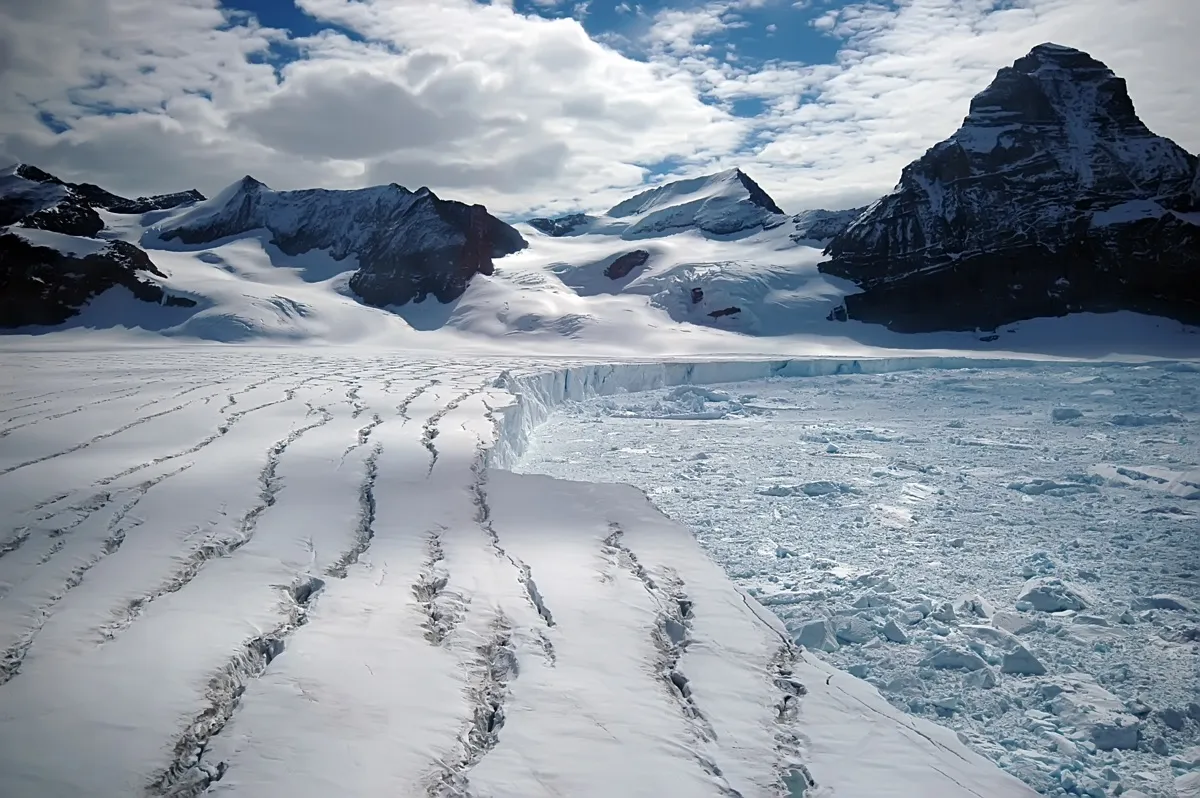
On Jan. 31, 2002, a vast crescent of ice about the size of Rhode Island splintered off of the coast of Antarctica and spilled a flotilla of massive, melting icebergs into the sea. By March, some 1,250 square miles (3,250 square kilometers) of ice had melted away from the continent's edge, undoing more than 10,000 years of growth and stability in a little more than a month.
NASA scientists monitoring the ancient ice sheet — formerly known as the Larsen B Ice Shelf — were startled by the sudden collapse; never had the researchers witnessed so much ice disappear so quickly.
They did have some warning, though. In the months preceding the collapse, the shelf's surface had become riddled with more than 2,000 meltwater lakes — large pools of melted ice and snow that form on the surfaces of ice shelves during the summer melting season. These seasonal reservoirs can contain more than a million tons of water apiece and, according to a new study published today (Feb. 13) in the journal Nature Communications, may actually be able to bend portions of huge ice shelves so much that they break in half, ushering in their spectacular demise. [Photos: Diving Beneath Antarctica's Ross Ice Shelf]
"That's most likely what happened to Larsen B in 2002," lead study author Alison Banwell, a visiting researcher at the Cooperative Institute for Research In Environmental Sciences (CIRES), said in a statement.
To bend a glacier
After the 2002 collapse, researchers suspected meltwater pools had something to do with Larsen B's sudden demise (on top of myriad other factors, including drastically warming Antarctic waters). However, direct evidence of this hypothetical lake strain was lacking.
In November 2016, Banwell and her colleagues sought some cold, hard proof. Through a combination of legwork and satellite imagery, the researchers scouted out four large lake basins on Antarctica's McMurdo Ice Shelf (one piece of the massive Ross Ice Shelf, the continent's largest) that would soon fill with summer meltwater.
Alison Banwell wades through a meltwater lake in Antarctica to retrieve a pressure sensor.
(Image credit: Grant Macdonald)
At each lake site, the team hammered down a metal pole containing GPS and pressure-sensing equipment to measure changes in ice elevation and water depth over the coming melt season. Three months later, the team retrieved the equipment via helicopter (the ice had since become too thin for overland travel).
Sign up for the Live Science daily newsletter now
Get the world’s most fascinating discoveries delivered straight to your inbox.
Each lake left a clear imprint on the ice sheet. According to the team's sensors, the center of each lake had sunk between 3 and 4 feet (about a meter) as water filled each basin, then bounced back up again after the water had drained. Ice just 1,500 feet (half a kilometer) away showed hardly any vertical movement at all.
While the bending caused by the meltwater lakes filling and draining did not fracture the McMurdo Ice Shelf, the team used some mathematical models to estimate that a group of slightly larger lakes clustered more closely together could indeed cause the whole shelf to break apart.
These findings make it clear that the added weight of thousands of seasonal meltwater lakes played a role in the precipitous collapse of Larsen B. The precise extent of that meltwater damage is impossible to know — however, the CIRES researchers are confident that their models could help scientists predict the breakup of large ice shelves more accurately in the future. With seemingly every new year setting heat records, and the Arctic (the other home to the world's massive ice sheets) warming two to three times as quickly as the rest of the planet, there's no question those models will be needed.
Brandon is the space / physics editor at Live Science. With more than 20 years of editorial experience, his writing has appeared in The Washington Post, Reader's Digest, CBS.com, the Richard Dawkins Foundation website and other outlets. He holds a bachelor's degree in creative writing from the University of Arizona, with minors in journalism and media arts. His interests include black holes, asteroids and comets, and the search for extraterrestrial life.