















There Be Dragons: 6-Foot-Long Lizard Terrifies Florida Family

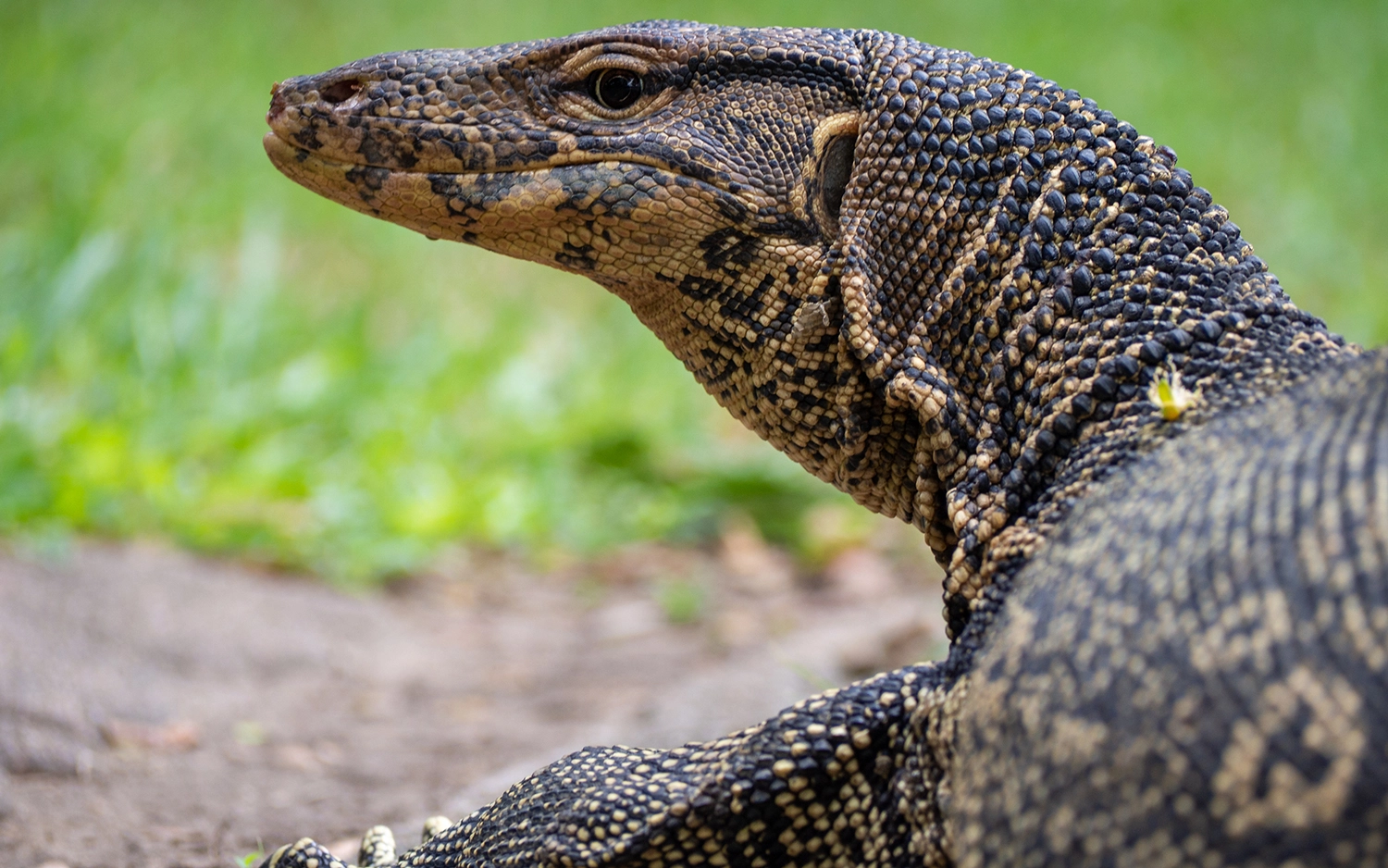
A Florida family is afraid to use their swimming pool — and with good reason. Earlier this week, the family spotted a giant monitor lizard the size of an adult human lurking on their property.
The Lieberman family in Davie, Florida, discovered the uninvited visitor roaming around their backyard, Miami-Dade's Local 10 News ABC reported on Aug. 29. Parents Zack and Maria Lieberman told reporters that the lizard was so big, they feared for the safety of their two young children. [See The World's Most Bizarre Lizards]
The enormous reptile — which was identified as an Asian water monitor (Varanus salvator) — measures approximately 6 feet (2 meters) long, according to Local 10 News. Over several days, the scaly invader made repeated appearances near the Lieberman home, but has thus far managed to evade capture by local trappers and wildlife authorities, the Miami Herald reported.
On Aug. 29, a neighbor visited the Liebermans, claiming that the lizard was an escaped pet, the family told Local 10 News. But because the lizard had not been reported as missing, anyone with a permit could trap it, the Florida Fish and Wildlife Conservation Commission (FWC) told 7 News Miami.
A dog working with the trappers briefly detected a scent that led searchers to a promising-looking burrow, but the hole turned out to be empty, according to the Miami Herald.
Massive invaders
Monitor lizards in the genus Varanus are a group of predatory reptiles with long necks, forked tongues, and muscular tails and bodies. They are native to Asia, Africa and Oceania, though some have become established in the Americas as an invasive species. The genus includes the Komodo dragon (Varanus komodoensis), which is the world's biggest lizard, capable of growing up to 10 feet (3 m) in length.
Fortunately for Floridians, Komodo dragons are found only in the island habitats of Indonesia, but a number of its monitor cousins have made Florida their home, after they were brought to the U.S. as exotic pets and escaped or were released into the wild. Monitor species found in Florida include crocodile monitors, water monitors, savannah monitors, peach-throated monitors and two species of black-throated monitors, according to the Department of Wildlife Ecology and Conservation at the University of Florida.
Get the world’s most fascinating discoveries delivered straight to your inbox.
Another monitor species, the semiaquatic Nile monitor (Varanus niloticus), is the most persistent and problematic of these reptilian invaders, the Florida Fish and Wildlife Conservation Commission (FWC) reported.
Meanwhile, the hunt for the wayward Asian water monitor continues. Alongside the FWC, Mike "Trapper Mike" Kimmel, a wildlife trapper with Martin County Wildlife Trappers and Removals, is on the lookout for the elusive lizard, trying to lure it with chicken thighs, 7 News Miami reported.
Original article on Live Science.

Mindy Weisberger is a science journalist and author of "Rise of the Zombie Bugs: The Surprising Science of Parasitic Mind-Control" (Hopkins Press). She formerly edited for Scholastic and was a channel editor and senior writer for Live Science. She has reported on general science, covering climate change, paleontology, biology and space. Mindy studied film at Columbia University; prior to LS, she produced, wrote and directed media for the American Museum of Natural History in NYC. Her videos about dinosaurs, astrophysics, biodiversity and evolution appear in museums and science centers worldwide, earning awards such as the CINE Golden Eagle and the Communicator Award of Excellence. Her writing has also appeared in Scientific American, The Washington Post, How It Works Magazine and CNN.