















Swiss Scientists Perform Massive Test of 80-Year-Old, 'Spooky' Quantum Paradox

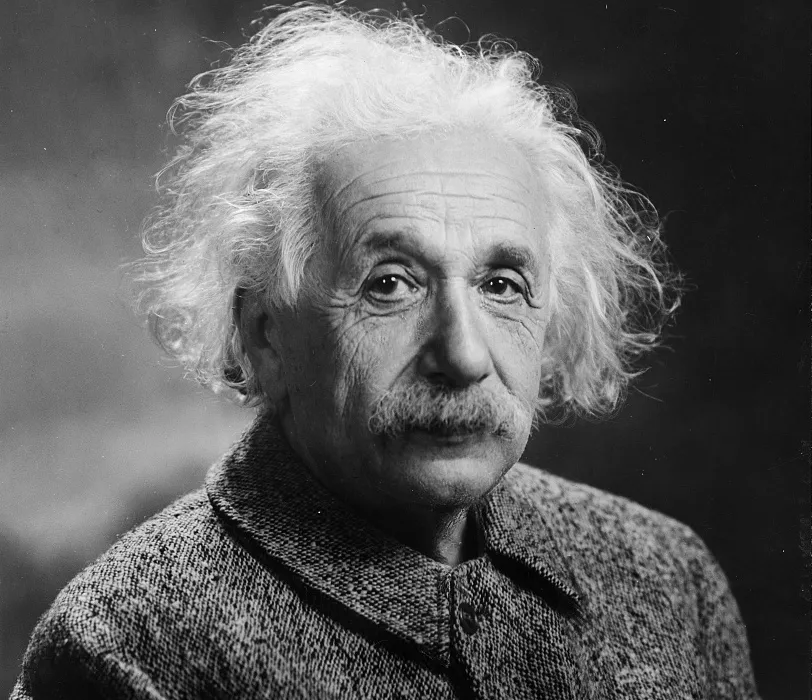
A team of Swiss scientists has performed a massive test of one of the strangest paradoxes in quantum mechanics, a huge example of the sort of behavior Albert Einstein skeptically called "spooky action at a distance."
The story begins more than 80 years ago. Way back in 1935, Einstein and physicists Boris Podolsky and Nathan Rosen found something strange. They entangled two particles — let's call them Alice and Bob — so that their physical properties were linked even across wide distances, and anything you did to one particle would impact the other. Intuitively, you'd think that if you had access to Alice, you'd know way more about her than you would about Bob, who's a distance away. This is also what you'd expect given Einstein's relativistic laws of physics at large scales. But the physicist trio discovered something odd, now called the Einstein-Podolsky-Rosen (EPR) paradox: By studying Alice, you actually learn much more about Bob than you do about Alice.
Later experiments using individual particles proved the physicists correct on this point. But this new experiment, published today (April 26) in the journal Science, shows that the effect still occurs using even a clump of nearly 600 supercooled particles.
It's not surprising, exactly, that a paradox originally framed in terms of two particles also occurs for clumps of hundreds of particles. The same physics at work in a very small system should also work in much larger systems. But scientists perform these ever-more-complex tests because they help confirm old theories and narrow down the ways in which those theories might be wrong. And they also demonstrate the capability of modern technology to put into action ideas that Einstein and his colleagues could think about only in abstract terms. [The Five States of Matter]
To pull off this experiment, the researchers cooled about 590 rubidium atoms (give or take 30 atoms) to the bleeding edge of absolute zero.
At that temperature, the atoms formed a state of matter called a Bose-Einstein condensate, which, as Live Science has previously reported, is a state of matter in which a large group of atoms become so entangled that they start to blur and overlap with one another; they begin to behave more like one large particle than lots of separate ones. Quantum physicists love to experiment with Bose-Einstein condensates because this kind of matter tends to demonstrate the weird physics of the quantum world at a large enough scale for the scientists to observe it directly.
In this experiment, they used high-resolution imaging to measure the spins of different chunks within the soup of rubidium atoms. The atoms in the condensate were so entangled that the physicists were able to predict the behavior of the second chunk by studying only the first. Both chunks of atoms, they showed, were so entangled that the behavior of the second chunk was in fact more knowable when only the first was observed, and vice versa.
Get the world’s most fascinating discoveries delivered straight to your inbox.
The EPR paradox had come to life, on a relatively massive scale for the quantum world.
Originally published on Live Science.
