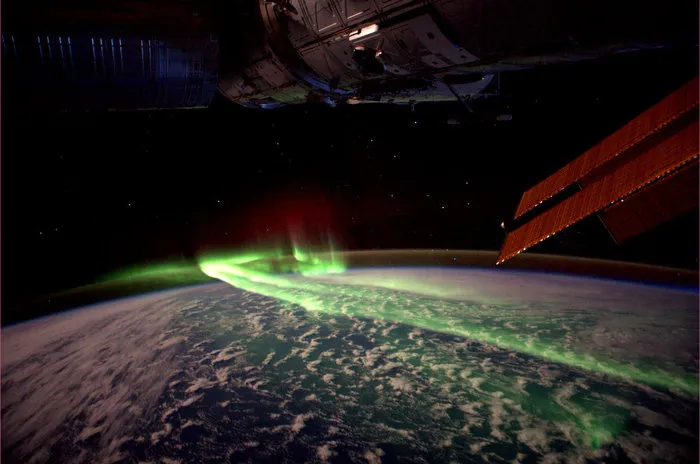
A powerful gust of solar wind is crackling its way through Earth's upper atmosphere yesterday (April 11), after it escaped through a large gap in the sun's atmosphere.
The first signs of the stream of energized particles turned up Tuesday night (April 10), in the form of dramatic auroras appearing at latitudes as low as Williston, North Dakota, as seen on spaceweathergalley.com.
They followed a geomagnetic storm warning from the U.S. Space Weather Prediction Center, which indicated that auroras might be visible in Alaska, much of central Canada, Montana, North Dakota, Minnesota, and northern fractions of Wisconsin, Michigan and Maine. Much of Scandinavia, the Shetland Islands and northern Russia could also plausibly witness geomagnetic lights in the sky. [8 Dazzling Facts About Auroras]
This storm is the result of what's called a coronal hole, which, as Live Science sister site Space.com has reported before, is a patch where the sun's atmosphere — its corona and outermost layer — has thinned substantially. Coronal holes are actually pretty common. NASA's Solar Dynamics Observatory reported that three coronal holes covered wide swaths of our local star from April 3 to April 6. Such holes make it easier for solar wind to escape earthward.
A map released by the National Weather Services's Space Weather Prediction Center reveals the expected visible extent of aurora activity.
(Image credit: Space Weather Prediction Center)
No one needs to worry too much about a G1-class storm like this one — the lowest severity of geomagnetic storm, where G5 is the most severe — even though there is some possibility it will disrupt satellite communications. But, it is yet another reminder of the sun's awesome power. Sooner or later, it's likely that a massive solar storm will strike Earth with only minimal notice, on a scale similar to a storm that struck in 1859. Only next time, in our electronics-dependent age, the consequences will almost certainly be more serious than telegraph operators' burnt fingers or auroras over Cuba.
Rafi joined Live Science in 2017. He has a bachelor's degree in journalism from Northwestern University’s Medill School of journalism. You can find his past science reporting at Inverse, Business Insider and Popular Science, and his past photojournalism on the Flash90 wire service and in the pages of The Courier Post of southern New Jersey.