















What Is Ramadan?

Ramadan is the most sacred month of the year in Islamic culture. Muslims observe the month of Ramadan, to mark that Allah, or God, gave the first chapters of the Quran to the Prophet Muhammad in 610, according to the Times of India. During Ramadan, Muslims fast, abstain from pleasures and pray to become closer to God. It is also a time for families to gather and celebrate.
Ramadan is the ninth month in the Islamic calendar, which is a lunar calendar based on the cycles of the moon. Observances begin the morning after the crescent moon is visibly sighted, marking the beginning of the new month. Traditionally, people searched for the slight crescent using the naked eye, which has led to the declaration of different starting times for Ramadan, due to weather or geography. In order to have a more consistent start time for Muslims around the world, however, astronomical calculations are now sometimes used. Using science to mark the beginning of the month is controversial, however, and in many parts of the world, Ramadan still does not begin until religious leaders announce that they have personally seen the crescent moon, according to Holidays.net.
In 2018, Ramadan will begin at sunset on May 15 as Muslims search for the crescent moon, according to the Islamic Networks Group. Fasting begins the next day. In upcoming years, it will begin on May 5, 2019; April 23, 2020; and April 12, 2021.
Powerful symbol of unity
The observance of Ramadan is very personal and individual and is a time for "sacrifice and renunciation as well as a period of reflection and spiritual growth," Florian Pohl, associate professor of religion at Oxford College of Emory University, told Live Science. Pohl added that Ramadan is also a powerful symbol of unity, with Muslims around the world fasting simultaneously while bringing family and friends together.
Imam Ossama Bahloul, resident scholar of the Islamic Center of Nashville, said that when he hears about Ramadan, "joy comes to my mind with the memories of my mother and father and the impact it had on our home. ... It continues to be an absolute joy."
When Ramadan arrives, Yushau Sodiq, associate professor of religion and Islamic studies at Texas Christian University, feels "thrilled, because I am expecting it just like any other Muslim," and uses the celebration to further connect himself to God and to services within his community.
Ramadan is a time when Muslims from all over the world come together. Sodiq said that in the United States, for example, some community mosques host Muslims from as many as 30 or 40 countries. Pohl said that it is also growing more common for people from various religions to come together during Ramadan to learn more about each other's cultures.
Get the world’s most fascinating discoveries delivered straight to your inbox.
Fasting: the fourth pillar of Islam
Fasting during Ramadan is the fourth of the Five Pillars of Islam. These pillars, or duties, form the basis of how Muslims practice their religion. According to Islam Guide, the Pillars of Islam are:
- Shahada: faith in the Islam religion,
- Salat: pray five times per day facing the direction of Mecca,
- Zakat: give support to the needy,
- Sawm: fast during Ramadan, and
- Hajj: make the pilgrimage to Mecca at least once during one's lifetime.
During Ramadan, observant Muslims fast from sunrise to sunset. Fasting is not only about abstaining from food and drink: Muslims must also refrain from smoking, taking oral medications and engaging in sexual activities, as well as gossip, fighting and lying. Bahloul said that while it sounds difficult to abstain from eating for up to 17 or 18 hours (depending on where in the world Ramadan is celebrated), after a couple of days it becomes the norm, and it is a reminder that a person is not just a physical body but a soul as well.
Muslims practice fasting upon reaching puberty. Some people are exempted, such as those who are ill or frail; women who are pregnant, lactating or menstruating; and travelers. Bahloul said that someone who cannot fast traditionally must feed one poor person for each day missed.
Fasting during Ramadan is a time for Muslims to commit themselves more to God and render "great services to the community in terms of helping the poor, assisting the needy and sharing whatever one has with others," according to Sodiq. He added that Muslims are generally more kind, tolerant and active during Ramadan, because they tend to celebrate each Ramadan as if it were their last in order to ensure that God will pardon them for any sins they have committed.
For the fasting to be valid, a serious intention, or niyyah, must be made to fast and adhere to the laws surrounding the fast. The commitment must be made each day before dawn. The fast will be considered to be nullified if one eats or drinks, intentionally vomits, has sexual intercourse or has menstrual or childbirth bleeding, according to Mohamed Baianonie, former imam of the Islamic Center of Raleigh, North Carolina. If the fast is broken, the fast must be made up for at a later date. According to Sodiq, as long as one's fast is not broken intentionally, God will forgive the individual.
In some Muslim communities, there is a growing stigma associated with eating in public, according to Pohl, due an increase in public awareness and piety. In addition to fasting, piety is also measured by participation in other practices, including the five daily prayers; and engaging in zakat, or acts of kindness and charity.
Breaking the fast
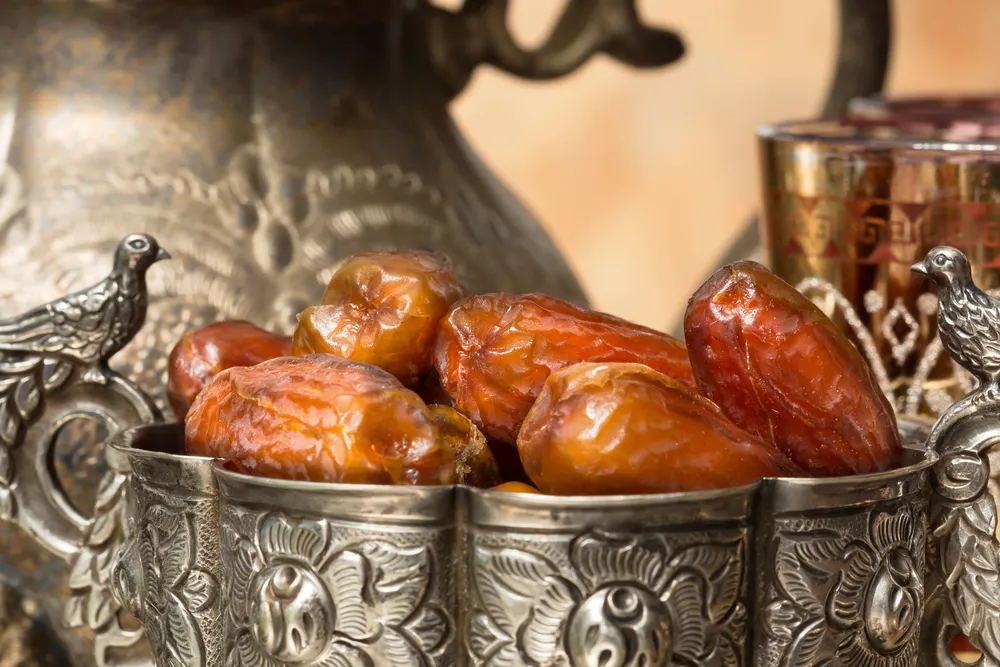
Muslims intending to fast wake up early and eat a light meal, known as suhoor, before dawn. Suhoor is typically consumed about half an hour before dawn, in time for the fajr, or morning, prayer, according to the IslamiCity news website. After the sun fully sets at the end of each day, the person typically breaks his or her fast with water and dates, followed by prayers and then a meal called iftar.
Many mosques around the world host interfaith celebrations to break the fast, according to Pohl. This allows everyone to reflect on shared experiences within their own traditions involving fasting, including spiritual growth and social responsibility. "On several occasions," Pohl said, "I have had Christian participants in these events tell me that they have regained an appreciation and deeper understanding of similar practices in their own faith traditions, such as during the Advent season or Lent."
At the end of Ramadan, a three-day spiritual celebration known as Eid al-Fitr occurs. During this time, Muslims rejoice in the completion of the fast. Family members and friends gather to share in feasts and prayers. During Eid al-Fitr, it is customary to donate to the poor and disadvantaged. During the three days, Muslims attend prayers in the morning, and then visit family, friends, neighbors, the sick and the elderly. Feasts are shared with family and friends and small gifts are given; it's socially similar to Christmas in the United States, according to Pohl.
Additional resources

Rachel Ross is a science writer and editor focusing on astronomy, Earth science, physical science and math. She holds a Bachelor of Arts in Philosophy from the University of California Davis and a Master's degree in astronomy from James Cook University. She also has a certificate in science writing from Stanford University. Prior to becoming a science writer, Rachel worked at the Las Cumbres Observatory in California, where she specialized in education and outreach, supplemented with science research and telescope operations. While studying for her undergraduate degree, Rachel also taught an introduction to astronomy lab and worked with a research astronomer.