













Frog Survival 101: Fake a Mean Look
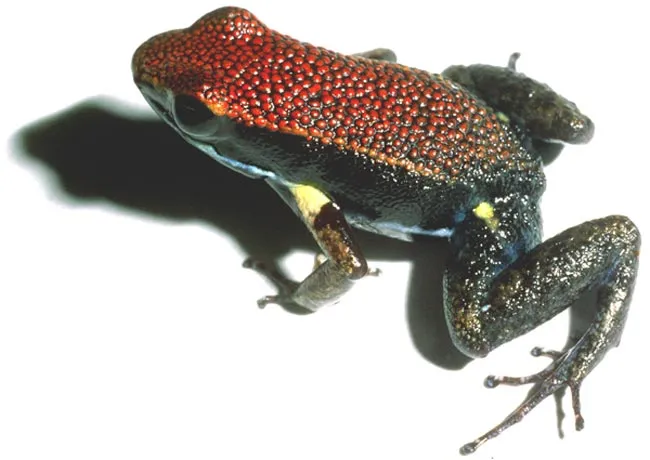
For nonpoisonous frogs, the trick to not becoming dinner is to look poisonous—but not too poisonous, new research reveals.
Scientists studied three species of poison dart frogs in the Amazon rainforest in Ecuador: the highly toxic Epipedobates parvulus; the less toxic E. bilinguis; and the non-toxic Allobates zaparo.
All three are blue with a speckling of red bumps on their backs. E. bilinguis also has yellow spots on its armpits.
These colorful patterns tell predators that the frogs are toxic and would not make a good meal. Although A. zaparo can't actually back up this threat, its coloration fools predators into looking elsewhere for food.
The rules of mimicry
In northern Ecuador, the benign A. zaparo coexist with E. parvulus, and over time have evolved to mimic their blue and red skin pattern.
In southern Ecuador, where there are no E. parvulus frogs to imitate, A. zaparo frogs mimic the yellow-spotted E. bilinguis.
Get the world’s most fascinating discoveries delivered straight to your inbox.
The three species overlap in central Ecuador, and based on the rules of mimicry, scientists expected to see A. zaparo mimicking the more poisonous species. Instead, they found the non-toxic frogs only mimic the less poisonous species, E. bilinguis.
"That is totally bizarre," said study co-author Catherine Darst, a graduate student at the University of Texas. "The whole point of mimicry is to gain protection from predation."
Covering all the bases
It turns out that mimicking the less poisonous species actually increases A. zaparo's chances of survival. Darst and her graduate professor Molly Cummings tested this strategy by offering all three species of frogs to hungry chickens.
While chickens happily downed A. zaparo frogs, they spat out both poisonous varieties. The chickens took cues from these frogs' color patterns and learned to avoid poisonous frogs.
The chickens that tasted E. parvulus frogs generalized the experience to both variations that A. zaparo mimics. The chickens that learned only with the yellow-spotted E. bilinguis frogs, however, only passed on the A. zaparo frogs with similar yellow spots—E. parvulus-like frogs were fair game.
"Therefore, predators who learned to associate either the bright colors of the less toxic or more toxic model frog species will avoid the mimic of the less toxic model frog," Darst told LiveScience. "So, the mimic of the less toxic frog receives double the protection from predation."
Population mismatch
The researchers were also surprised to find that mimics of E. bilinguis in the central region outnumbered the real thing. Scientists generally believe that if a mimic outnumbers its model, the system could break down once predators stop associating that color pattern with toxicity.
"Why A. zaparo mimics can outnumber the model they are mimicking appears to be 'allowed' due to the extra protection they are gaining from predator generalization on the very abundant E. parvulus," Cummings said.
Another explanation for this mismatch is that scientists may be looking only at a "snapshot" of the region—E. parvulus may have just recently moved into central Ecuador, or E. bilinguis populations may have recently moved further south.
The research is detailed in the March 9 issue of the journal Nature.