














Beyond Clickbait: Viral Skin-Cancer Selfie Boosted Online Searches
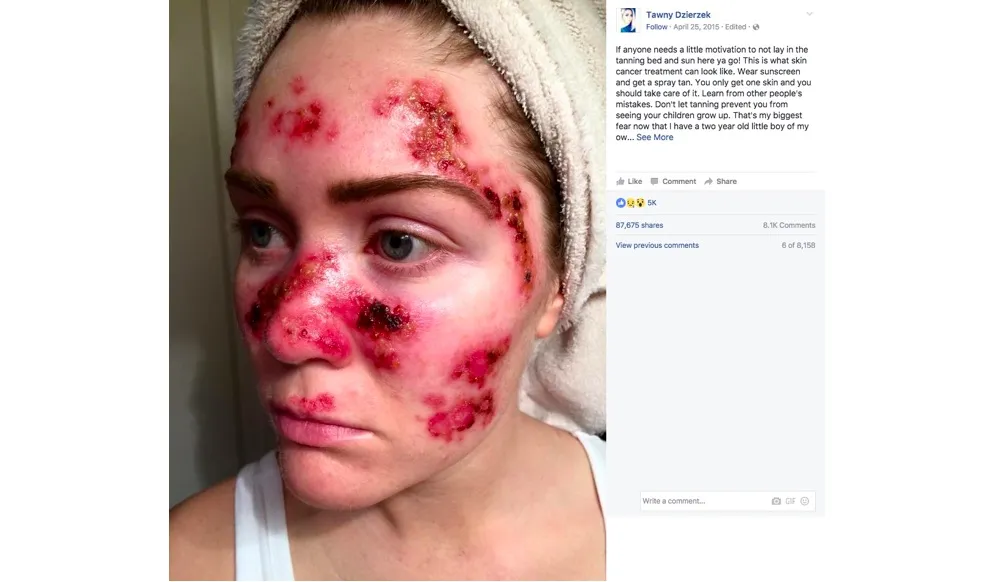
A Kentucky woman's brutally honest selfie and Facebook post while undergoing treatment for skin cancer drew the type of social media attention and news coverage usually reserved for celebrity health disclosures, a new study suggests.
The riveting photo — which showed then 27-year-old Tawny Willoughby's raw, scab-ridden face along with her message that "this is what skin-cancer treatment can look like" — not only drew eyeballs and ten of thousands of shares of her post, but also triggered near record-setting levels of online searches about skin cancer and its prevention, according to the study.
Willoughby, who works as a nurse, began the April 25, 2015, post by saying, "If anyone needs a little motivation to not lay in the tanning bed and sun here ya go!" [5 Things You Must Know About Skin Cancer]
By May 11, Willoughby's post had reached 50,000 shares, according to the findings. That same day, her selfie caught the eye of one news outlet that covered her story.
From there, the media attention started to snowball: Between May 12 and May 14, there were 161 news reports of the story, including TV, magazines and online media coverage, according to the study.
The findings were published today (Dec. 11) in the journal Preventive Medicine.
Tawny's message was likely impactful because it was authentic, said senior study author John Ayers, a public health researcher at San Diego State University.
Get the world’s most fascinating discoveries delivered straight to your inbox.
The public may get tired of hearing the same old health messages coming from experts, Ayers told Live Science. But in the age of social media, people don't have to guess what skin cancer can do to your face, they can see it in a selfie, he said.
Seeing the effects can also stimulate curiosity, the findings showed: In the study, the researchers evaluated various metrics, such as the number of comments and shares of Willoughby's original post, along with news coverage and Google searches related to skin cancer for one month after her selfie and story appeared on Facebook (the post initially received 50 comments).
Impacting public health
The news reports that stemmed from Willoughby's post provided more details about how the Kentucky nurse had regularly used tanning beds as a teenager, and was first diagnosed with skin cancer at 21, the study said. By age 27, Willoughby had been diagnosed with basal cell carcinoma five times and squamous cell carcinoma once, according to news reports.(Since the time she first posted her selfie, Willoughby changed her last name and now posts on Facebook as Tawny Dzierzek.)
When the researchers looked at how interest in skin cancer was affected by the news coverage of the selfie, they found that Google searches of the terms "skin" and "cancer" were up to 162 percent higher than expected search volumes on May 13 and 14, the two days when news coverage of the story had reached its peak. (Search volume was compared to expected search volumes based on historical trends of this time period.)
The analysis also revealed that Google searches for "skin-cancer prevention," as well as for "tan" and "tanning" showed even higher increases around this same period, compared to expected volumes. In fact, the study estimated that from May 13 to 18, there were as many as 229,000 searches for the term "skin cancer," with several days nearing record high levels. [7 Beauty Trends That Are Bad for Your Health]
The study authors noted that one of the limitations of the study is that it only looked at Google searches, which capture most online queries, but not all of them, Another drawback is that researchers were not able to investigate who conducted searches or which sites they visited as a result.
Despite these limitations, before this study, no one had ever considered that a single ordinary person could impact population health, Ayers said.
Events like Tawny's selfie are undoubtedly happening now, both inside and outside of health topics like cancer, Ayers said. If public-health leaders could spend more time listening to and engaging in social-media or news media conversations, their educational messages may become more impactful, he said.
Over time, this may yield important public-health benefits, the study authors wrote. These messages could have such positive effects as raising awareness of health issues, helping to prevent them and even saving lives.
Big media data surveillance is one way to listen to what health topics and stories are engaging people and generating queries online, Ayers said. "It gets the public back into public health," he said.
Originally published on Live Science.
Cari Nierenberg has been writing about health and wellness topics for online news outlets and print publications for more than two decades. Her work has been published by Live Science, The Washington Post, WebMD, Scientific American, among others. She has a Bachelor of Science degree in nutrition from Cornell University and a Master of Science degree in Nutrition and Communication from Boston University.