














Here's Why a Man's Arm Looks Like Popeye's
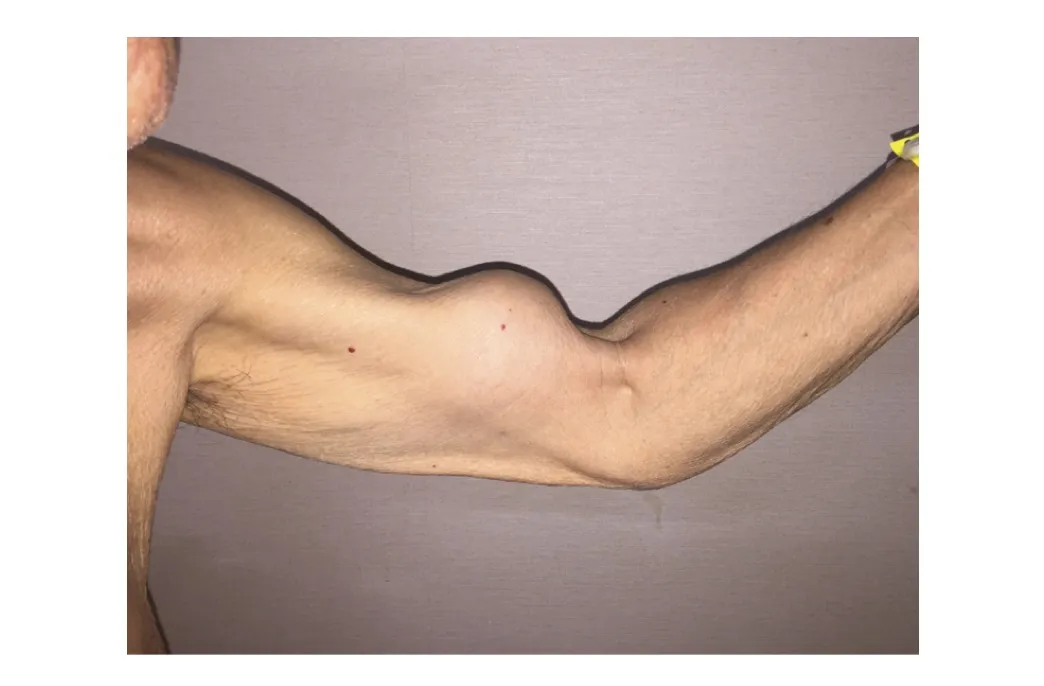
He might not be a sailor or have a girlfriend named Olive Oyl, but a man in Japan did share something in common with the cartoon character named Popeye — a bulging biceps in his left upper arm, a new report of the man's case reveals.
The 79-year-old man's visible bulge in the middle of his left upper arm, known medically as a "Popeye sign" or Popeye deformity, was not obtained after downing a can of spinach. Instead, it happened after he lifted an object and immediately felt a sharp pain in his left shoulder, according to the case report, published today (Nov. 15) in The New England Journal of Medicine.
And although Popeye's bulging biceps are considered a sign of strength, the appearance of a Popeye sign may instead be caused by weakness in the shoulder and elbow. [27 Oddest Medical Cases]
In the man's case, the Popeye sign occurred because the man tore one of his biceps tendons. Tendons are the tissues that connect muscle to bone; the biceps muscle is attached to the shoulder bone by two tendons, and to the elbow bone by one tendon.
An MRI showed he had a complete tear of the long head of the biceps tendon, according to the case report.
The "long head" of the biceps tendon is the longer of the two biceps tendons attached at the shoulder, said Dr. Dominic King, an orthopedic physician at The Cleveland Clinic in Ohio, who was not involved in treating the man's case.
When this tendon tears, the biceps muscle, which is no longer pulled as strongly toward the shoulder, sags toward the elbow.
Get the world’s most fascinating discoveries delivered straight to your inbox.
The result is a big, balled-up muscle in the middle of the arm, which produces the characteristic bulge in the biceps, King told Live Science. This bulge is more noticeable when the arm flexes at the elbow, and may appear thinner when the arm is at rest, he said.
These tendon tears are more common in older adults, as wear-and-tear over time weakens the muscles and tendons, according to the report. But the injury can still occur in younger people, especially in body builders and weightlifters, when they lift something heavy too quickly, King said.
King noted that surgery typically isn't needed to fix this type of injury, because a person still has one biceps tendon attached to the shoulder.
Indeed, in the man's case, the patient was treated with nonsteroidal anti-inflammatory medications, and four months later, he told doctors that his pain no longer affected his daily life, according to the case report.
Originally published on Live Science.
Cari Nierenberg has been writing about health and wellness topics for online news outlets and print publications for more than two decades. Her work has been published by Live Science, The Washington Post, WebMD, Scientific American, among others. She has a Bachelor of Science degree in nutrition from Cornell University and a Master of Science degree in Nutrition and Communication from Boston University.