













What Caused the Eruption of the World's Largest Mud Volcano?

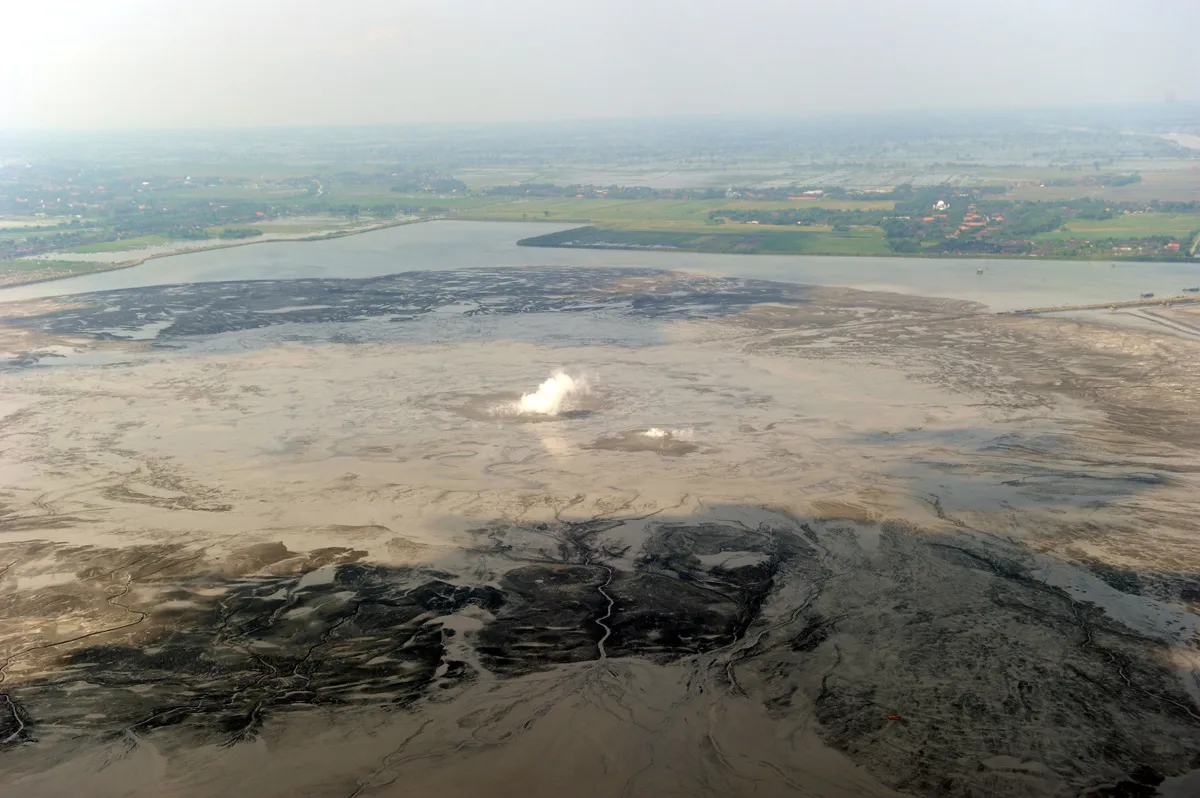
On May 29, 2006, a torrent of mud spewed from vents that opened up in the ground in a densely populated area of the Indonesian island of Java. That mudflow eventually buried houses, businesses and roads over an area twice the size of Central Park in New York and drove tens of thousands of people from their homes. More than 11 years later, mud, rocks and gases still sputter from the gashes in the earth there.
A group of scientists now said they've figured out what's fueling the world's largest known mud eruption: an underground connection to nearby volcanoes that funneled hot water and other material below the area where the mud erupted. That piping-hot material baked the overlying sediment, priming it for an eruption; an earthquake lit the final fuse, and the mud spewed forth that spring day, the researchers said.
"This study shows that the whole system was powerful, naturally prepared and ready to come out to the surface," study co-author Adriano Mazzini, of the University of Oslo, told Live Science. [7 Ways the Earth Changes in the Blink of an Eye]
The work, detailed online Oct. 28 in the Journal of Geophysical Research: Solid Earth, is the latest salvo in a scientific debate over what triggered the eruption. That debate began nearly the moment the first mud shot up from the ground. While the researchers behind the new study favor the explanation of an earthquake trigger, another group thinks a nearby, improperly drilled oil well set things in motion.

One of the scientists in the latter group also disputed the findings of the new study, though another seismologist not involved with any work on the mud volcano said the new findings were plausible, but not definitive without further evidence.
Surprise eruption
Even though Indonesia is one of the most seismically and volcanically active areas on the planet, the mud volcano eruption came as a surprise, because there were no warning signs.
Villagers were forced to quickly flee, and the government eventually built levees to contain the tidal wave of mud. In the first few months, that material flowed at a rate that could fill 72 Olympic-size swimming pools every day. The eruption was dubbed "Lusi," a portmanteau of "lumpur," the Indonesian word for mud, and Sidoarjo, the region where the event occurred. [Image Gallery: This Millennium's Destructive Earthquakes]
Get the world’s most fascinating discoveries delivered straight to your inbox.
Today, visitors can walk on the dried-up pool of mud and see roofs sticking out from the material. The still-erupting vents are fenced off, though "you can see these big mud blasts," Mazzini said, with "huge bubbles" like boiling yogurt. The area smells of oil and other hydrocarbons found below the surface, he said.

In the days after the mud volcano erupted, Mazzini and other geologists and seismologists set out to figure out what had set it off.
Some suspected the oil well almost immediately. The Indonesian company Lapindo Brantas was drilling for natural gas about a tenth of a mile from where the eruption occurred. According to the drilling logbooks, workers were having trouble controlling the pressure in the well the day before the eruption, Richard Davies, a petroleum geologist at Newcastle University in England, told Live Science. Drilling mud is put into such wells to keep the pressurized mud, natural gas and other material located below the Earth's surface from shooting up through the well.
The workers pulled out the drill bit, Davies said. The well, however, had a blowout preventer — the same apparatus whose failure led to the disastrous BP oil spill in the Gulf of Mexico in 2010 — that kept the contents from blasting out of the well. But because the preventer worked, all that pressurized material trying to push up through the well fractured the surrounding rock, bursting forth via the Lusi eruption instead, Davies and his colleagues contended.
While the new study doesn't specifically address the final spark that caused the eruption, the study authors said they favor a different trigger: a 6.3-magnitude earthquake that struck the city of Yogyakarta 150 miles (240 kilometers) away two days before the eruption. Davies and his colleagues said the temblor was too far away and too weak to be the trigger.
Davies said he does agree with the authors on one point, that the fluids that led to the eruption likely traveled along a local fault system. And it is this fault system that researchers explored in the new study, which lays out the background setup for the eruption.
What lies beneath
To get a look at what was happening under the ground in the area of the mud volcano, Mazzini and his colleagues set up a network of 31 seismometers. Seismic waves bounce off different types of rocks, fluids and even voids in different ways, and so scientists can use the waves to detect underground features, such as faults and volcanic magma chambers.

The scientists saw features they interpreted as a magma chamber under the Arjuno-Welirang volcanic complex, located a few miles away from the Lusi eruption, and a large feature under the mud volcano that appeared to connect to a tunnel. [Sights and Sounds: Cali's Gurgling Mud Volcanoes]
The researchers said they suspect the tunnel acted as a conduit to funnel material from the volcanic complex to the area under the mud volcano. As the material built up, it baked the surrounding, hydrocarbon-rich sediment, generating gases that built up pressure, priming the area to blow with the right trigger.
The connection makes Lusi a hybrid system, Mazzini said: Not a purely sedimentary mud volcano, nor a hydrothermal volcanic system, but a meeting of the two.
Davies said he disagrees with that interpretation of what the images show. He has done similar imaging under mud volcanoes near the Caspian Sea and said he thinks the researchers are simply seeing the typical jumble of faults and mixed-up sediments that have shown up under other mud volcanoes.
"I'm highly, highly skeptical of this paper," he said.
Bill Menke, a seismologist at Columbia University's Lamont-Doherty Earth Observatory in New York, has done similar studies, though not in Indonesia, and said the authors' interpretation is entirely plausible because of the strength of the seismic wave signal they're seeing.
"I thought this was an excellent paper," Menke said.
The indirect nature of the images means that the results are somewhat ambiguous, though, he said. Other tests, such as one that measures how electricity travels through the ground, could back up the team's interpretation, as hot water is a good electrical conductor, Menke said.
Mazzini and his colleagues also pointed to other evidence to bolster their interpretation. That includes the high temperature — more than 200 degrees Fahrenheit (100 degrees Celsius) — of the mud coming out of the vent and a match between the chemical composition of the gas coming out of the mud eruption and the nearby volcanic complex.
Neither side in the debate over the cause of the Lusi eruption looks to budge anytime soon, though the drilling company has been ordered to compensate the victims, according to news reports.
And regardless of the trigger, Lusi looks to keep leaking mud to the surface for a long time to come, keeping residents wary and the government working to control the onslaught.
Original article on Live Science.

Andrea Thompson is an associate editor at Scientific American, where she covers sustainability, energy and the environment. Prior to that, she was a senior writer covering climate science at Climate Central and a reporter and editor at Live Science, where she primarily covered Earth science and the environment. She holds a graduate degree in science health and environmental reporting from New York University, as well as a bachelor of science and and masters of science in atmospheric chemistry from the Georgia Institute of Technology.