













Teen Astronomer's 1886 Sketch Reveals Rare White Solar Flare

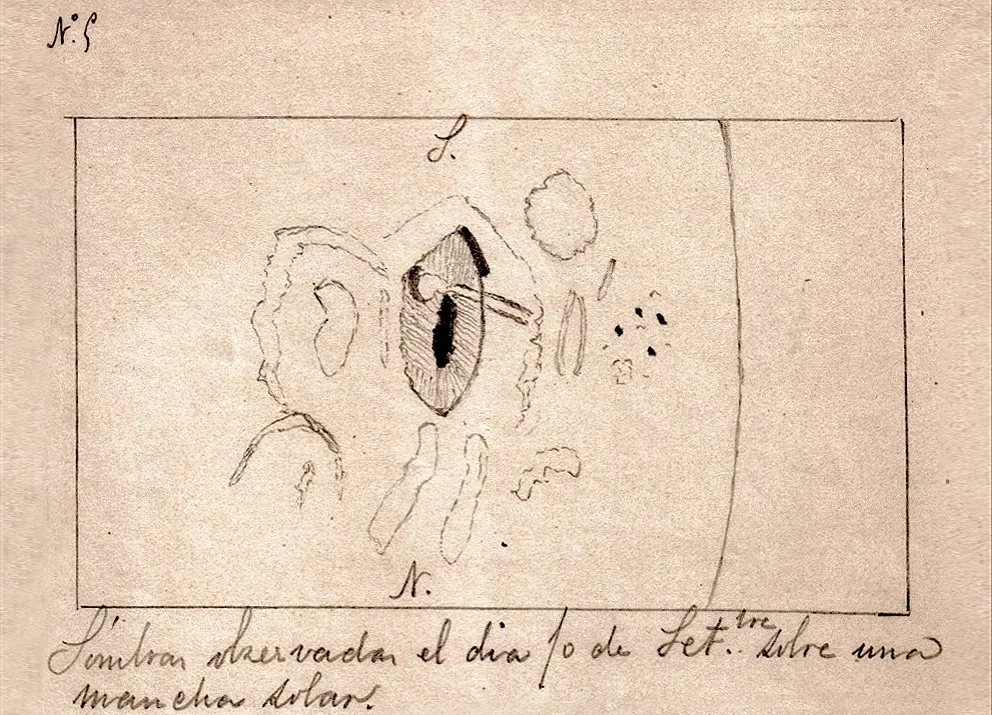
A newly discovered sketch more than a century old reveals a rare solar phenomenon — a white solar flare.
The sketch looks a little like a doodle with various shapes and shadings. Drawn in the journal of amateur astronomer Juan Valderrama y Aguilar when he was only 17 in 1886, it was published that same year in the French journal L'Astronomie. But a new look at Valderrama's private journals reveals more detail than ever before about the observation, which was only the third recorded white solar flare in history.
In his journal, Valderrama describes the magnetically weaker part of a sunspot called the penumbra.
"A huge, beautiful sunspot was formed from yesterday to today," Valderrama wrote on Sept. 10, 1886. He went on: "By looking at it carefully I noticed an extraordinary phenomenon on her, on the penumbra to the west of the nucleus, and almost in contact with it, a very bright object was distinguishable producing a shadow clearly visible on the sunspot penumbra. This object had an almost circular shape, and a light beam came out from its eastern part that crossed the sunspot to the south of the nucleus, producing a shadow on the penumbra that was lost in the large mass of faculae surrounding the eastern extreme of the sunspot." [Amazing Astronomy: Victorian-Era Illustrations of the Heavens]
What Valderrama had observed was a high-energy solar flare, strong enough to create a flash in not just ultraviolet or X-ray ranges, but also in visible light. Recent observations have shown that most solar flares release some white, or visible, light, Spanish researchers wrote in a new paper accepted for publication in a forthcoming issue of the journal Solar Physics. But highly sensitive equipment is usually needed to detect that light. Valderrama made his observations with a simple 2.5-inch-diameter (6 centimeters) telescope.
"It is extraordinary that in the Spain of the 19th century, a 17-year-old kid would make such a scientific discovery, and it is even more impressive that he had the courage of submitting it for publication to a foreign scientific journal," study co-author Jorge Sánchez Almeida, of the Instituto de Astrofísica de Canarias (IAC), said in a statement.
British astronomer Richard C. Carrington was the first person to ever observe a solar flare, only a few decades before Valderrama, in 1859. Italian astronomer Pietro Angelo Secchi described the second observed occurrence of the phenomenon in 1872.
Get the world’s most fascinating discoveries delivered straight to your inbox.
As Valderrama observed, sunspots (dark regions on the sun's surface defined by intense magnetic fields) are common progenitors of solar flares. The flares themselves are huge eruptions of electromagnetic energy that sometimes can last for hours; the one Valderrama saw lasted at least 30 minutes, according to his journals.
"White-light flares correspond to the most extreme cases of this phenomenon, where so much energy is dumped into the chromosphere and corona [of the sun] that the energy propagates downward to the photosphere, heating it up, and producing the excess brightness that we observe in white light," Almeida said. (The sun's atmosphere is divided into three layers, from one closest to its core, called the chromosphere, to the photosphere and finally the outer layer, called the corona.)
Original article on Live Science.

Stephanie Pappas is a contributing writer for Live Science, covering topics ranging from geoscience to archaeology to the human brain and behavior. She was previously a senior writer for Live Science but is now a freelancer based in Denver, Colorado, and regularly contributes to Scientific American and The Monitor, the monthly magazine of the American Psychological Association. Stephanie received a bachelor's degree in psychology from the University of South Carolina and a graduate certificate in science communication from the University of California, Santa Cruz.