













Baby Arachnophobia: Tots’ Fear of Spiders and Snakes May Be Innate

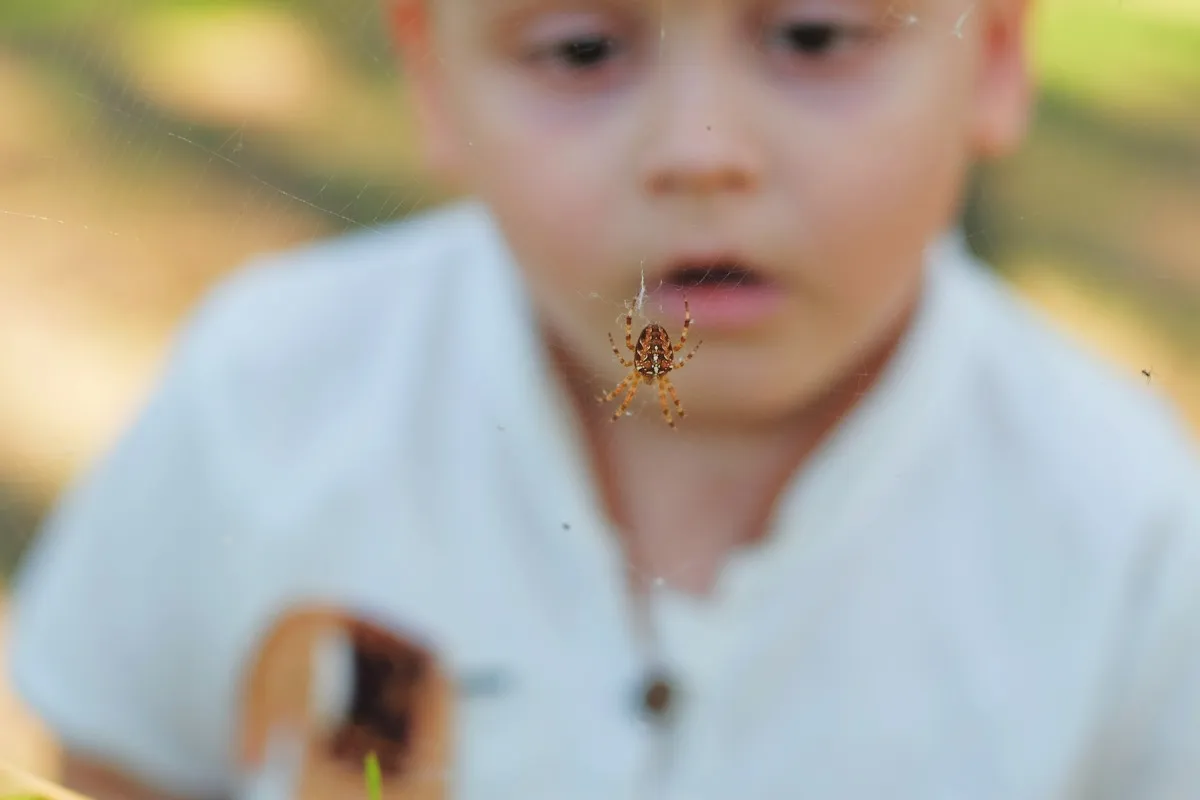
Itty-bitty babies are stressed by the itsy-bitsy spider, new research finds.
OK, not the nursery rhyme — actual arachnids. In a new study, researchers found that at 6 months of age, infants responded with more alarm to pictures of spiders than to flower images. In certain conditions, snakes also elicited more of an alarm response than fish. Humans and human ancestors have lived alongside snakes and spiders for 40 million to 60 million years, the study researchers wrote, so it's possible that a slight predisposition to worry about these "ancestral threats" may be hardwired at birth.
Snake and spider phobias afflict between 1 percent and 5 percent of the population, researchers at the Max Planck Institute for Human Cognitive and Brain Sciences (MPI CBS) in Leipzig, Germany, and Uppsala University in Sweden wrote in a paper published Oct. 18 in the open-access journal Frontiers in Psychology. Meanwhile, a full third of children and adults report strongly disliking spiders and snakes, despite the fact that neither animal poses much of a threat to humans in most parts of the world. [What Really Scares People: Top 10 Phobias]
Creepy critters
Neuroscientist Stefanie Hoehl of MPI CBS and the University of Vienna and her colleagues were interested in getting at the origin of this fear and loathing. A few earlier studies had hinted that infants might be innately biased to pay attention to things like spiders and snakes over non-threatening imagery, or even that they might fear them. But those earlier results weren't consistent, and the studies usually failed to control for confounding factors like the colors or brightness of varying imagery.
Hoehl and her colleagues conducted two studies using images matched for color, size and luminosity. In the first, 16 infants (age 6 months) sat on their parents' laps as they watched images of either spiders and flowers or snakes and fish pop up on a screen. Half of the infants saw the spider/flower sequences first and then switched to snakes and fish after a break; the other half saw the image batches in the opposite order.
As the infants watched, the researchers tracked their pupil dilation with an infared eye tracker. The pupils dilate when the brain releases the neurotransmitter norepinephrine, a signal of the stress response, Hoehl said in a statement. The neurotransmitter primes the nervous system for vigilance and alertness.
Eyes wide open
When infants viewed spiders, their pupils opened up significantly wider when they looked at flowers — a dilation of 0.14 millimeters versus 0.03 mm on average, the researchers reported. There was no difference in pupil dilation between snake images and fish images, which could have been because dilation is the result of infants detecting that something is a live animal, the researchers wrote. Or it could be that the stress response for spiders and snakes got carried over to fish.
Get the world’s most fascinating discoveries delivered straight to your inbox.
To investigate further, the team ran a second experiment with 32 additional 6-month-olds. This time, babies saw either snake photos only, or only fish. The snake-viewing babies showed greater pupil dilation (0.29 mm on average) than the fish-viewing babies (0.17 mm on average).
The findings still might indicate that babies' pupils dilate at signs of life, but the difference between fish and snakes in the second study does suggest that babies come hardwired with a predisposition toward alertness for creatures that threatened our ancestors, the researchers wrote. Babies at 6 months aren't yet moving much and probably haven't had many opportunities to interact with spiders or snakes in the real world, so their increased alertness could be innate.
However, the researchers noted, studies on toddlers suggest that the little ones aren't necessarily fearful of spiders or snakes. If the predisposition for alertness is hardwired, it's likely not an innate fear, they wrote. It's more like a tendency that when mixed with negative interactions or cultural messages about snakes and spiders can easily lead to fear.
"Similar to primates, mechanisms in our brains enable us to identify objects as 'spider' or 'snake' and to react to them very fast," Hoehl said in the statement. "This obviously inherited stress reaction, in turn, predisposes us to learn [that] these animals as dangerous or disgusting. When this accompanies further factors, it can develop into a real fear or even phobia."
Original article on Live Science.

Stephanie Pappas is a contributing writer for Live Science, covering topics ranging from geoscience to archaeology to the human brain and behavior. She was previously a senior writer for Live Science but is now a freelancer based in Denver, Colorado, and regularly contributes to Scientific American and The Monitor, the monthly magazine of the American Psychological Association. Stephanie received a bachelor's degree in psychology from the University of South Carolina and a graduate certificate in science communication from the University of California, Santa Cruz.