













Watch Swarms of Earthquakes Sweep Across Oklahoma
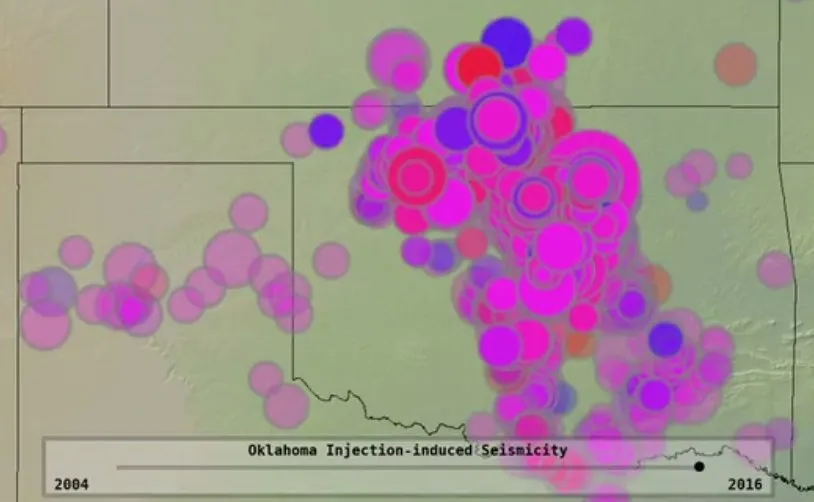
The dots appear sporadically at first. Then they start bursting forth like popcorn.
An animated map posted by the US Geological Survey office in Oklahoma recently illustrates the dramatic growth in the number of earthquakes rattling the Sooner State in recent years, a surge scientists have linked to the underground injection of wastewater from oil wells.
Oklahoma became the nation's seismic hot spot a few years ago, as hundreds of small-to-moderate earthquakes began shaking the state. Before 2010, it typically had two or three tremors a year of magnitude 3.0 or bigger; the number soared to 903 in 2015. By mid-2016, the USGS warned that 7 million people living between northern Texas and south-central Kansas were at risk of a damaging earthquake, leaving scientists and government officials scrambling to get a handle on the problem.
Though popularly tied to hydraulic fracturing, which uses high-pressure water to bore oil and gas wells into shale rock, the quakes aren't the result of the "fracking" process itself. Once they're drilled, wells in the area draw up 10 gallons or more of the salty wastewater with every gallon of oil. And the oil and gas boom that fracking produced led to a huge increase in the amount of wastewater that needed to be eliminated.
That water is usually disposed of with wells that can reach more than a mile below the surface. Scientists say that brine has lubricated long-dormant faults, causing them to slip and cause earthquakes.
The quakes also got bigger: There were 27 magnitude 4.0 or bigger last year and three in the 5 range, including a magnitude 5.8 that damaged numerous buildings in the city of Pawnee in September. No deaths have resulted, but they've led to lawsuits from homeowners whose property has been damaged and raised concerns in the insurance industry about the potential losses from a bigger shake.
But since state oil regulators starting imposing limits on wastewater injection depths and volumes in a broad area of north-central Oklahoma, the numbers have dipped sharply. The state recorded 623 noticeable quakes in 2016, and fewer than 180 so far this year.
Get the world’s most fascinating discoveries delivered straight to your inbox.
RELATED: Renewed Fossil Fuel Development Threatens Conservation Mission at Interior
"We're not out of the woods by any stretch of the imagination," said Matt Skinner, a spokesman for the Oklahoma Corporation Commission, which oversees the oil industry.
"We're still at an elevated risk for damaging quakes." But the numbers are down, "and researchers agree that our volume cutbacks and well-shut ins have certainly played a role in that," Skinner said.
The animation was produced by the Seismic Sound Lab, a project of the Lamont-Doherty Earth Observatory at Columbia University. It has been retweeted more than 3,100 times since it went online last week.
Originally published on Seeker.