Single-celled algae known as diatoms, long thought to reproduce asexually, were recently found to be friskier than expected.
Researchers discovered that diatoms do engage in sexual reproduction — and are especially likely to do it when in the presence of the compound ammonium, a waste product generated by most animals.
Previously, scientists had observed the complete life cycles in barely a handful of diatom species, and even among well-studied diatoms, sexual reproduction had never been seen, the researchers wrote in the study, published online July 7 in the journal PLOS ONE. [Photos Reveal the Diversity of Diatoms]
However, the study authors found that they could manipulate the diatom Thalassiosira pseudonana into changing its cell structures to be male or female. All they had to do was eliminate one of the factors that the diatom needed to grow — such as light or phosphorous — and then introduce ammonium, and the diatoms would differentiate into male and female cells.
"Our discoveries solve two persistent mysteries that have plagued diatom researchers," study co-author Kimberly Halsey, a microbiologist at Oregon State University, said in a statement.
"Yes, they have sex, and yes, we can make them do it," Hasley said.
Diatoms are protists, a diverse group made up of unicellular organisms whose bodies have cell walls and highly organized interiors, with a nucleus and an array of specialized structures called organelles. There are an estimated 200,000 diatom species in the world, and they can be found wherever there's liquid water.
Sign up for the Live Science daily newsletter now
Get the world’s most fascinating discoveries delivered straight to your inbox.
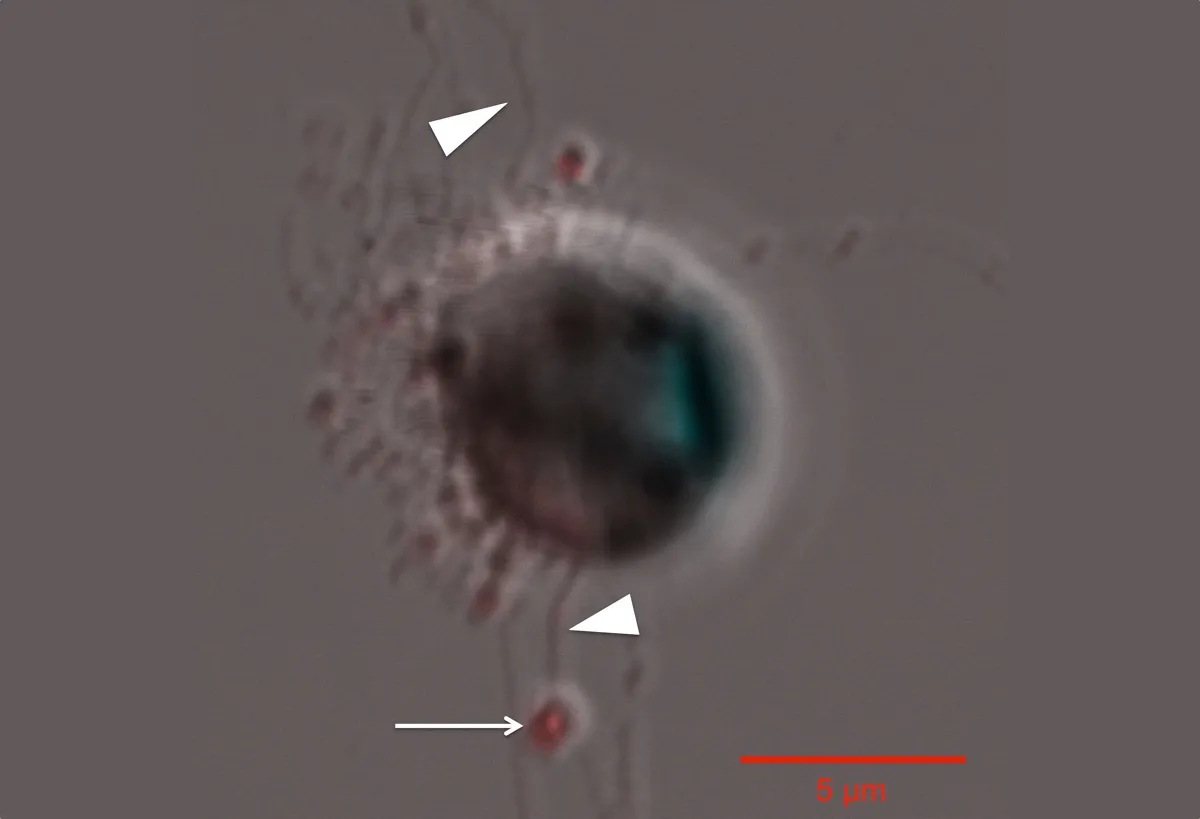
An egg cell of the diatom Thalassiosira pseudonana beginning to expand through the cell wall. Chlorophyll is shown in blue and DNA in red.
(Image credit: Oregon State University)
Though tiny, diatoms play an important if unseen role in Earth's carbon cycle — marine diatoms generate oxygen through photosynthesis — and in cycling silica, which makes up about 25 percent of the planet's crust and which diatoms incorporate into structures in their cell walls.
But very little is known about how most diatoms grow and reproduce. T. pseudonana is one of only two diatom species that has had its genome sequenced, making it a perfect candidate for identifying changes on the genetic level that could be linked to sexual characteristics — and prior studies had even identified genes that were necessary for sexual reproduction, but determined that they were inactive, the scientists reported in the new study.
Ammonium proved to be the missing ingredient. It sparked a cascade of genetic responses that produced egg and sperm structures. But that wasn't all — more than 1,200 genes also started performing differently when ammonium was present, though the effects of those changes are as yet unclear, the study authors wrote. However, pinpointing ammonium as one of the factors that drives diatoms to reproduce sexually will enable scientists to continue to replicate the behavior in order to study it further, according to Halsey.
"Identifying ammonium as a sexuality inducer potentially opens the door to new avenues of research into breeding and genetic modification to control important traits," Halsey said in the statement.
Mindy Weisberger is a science journalist and author of "Rise of the Zombie Bugs: The Surprising Science of Parasitic Mind-Control" (Hopkins Press). She formerly edited for Scholastic and was a channel editor and senior writer for Live Science. She has reported on general science, covering climate change, paleontology, biology and space. Mindy studied film at Columbia University; prior to LS, she produced, wrote and directed media for the American Museum of Natural History in NYC. Her videos about dinosaurs, astrophysics, biodiversity and evolution appear in museums and science centers worldwide, earning awards such as the CINE Golden Eagle and the Communicator Award of Excellence. Her writing has also appeared in Scientific American, The Washington Post, How It Works Magazine and CNN.