Ancient Sloth and Bison Fossils Turn Up in LA Metro Dig

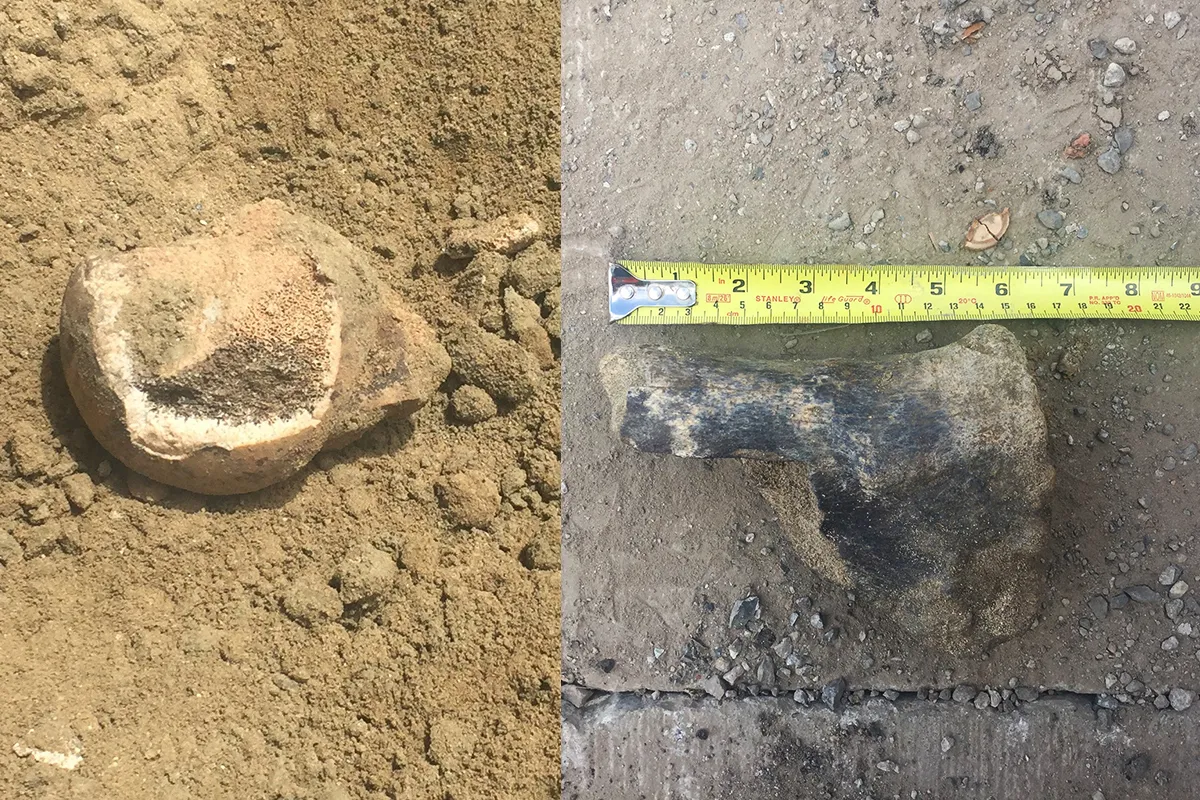
It's been around 11,000 years since giant ground sloths roamed North America, but evidence of one of them recently surfaced in Los Angeles, during excavation for a transit project managed by the LA County Metropolitan Transportation Authority.
Fossils from a giant sloth and a bison were unearthed on May 16 in a layer of sandy clay about 16 feet (5 meters) below Crenshaw Boulevard between 63rd Street and Hyde Park Boulevard, according to a post published online May 31 by The Source, a blog about the LA Metro.
The rocky fragments were identified on May 24 by Gary Takeuchi, collections manager at the La Brea Tar Pits and Museum, as pieces of leg bones — one belonging to a sloth and the other to a bison, LA Metro representatives said in a statement. [Image Gallery: 25 Amazing Ancient Beasts]
Article continues belowFossils of other ancient massive beasts, which roamed North America during the last ice age, have unexpectedly appeared during other LA construction projects in recent years. In April, work on a subway line extension near the La Brea Tar Pits was temporarily halted while paleontologists recovered first a camel bone and then a bone from an elephant relative, a mammoth or mastodon. And in December 2016, workers discovered a skull and partial tusks, as well as a section of mammoth tusk, also close by the tar pits.
In fact, fossils such as these turn up more frequently in LA than you might think, Takeuchi told Live Science in an email.
"Fossils periodically are found during excavation due to construction in the LA area. These fossils would probably not have been found if it were not for this construction unearthing them," he said.
The fossil belonging to the bison is part of a front leg, while the sloth fossil is a femur-head fragment, The Source reported. In photos that show the new finds positioned next to complete bones from the same animals, the rough and fragmented fossils don't look like much. But the trained eye of a paleontologist can quickly puzzle out the animal — and body part — that they represent, Takeuchi explained.
Get the world’s most fascinating discoveries delivered straight to your inbox.
"The shape and size of the end of long bones can tell you what element in the body and what animal it belongs to," he said in an email. "You do not need the complete bone or animal for identification."
For now, the new finds will remain with experts at Paleo Solutions, a company that assists in the removal and preservation of paleontological and archaeological artifacts and objects that are found on construction sites. In time, the fossils will find a home with other ice age fossils, possibly at the Natural History Museum of Los Angeles County, The Source reported.
Original article on Live Science.

Mindy Weisberger is a science journalist and author of "Rise of the Zombie Bugs: The Surprising Science of Parasitic Mind-Control" (Hopkins Press). She formerly edited for Scholastic and was a channel editor and senior writer for Live Science. She has reported on general science, covering climate change, paleontology, biology and space. Mindy studied film at Columbia University; prior to LS, she produced, wrote and directed media for the American Museum of Natural History in NYC. Her videos about dinosaurs, astrophysics, biodiversity and evolution appear in museums and science centers worldwide, earning awards such as the CINE Golden Eagle and the Communicator Award of Excellence. Her writing has also appeared in Scientific American, The Washington Post, How It Works Magazine and CNN.