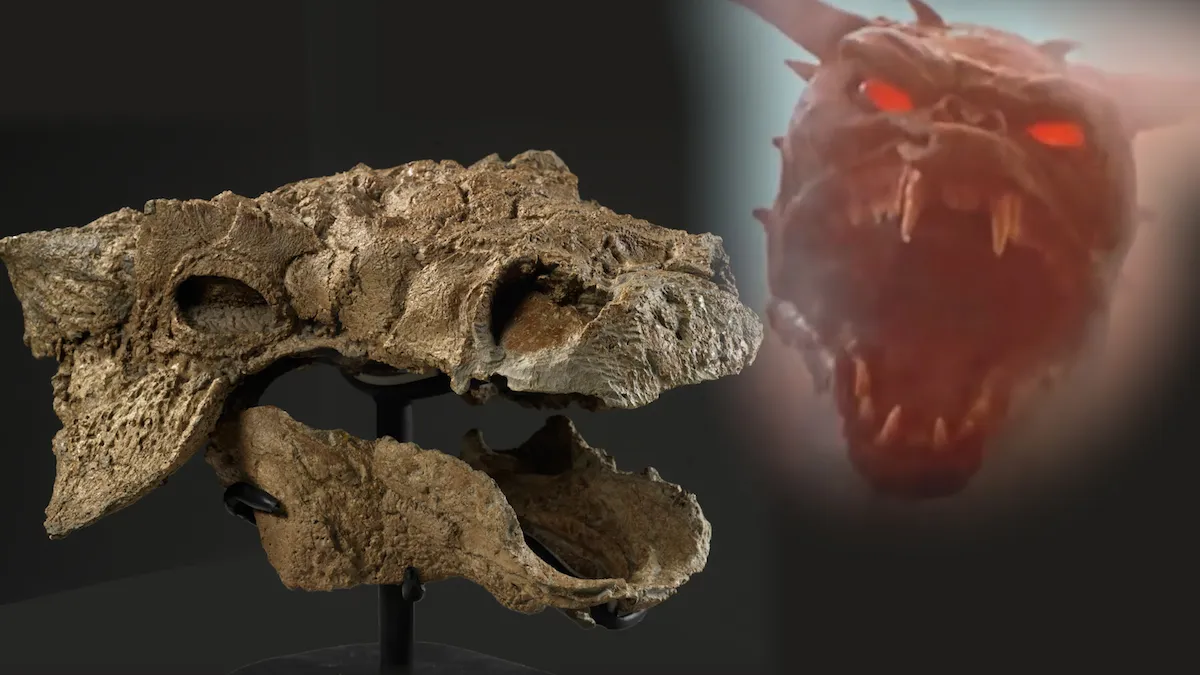
What's as long as a pickup truck, as heavy as a white rhinoceros and as weird-looking as Zuul, the monster from the 1984 "Ghostbusters" movie? A newfound species of ankylosaurus.
In a new study, researchers describe the 75-million-year-old dinosaur that lived during the Cretaceous and sported bony armor and spikes.
Due to its uncanny resemblance to Zuul, paleontologists are calling it Zuul crurivastator (CRUR-uh-vass-TATE-or). The genus name is a nod to Zuul, the fictional Gatekeeper of Gozer in "Ghostbusters." The species name translates to "destroyer of shins" in Latin, a name inspired by the club at the end of the dinosaur's tail. [See images of Zuul crurivastator, the 75-million-year-old ankylosaurus]
But despite the formation's fame among fossil hunters, the discovery of Z. crurivastator took the researchers by surprise. For starters, it is the first ankylosaur from the formation that has received a scientific name, they said. It's also one of the most complete dinosaur skeletons from this formation.
"Remarkably, [it] is the first ankylosaurin skeleton known with a complete skull and tail club, and it is the most complete ankylosaurid ever found in North America," the researchers wrote in the study.
For size comparison, here is Z. crurivastator standing next to an adult human.
(Image credit: Danielle Dufault/Copyright Royal Ontario Museum)
The Zuul-like specimen also has preserved soft tissues, including osteoderms (armor made of bone), skin impressions and dark films that likely represent preserved keratin, the researchers said.
Z. crurivastator may have looked intimidating, as if it would devour another dinosaur, but it was actually a plant eater, the researchers said. Rather, it likely used the club at the end of its 10-foot-long (3 meters) tail to hit the legs of predators, they added. Moreover, it may have used its powerful tail to battle rival males for mates or territory, the researchers said.
Sign up for the Live Science daily newsletter now
Get the world’s most fascinating discoveries delivered straight to your inbox.
Zuul also sported several rows of large, sharp, bony spikes along its 20-foot-long (6 m) body, the researchers said. It weighed about 5,500 lbs. (2,500 kilograms), about as much as a modern white rhinoceros.
"I’ve been working on ankylosaurs for years, and the spikes running all the way down Zuul’s tail were a fantastic surprise to me — like nothing I’ve ever seen in a North American ankylosaur," the study's lead researcher, Victoria Arbour, a postdoctoral fellow of paleontology at the Royal Ontario Museum and University of Toronto, said in a statement.
The finding shows that ankylosaurus dinosaurs were evolving rapidly during the late Cretaceous period in North America, the researchers added.
The study's lead researcher, Victoria Arbour (left), and senior researcher David Evans (right) sit next to the tail club of Z. crurivastator.
(Image credit: Brian Boyle/Copyright Royal Ontario Museum)
The preservation of Zuul is "truly remarkable," the study's senior researcher, David Evans, the curator of vertebrate palaeontology at the Royal Ontario Museum, said in the statement.
"Not only is the skeleton almost completely intact, but large parts of the bony armour in the skin are still in its natural position," Evans said. "Most excitingly, soft tissues such as scales and the horny sheaths of spikes are preserved, which will be a focus of our future research."
Laura is the managing editor at Live Science. She also runs the archaeology section and the Life's Little Mysteries series. Her work has appeared in The New York Times, Scholastic, Popular Science and Spectrum, a site on autism research. She has won multiple awards from the Society of Professional Journalists and the Washington Newspaper Publishers Association for her reporting at a weekly newspaper near Seattle. Laura holds a bachelor's degree in English literature and psychology from Washington University in St. Louis and a master's degree in science writing from NYU.