













Manatees FTW! Sea Cows Escape 'Endangered' Status

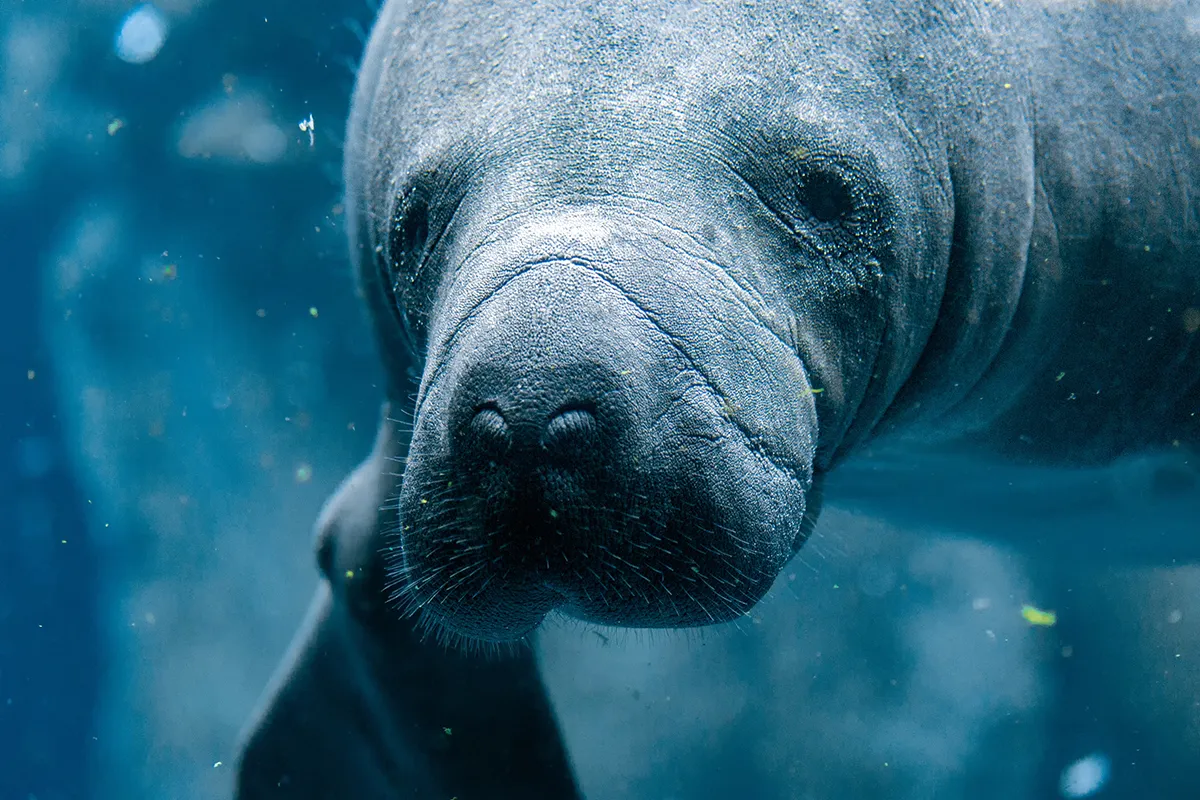
Dire environmental reports are seemingly everywhere, but today, there's a bit of good news: The roly-poly West Indian manatee (Trichechus manatus) is doing so well that the species is no longer considered endangered.
Significant increases in manatee population numbers and noted improvements to the animals' habitats convinced the U.S. Fish and Wildlife Service (FWS) to downgrade manatees' status from endangered to threatened, as defined by the Endangered Species Act (ESA), FWS representatives announced online today (March 31) in a statement.
Both subspecies of the West Indian manatee — the Florida manatee (Trichechus manatus latirostris) and the Antillean manatee (Trichechus manatus manatus) — will retain federal protections, as will the animals' vulnerable Florida habitats, according to the FWS ruling. [Image Gallery: Endangered & Threatened Wildlife]
Florida manatees were listed as endangered in 1967 under the Endangered Species Preservation Act of 1966, and officials added the Antillean manatee to the listing in 1970, the ruling reported.
While the manatees' revised status represents improvement in their prospects, a threatened species is still considered to be at risk, as it is "likely to become endangered within the foreseeable future throughout all or a significant portion of its range," according to the Endangered Species Act.
Conservation efforts by local governments, industries, businesses and private citizens contributed to the manatees' recovery, though challenges remain, FWS representatives warned.
Minimizing manatee interactions with boats, which are frequently lethal to the animals, will be a priority for FWS in collaboration with the U.S. Coast Guard and with coastal communities in Florida, the representatives added. Additional initiatives will regulate water pollution and the use of fishing gear in manatee habitats, and monitor the manatees' access to warm natural springs, which could help the animals survive winter cold snaps, FWS representatives said.
Get the world’s most fascinating discoveries delivered straight to your inbox.
The FWS estimated that about 6,300 Antillean manatees live in the wild, in an area ranging from the Mexican Gulf Coast to northern Brazil and the Caribbean, while an estimated 6,620 T. manatus latirostris individuals call Florida home.
"Today, we both recognize the significant progress we have made in conserving manatee populations while reaffirming our commitment to continuing this species' recovery and success throughout its range," Jim Kurth, acting director of the FWS, said in the statement.
Original article on Live Science.

Mindy Weisberger is a science journalist and author of "Rise of the Zombie Bugs: The Surprising Science of Parasitic Mind-Control" (Hopkins Press). She formerly edited for Scholastic and was a channel editor and senior writer for Live Science. She has reported on general science, covering climate change, paleontology, biology and space. Mindy studied film at Columbia University; prior to LS, she produced, wrote and directed media for the American Museum of Natural History in NYC. Her videos about dinosaurs, astrophysics, biodiversity and evolution appear in museums and science centers worldwide, earning awards such as the CINE Golden Eagle and the Communicator Award of Excellence. Her writing has also appeared in Scientific American, The Washington Post, How It Works Magazine and CNN.