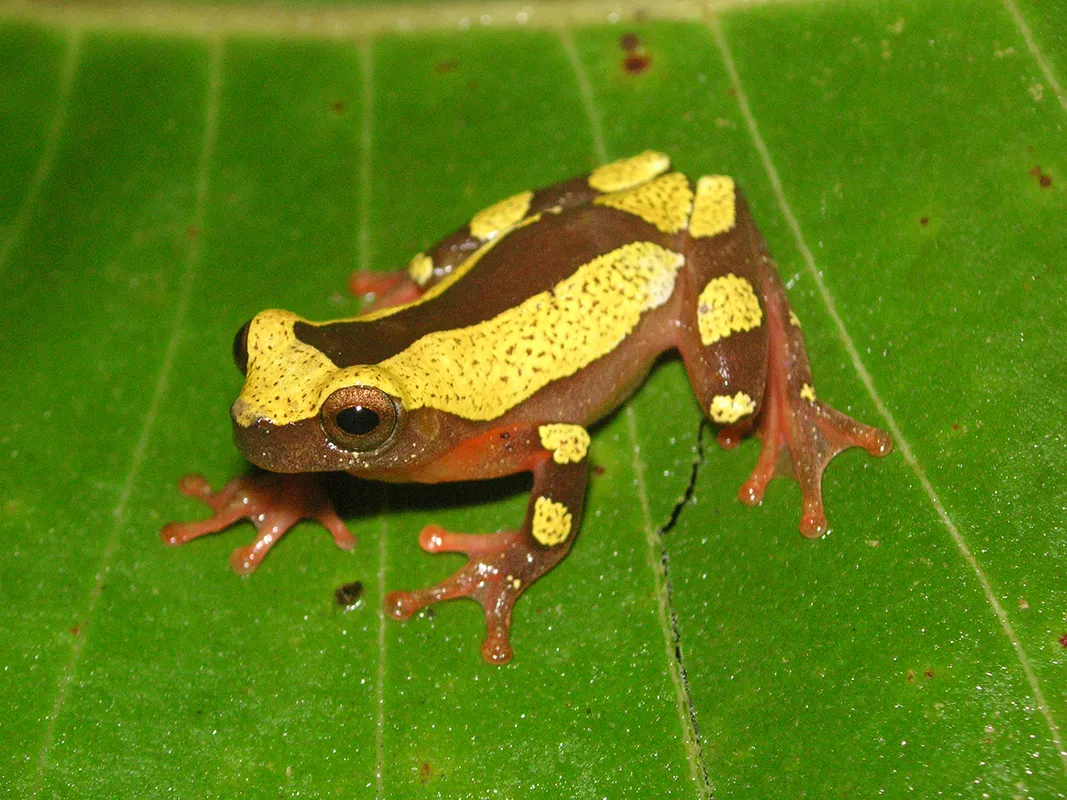
Scientists recently described two new species of clown tree frogs — brightly patterned amphibians from the Amazon region — and this classification re-evaluated how the frogs were previously identified.
The clown frog group, named for its vibrant colors, was formerly thought to contain only two species: Dendropsophus leucophyllatus and Dendropsophus triangulum.
But researchers looked more closely at the frogs, which are distributed widely across Ecuador, Guyana, French Guiana, Suriname, Peru, Brazil and Bolivia. The scientists used genetic analysis to identify the two new species, and determined that there could be as many as nine distinct species of Amazonian clown frogs in total, according to a new study. [40 Freaky Frog Photos]
"Two of those species kept their names, one species got an old name, two species were described as new and at least two populations are candidate species — meaning that we have to collect and analyze more data to see if they are new as well," study co-author Martin Jansen, a research associate in the herpetology department at the Senckenberg Research Institute and Natural History Museum in Frankfurt, Germany, told Live Science in an email.
Not a "universal" species after all: Dendropsophus triangulum.
(Image credit: Santiago R. Ron)
One of the newly classified species, Dendropsophus arndti, measures about 1.2 inches (30 millimeters) in length and was found in Bolivia. The other new species, Dendropsophus vraemi, averages about 1 inch (26.5 mm) long and is known from only one location in the Peruvian Amazon basin.
This new perspective on the distinctly colorful croakers hints at the range of amphibian biodiversity in the area, much of which is in peril of going extinct before it can be discovered and protected, Marcel Caminer, the study's lead author and a researcher at the Pontifical Catholic University of Ecuador, said in a statement.
"Our new study shows once again that we are not even close to knowing the actual species diversity of South American frogs and that even supposedly widespread species may be endangered," Caminer said.
Sign up for the Live Science daily newsletter now
Get the world’s most fascinating discoveries delivered straight to your inbox.
"It is important to achieve a complete species inventory in order to undertake the subsequent steps toward the protection of this biodiversity," he added.
The findings were published online March 1 in the journal PLOS ONE.
Mindy Weisberger is a science journalist and author of "Rise of the Zombie Bugs: The Surprising Science of Parasitic Mind-Control" (Hopkins Press). She formerly edited for Scholastic and was a channel editor and senior writer for Live Science. She has reported on general science, covering climate change, paleontology, biology and space. Mindy studied film at Columbia University; prior to LS, she produced, wrote and directed media for the American Museum of Natural History in NYC. Her videos about dinosaurs, astrophysics, biodiversity and evolution appear in museums and science centers worldwide, earning awards such as the CINE Golden Eagle and the Communicator Award of Excellence. Her writing has also appeared in Scientific American, The Washington Post, How It Works Magazine and CNN.