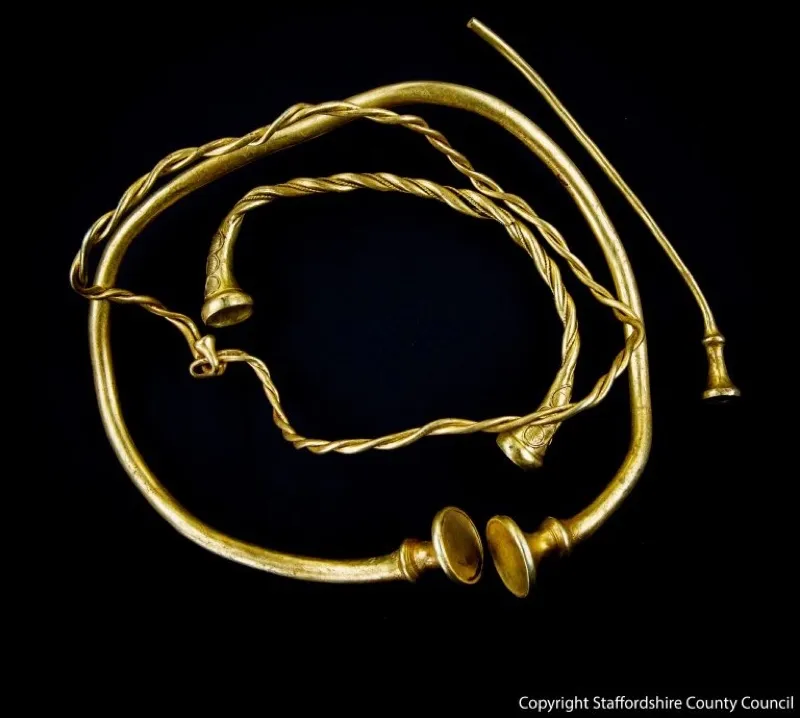
Found in a field near the town of Leek in the United Kingdom, the gold jewelry dates back sometime between 400 B.C. and 250 B.C. and could be the oldest example of gold work discovered in Britain.
(Image credit: copyright Staffordshire City Council)
Two amateurs using metal detectors have discovered four gold torques from more than 2,000 years ago in a field near the town of Leek in central England.
The jewelry, which would have been worn as a necklace or bracelet, "dates to around 400 to 250 B.C., and is probably the earliest Iron Age goldwork ever discovered in Britain," Julia Farley, curator of British and European Iron Age collections at the British Museum in London, said in a statement. The jewelry likely would have been worn by "wealthy and powerful women," possibly from Europe, Farley said.
After the jewelry was found, a professional archaeological team from the Stoke-on-Trent City Council investigated the field but didn't find any more jewelry or signs of an ancient town or tomb, leaving the question of why the gold jewelry was buried in the field unsolved. [Photos: Gold Jewelry Found in 1,500-Year-Old Tomb of Chinese Woman]
"Piecing together how these objects came to be carefully buried in a Staffordshire field will give us an invaluable insight into life in Iron Age Britain," Farley said in the statement.
Four ancient gold torcs, jewelry that can be worn around the neck or wrist, was discovered by individuals using metal detectors in a field in Staffordshire.
(Image credit: copyright Staffordshire City Council)
Metal detecting
Using metal detectors, amateurs Mark Hambleton and Joe Kania discovered the hoard of gold jewelry in December 2016, according to a statement from the Staffordshire County Council. However, the jewelry wasn't unveiled until yesterday (Feb. 28), at the Potteries Museum & Art Gallery, where it will be displayed for at least the next three weeks.
In England and Wales, amateurs like Hambleton and Kania are allowed to use metal detectors to search for antiquities if they have permission from the landowner and if they avoid archaeological sites that have been granted protection by the government. While metal detecting is legal, it's a controversial practice among professional archaeologists, who have expressed concerns that amateurs risk destroying undiscovered archaeological sites.
Under Britain's Treasure Act, discoveries of precious metals must be reported to the government. A committee then sets the value of the artifacts, and British museums are given the first opportunity to purchase the artifacts. The Treasure Act stipulates that money from the purchase is to be split among the discoverers and the landowner.
Sign up for the Live Science daily newsletter now
Get the world’s most fascinating discoveries delivered straight to your inbox.
The value of the four gold torques has yet to be set, but local officials in Staffordshire County are hopeful that they will be able to raise enough money to purchase the ancient jewelry and keep the pieces in the Potteries Museum & Art Gallery. The discovery "is quite simply magical, and we look forward to sharing the secrets and story they hold in the years to come," Philip Atkins, the leader of the Staffordshire County Council, said in the statement.
The discovery has yet to be published in a peer-reviewed scientific journal, and more analysis will be conducted in the future.
Owen Jarus is a regular contributor to Live Science who writes about archaeology and humans' past. He has also written for The Independent (UK), The Canadian Press (CP) and The Associated Press (AP), among others. Owen has a bachelor of arts degree from the University of Toronto and a journalism degree from Ryerson University.