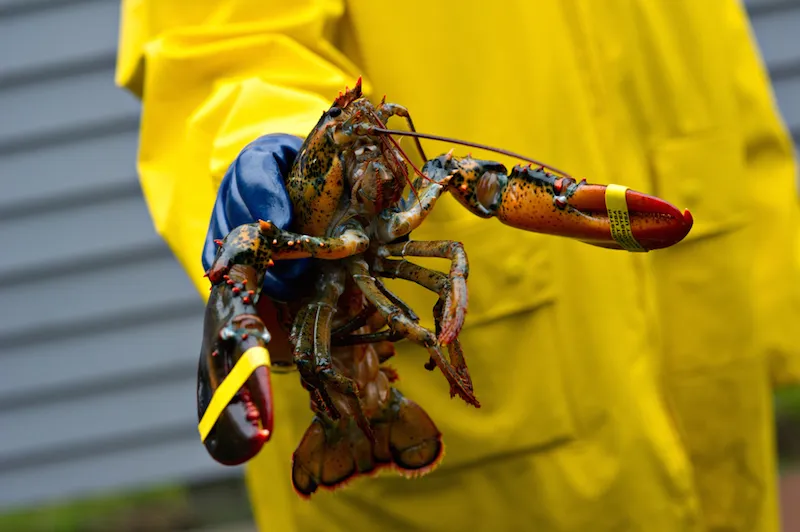
Many animals that live in the deep, dark sea are subject to myths, and lobsters are no different. But one particular “belief” — that lobsters would be immortal were it not for fishermen and hungry predators — doesn't exactly hold water, biologists told Live Science.
"Lobsters age just like most other organisms," said Thomas Matthews, a lobster biologist with the Florida Fish and Wildlife Conservation Commission.
Some lobsters, however, do have extraordinarily long life spans. The American lobster (Homarus americanus) can live to at least 100 years, which is more than five times the life span of the Caribbean spiny lobster (Panulirus argus), which doesn't even make it to 20 years, Matthews said. [Why Is the Ocean Salty?]
Water temperature explains most of this difference in age, Matthews said. When lobsters are in warm water, such as the Caribbean, they have faster metabolisms. Conversely, when they're in cold water, their metabolisms are slower.
With the American lobster, the cold Atlantic waters off the northern part of the Eastern Seaboard help slow down its metabolism, allowing it to age slowly and live longer, so long as it escapes predators and disease, Matthews said.
Mythical origins
The lobster does have a special ability that may have supplemented the immortality myth. These big-clawed crustaceans never stop growing, although the rate at which they grow decreases with age, said Heather Bracken-Grissom, an assistant professor of marine science at Florida International University.
Fishermen capture most lobsters when the invertebrates are between 4 and 18 months old and weigh about 1 lb. (0.5 kilograms). But because of never-ending growth, older American lobsters can weigh up to 25 lbs. (11 kg), Matthews said.
Sign up for the Live Science daily newsletter now
Get the world’s most fascinating discoveries delivered straight to your inbox.
Though many other organisms, including humans, stop growing when they reach adulthood, indeterminate growth is common among crustaceans and other groups, such as barnacles and water fleas known as daphnia, Bracken-Grissom said.
Moreover, lobsters can reproduce into old age, a feature that isn't always seen in other animals, he said. Geriatric mating can actually be beneficial, he said. Older female lobsters are often better mothers because they travel farther out to sea to release their eggs, unlike younger lobsters that usually lay their eggs closer to shore, where there is more pollution and sediment, which can smother the eggs, Matthews said.
How old are you?
These teeth, located in the lobster's stomach, persist through molts.
(Image credit: Gaya Gnanalingam)
Lobsters aren't immortal, but it's still hard to figure out their age. These creatures molt, and leave almost nothing behind that could divulge their true age. "The lining of the stomach, the covering of the gills, the eyes themselves — all of the hard parts get taken out," Matthews told Live Science. "It's an unbelievable process."
Within the past few years, however, researchers have discovered that lobsters have teeth in their stomach that persist through all of the molts. These teeth have lines akin to tree rings, which can help decipher the lobster's age. [Can Saltwater Fish Live in Fresh Water?]
Researchers are determining how these lines are formed, and whether the temperature of the water influences their appearance or growth rate. For instance, if a lobster spends time atop a seamount (an underwater mountain) where the water is warmer, and then returns to the colder water on the ocean's bottom, does that influence the growth rings on its stomach teeth, Matthews wondered.
But though there is much to learn about lobsters, one fact is clear: They don't live forever, he said.
Laura is the managing editor at Live Science. She also runs the archaeology section and the Life's Little Mysteries series. Her work has appeared in The New York Times, Scholastic, Popular Science and Spectrum, a site on autism research. She has won multiple awards from the Society of Professional Journalists and the Washington Newspaper Publishers Association for her reporting at a weekly newspaper near Seattle. Laura holds a bachelor's degree in English literature and psychology from Washington University in St. Louis and a master's degree in science writing from NYU.