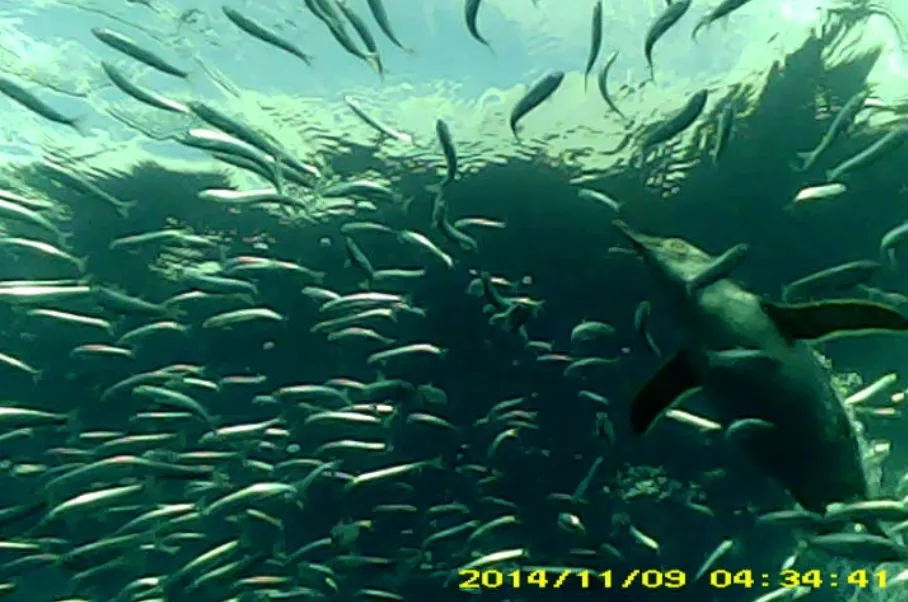
Wearing video cameras, the world's smallest penguins have revealed their hunting secrets: The little blue-hued birds swim together to stalk groups of prey, but when it comes to catching and killing their meals, it's every penguin for itself.
The aptly named little penguin (Eudyptula minor) is the smallest living species of penguin, growing to an average of 13 inches (33 centimeters) high and 17 inches (43 cm) long.
Previous research suggested that little penguins spent ample amounts of time swimming together when hunting food. Researchers wanted to learn more about why these birds formed groups when foraging, such as whether doing so gives them a better chance at capturing anchovies, krill, jellyfish and other prey. [See Photos of All 18 Penguin Species]
The scientists equipped 21 little penguins from two breeding colonies in southeastern Australia with cameras, GPS trackers, and depth and time recorders. The video cameras faced forward to give a penguin's-eye view.
"By putting video cameras on little penguins, this has been the first time we have been able to get a glimpse, literally, into their behavior and how they interact with other penguins at sea," said study lead author Grace Sutton, an ecologist at Deakin University in Burwood, Australia.
Little penguins in Australia were equipped with cameras, GPS trackers, and depth and time recorders
(Image credit: John Arnould, Deakin University)
The researchers attached the devices to the backs of the penguins with special waterproof tape that does not destroy the plumage of the birds when the tape is removed. Altogether, these devices weighed about 1.25 ounces (35.4 grams), less than 3 percent of the average weight of the birds; they were removed after each bird made a foraging trip.
"The penguins I work on are the smallest of all the penguin species, but they make up for it with how feisty, wriggly and aggressive they are," Sutton told Live Science. "It constantly amazes me how strong they are."
Sign up for the Live Science daily newsletter now
Get the world’s most fascinating discoveries delivered straight to your inbox.
During the breeding season, the penguins leave their nests at sunrise and return after dusk to feed their chicks. The scientists found that little penguins were more likely to swim together when hunting groups of prey than when encountering solitary prey.
Surprisingly, "the penguins had no more chance of capturing a meal when they were in groups than when alone," Sutton said. The birds may swim together, but they apparently do not work together after they encounter prey.
The researchers did find that little penguins were more likely to encounter schooling prey than solitary prey when the birds foraged in groups. This suggested that the penguins "hunt in groups in order to find prey and avoid predation by safety in numbers," Sutton said. "But, once they find prey, it is every penguin for themselves."
The scientists detailed their findings online Dec. 16 in the journal PLOS ONE.
Charles Q. Choi is a contributing writer for Live Science and Space.com. He covers all things human origins and astronomy as well as physics, animals and general science topics. Charles has a Master of Arts degree from the University of Missouri-Columbia, School of Journalism and a Bachelor of Arts degree from the University of South Florida. Charles has visited every continent on Earth, drinking rancid yak butter tea in Lhasa, snorkeling with sea lions in the Galapagos and even climbing an iceberg in Antarctica.