













T. Rex Was a True Killer
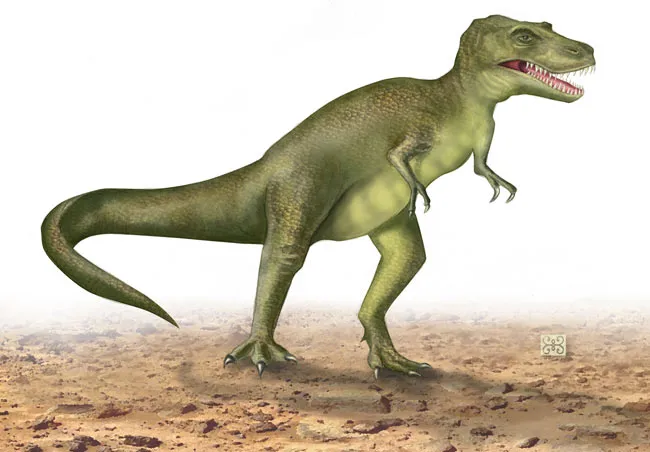
Tyrannosaurus rex relied on its elite nose to sniff out victims and take down live prey at night, a new study shows.
Some scientists previously had considered T. rex a scavenger of carrion, rather than a hunter, due to various features including its sense of smell. The new study, which analyzed data for a range of meat-eating dinosaurs as well as living carnivores (alligators), suggests T. rex likely was a true hunter and took down live prey such as other dinosaurs.
To figure this out, Darla Zelenitsky, a paleontologist at the University of Calgary in Alberta, Canada, and her colleagues looked at the importance of the sense of smell among various meat-eating dinosaurs called theropods, based on the size of the dinosaurs' olfactory bulbs, the brain area linked with smell. Dinosaur brains are not preserved, but the impressions of such brain regions left on skull bones or the space they occupied in the skull reveals the size and shape of the different parts of the brain.
The researchers relied on computed tomography scans and museum specimens or endocasts of the skulls to obtain data from a wide variety of theropods (including raptors and ostrich-like dinosaurs), the primitive bird Archaeopteryx and alligators.
While tyrannosaurs, including T. rex, and Velociraptor showed the largest olfactory bulbs relative to brain size and body mass, the worst sniffers based on bulb measurements were the oviraptors and the ostrich-like ornithomimids.
"They probably had a poor sense of smell, and it could imply an omnivorous or herbivorous diet," Zelenitsky told LiveScience, adding that past research also has suggested oviraptorids and ornithomimids could have been omnivores or herbivores.
The oversized olfactory bulbs also suggest T. rex and its tyrannosaurid buddies, such as Gorgosaurus libratus, which sported arm feathers, relied on their strong sense of smell to find prey at night or in large territories, Zelenitsky said.
Get the world’s most fascinating discoveries delivered straight to your inbox.
"Large olfactory bulbs are found in living birds and mammals that rely heavily on smell to find meat, in animals that are active at night, and in those animals that patrol large areas," Zelenitsky said. "Although the king of carnivorous dinosaurs wouldn't have passed on scavenging a free dead meal, it may have used its sense of smell to strike at night or to navigate through large territories to find its next victim."
The extinct bird Archaeopteryx, thought to have evolved from small meat-eating dinosaurs, had an olfactory bulb size comparable to most theropod dinosaurs. Most of today's birds have keen eyesight but lack a good nose, suggesting smell became less important at some point in birds' ancestral history, the researchers said.
The research is detailed in the current issue of the journal Proceedings of the Royal Society B.
- T. Rex's Secret Weapon Discovered
- Avian Ancestors: Dinosaurs That Learned to Fly
- Dino Quiz: Test Your Smarts
Jeanna Bryner is managing editor of Scientific American. Previously she was editor in chief of Live Science and, prior to that, an editor at Scholastic's Science World magazine. Bryner has an English degree from Salisbury University, a master's degree in biogeochemistry and environmental sciences from the University of Maryland and a graduate science journalism degree from New York University. She has worked as a biologist in Florida, where she monitored wetlands and did field surveys for endangered species, including the gorgeous Florida Scrub Jay. She also received an ocean sciences journalism fellowship from the Woods Hole Oceanographic Institution. She is a firm believer that science is for everyone and that just about everything can be viewed through the lens of science.