













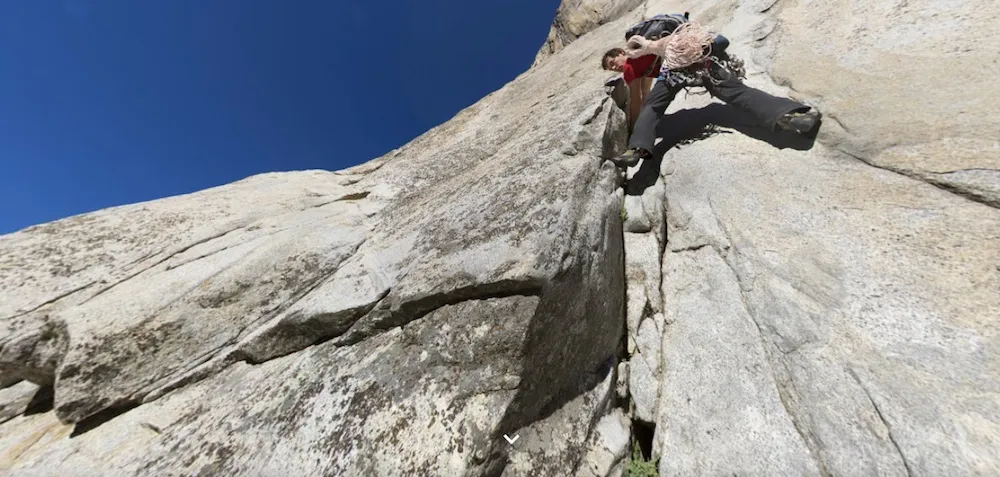
No need for that carabiner or rope: Now, you can climb up one of the sheerest, most iconic rock faces in the world without having to deal with blisters, crimp holds or fear of heights.
Google Street View has created a way for users to pull their way up El Capitan, with about two dozen stopping points that afford gorgeous panoramic views of the surrounding environment and shots of the best climbers in the world doing their jaw-dropping moves.
El Capitan, in Yosemite National Park in California, is perhaps one of the most famous climbing spots in the world. But the steep granite monolith, which stretches 3,000 feet (900 meters) from its base to its summit, is not for the faint of heart. [In Images: One-of-a-Kind Places On Earth]
El Capitan's craggy face has dozens of climbing routes, but even the most pedestrian of "El cap" climbs can be challenging. The monster monolith also boasts the hardest big wall climb in the world, called the Dawn Wall. In January, climbers Tommy Caldwell and Kevin Jorgeson became the first to summit the entire Dawn Wall in a free climb (meaning they did not use ropes to help pull them up, only ones to catch their falls).
Needless to say, most people will never summit the imposing rock face. To remedy that, members of the Google Street View team approached Caldwell, along with expert climbers Lynn Hill and Alex Honnold, after Caldwell's historic Dawn Wall ascent, to see if they would help the masses share the experience of ascending El Capitan.
The trio helped to capture Google's stunning new Street View images using a combination of traditional climbing gear and specialized camera equipment. They fixed cameras on tripods at the most famous spots along the wall with ropes, pulleys and anchors. The tripod cameras snapped 23 panoramic views at these stops, which also show the master climbers doing expert moves at famous spots such as the "Texas Flake" and the "Bolt Ladder," Caldwell said in a blog post about the project. Those who want to experience a little vertigo can also look down thousands of feet to the valley floor below.
A second view takes users up the most famous of those climbs, The Nose, which juts out like the prow of a ship. To get those shots, Honnold climbed the route with a 10-lb. (4.5 kilograms) camera rig on his back. The rig had six small cameras that sat above his head and snapped photos as he ascended. The images were then stitched together to create the breathtaking climbing imagery.
Get the world’s most fascinating discoveries delivered straight to your inbox.
This isn't the first time Street View has charted some of the most beautiful and forbidding places on Earth. The mapping project has captured images from coral reefs and Mount Everest's base camp, and has even sent its cameras floating down the Colorado River.
Follow Tia Ghose on Twitterand Google+. Follow Live Science @livescience, Facebook & Google+. Original article on Live Science.

Tia is the editor-in-chief (premium) and was formerly managing editor and senior writer for Live Science. Her work has appeared in Scientific American, Wired.com, Science News and other outlets. She holds a master's degree in bioengineering from the University of Washington, a graduate certificate in science writing from UC Santa Cruz and a bachelor's degree in mechanical engineering from the University of Texas at Austin. Tia was part of a team at the Milwaukee Journal Sentinel that published the Empty Cradles series on preterm births, which won multiple awards, including the 2012 Casey Medal for Meritorious Journalism.