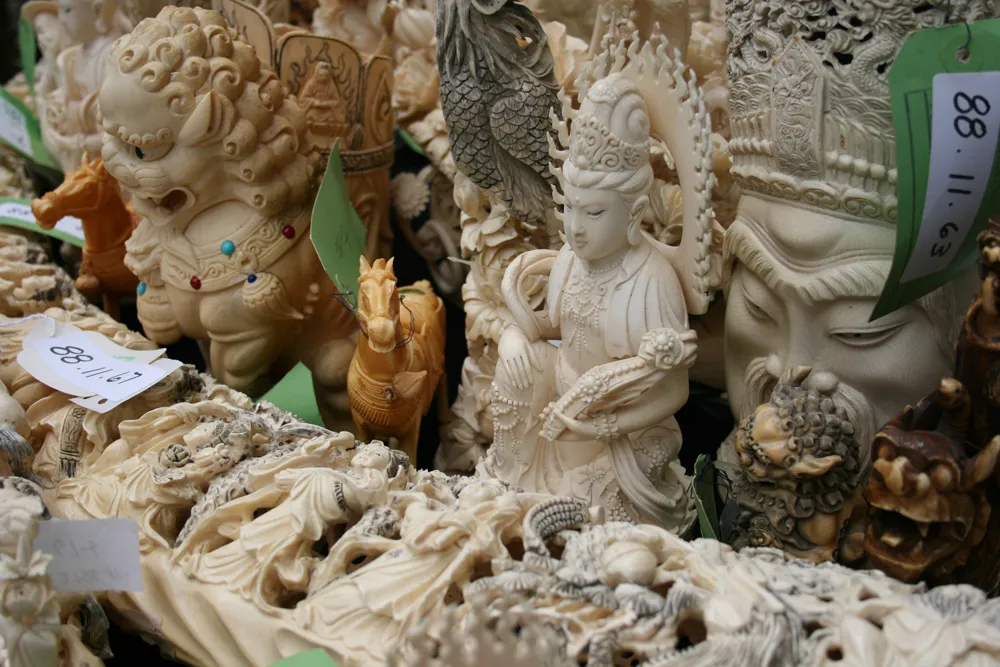
More than 1 ton of illegal ivory was destroyed today (June 19) in New York City. The public demonstration, held in Times Square, was designed to raise awareness about elephant conservation and promote anti-poaching regulations. Carved tusks, trinkets and other ivory objects were pulverized, in an effort to stop worldwide demand for the material. [Read full story about the ivory crush event]
Anti-poaching messages
Approximately 1,500 people showed up to witness the ivory being crushed. (Credit: Elizabeth Goldbaum)
Some of the ivory pieces came from an undercover operation conducted by the U.S. Fish and Wildlife Service in Philadelphia in 2009. (Credit: Elizabeth Goldbaum)
Times Square
The objects included carved tusks, sculptures and other ivory trinkets. (Credit: Elizabeth Goldbaum)
Sign up for the Live Science daily newsletter now
Get the world’s most fascinating discoveries delivered straight to your inbox.
Elephant conservation
The public demonstration was designed to promote elephant conservation and take a stand against poaching practices. (Credit: Elizabeth Goldbaum)
Halting demand
By destroying the illegal ivory, U.S. officials are hoping to demonstrate that the illicit material has no value. (Credit: Elizabeth Goldbaum)
Saving the elephants
"In just a three-year span, an estimated 100,000 elephants were killed for their ivory. That's an average of 34,000 elephants per year killed in Africa,” U.S. Secretary of the Interior Sally Jewell said at the event. (Credit: Elizabeth Goldbaum)
Witnessing the crush
Supporters gathered in Times Square to witness the destruction of the confiscated ivory. (Credit: Elizabeth Goldbaum)
Crushing demand
Some of the ivory pieces came from busts made by the New York State Department of Environmental Conservation. (Credit: Elizabeth Goldbaum)
Illegal ivory trade
The objects were loaded one-by-one onto a conveyor belt, before they were pulverized into powder. (Credit: Elizabeth Goldbaum)
Ivory carvings
More than 1 ton of ivory was destroyed as part of the public event. (Credit: Elizabeth Goldbaum)
Crushing machine
The machine used to crush the ivory resembled a trash-collecting truck, with a conveyor belt attached. (Credit: Elizabeth Goldbaum)
Strong message
The event was led by the U.S. Fish and Wildlife Service, with support from organizations like the Wildlife Conservation Society, World Wildlife Fund and New York State Department of Environmental Conservation. (Credit: Elizabeth Goldbaum)
Elephant conservation
The only other ivory crush in the U.S. was held in Colorado in November 2013. At that time, U.S. officials destroyed more than 6 tons of ivory. Since then, other countries around the world, including France, Belgium, China, Hong Kong and the Philippines, have followed suit. (Credit: Elizabeth Goldbaum)
Public demonstration
The ivory trinkets were loaded onto a conveyor belt, before they were reduced to powder. (Credit: Elizabeth Goldbaum)
To dust
The powdered ivory was stored in a massive collection bin. (Credit: Elizabeth Goldbaum)
Elizabeth is a staff writer for Live Science. She enjoys learning and writing about natural and health sciences, and is thrilled when she finds an evocative metaphor for an obscure scientific idea. She researched ancient iron formations in China for her Masters of Science degree in Geosciences at the University of California, Riverside, and went on to Columbia Journalism School for a master's degree in journalism, focusing on environmental and science writing.