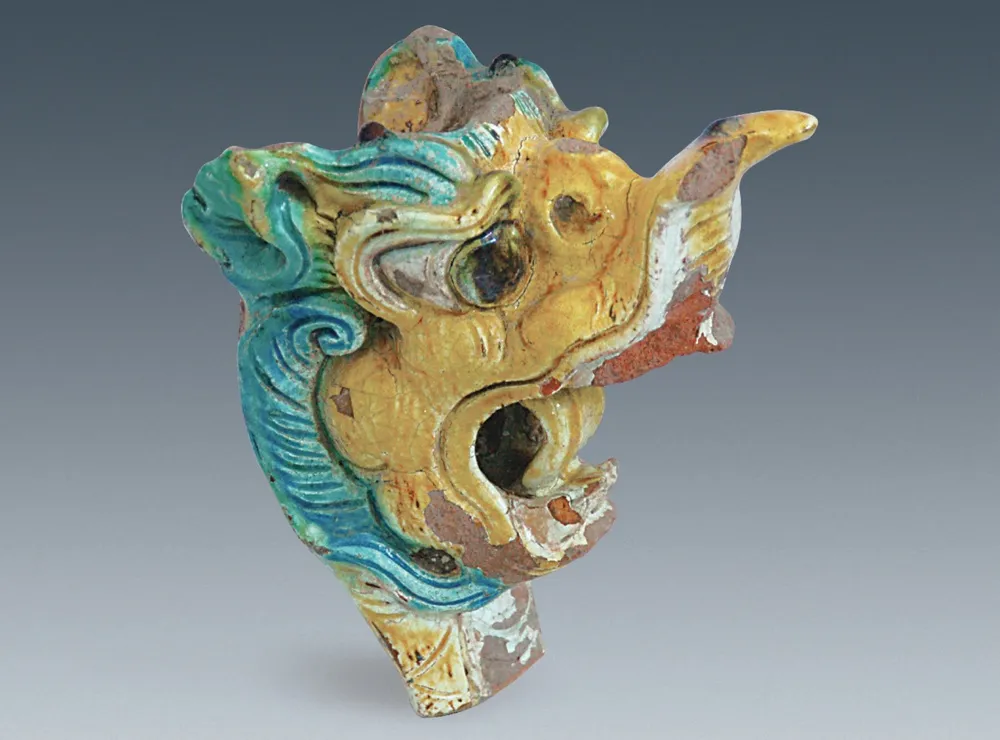
A team of archaeologists are excavating the site of Xanadu, a legendary city that flourished between 1256 and 1368. Built by the grandsons of Genghis Khan the city served as a summer capital of China (the country was under Mongolian control). Take a look at images of the city and colorful discoveries. [Read full story on Xanadu findings]
Dragon head
A colorful dragon head was found in a palace at Xanadu. Made of fine red baked clay, it has yellow, blue, black and white colors glazed on it. The head would have been attached to the end of a beam. Two other dragon heads like this were found in the excavations. This particular head was published in full color in the journal Chinese Cultural Relics. (Photo courtesy Chinese Cultural Relics)
The palace where the dragon head was found sprawls over 9,000 square meters (about 100,000 square feet) of space. That's almost twice the floor space of the modern-day White House. The top of one of the palace's platforms is seen here in this black-and-white image. (Photo courtesy Chinese Cultural Relics)
Horse ramp
Archaeologists found that a special type of ramp allowed horses and vehicles to pass through the palace. The ramp is called mandao meaning "path for the horses." Shown here, a black-and-white image of one of these ramps. (Photo courtesy Chinese Cultural Relics)
Sign up for the Live Science daily newsletter now
Get the world’s most fascinating discoveries delivered straight to your inbox.
Colorful city
The artifacts the archaeologists found show some of the lively colors that would have decorated the Khan's palace. This image shows eaves and dripstones (the dripstones deflect rainwater). They are decorated in blue and yellow designs with images of dragons or birds. (Photo courtesy Chinese Cultural Relics)
Fish head
Here, the remains of an artifact depicting a fish head, discovered in the palace at Xanadu. Decorated in glazed green and yellow colors the scales still survive. (Photo courtesy Chinese Cultural Relics)
Khan portrait
Kublai Khan helped organize the construction of Xanadu. He became Khan in 1260, and the city eventually became his summer residence and, in essence, China's capital during the summer months. This image shows a portrait of Kublai. (Image in public domain courtesy Wikimedia)
Owen Jarus is a regular contributor to Live Science who writes about archaeology and humans' past. He has also written for The Independent (UK), The Canadian Press (CP) and The Associated Press (AP), among others. Owen has a bachelor of arts degree from the University of Toronto and a journalism degree from Ryerson University.