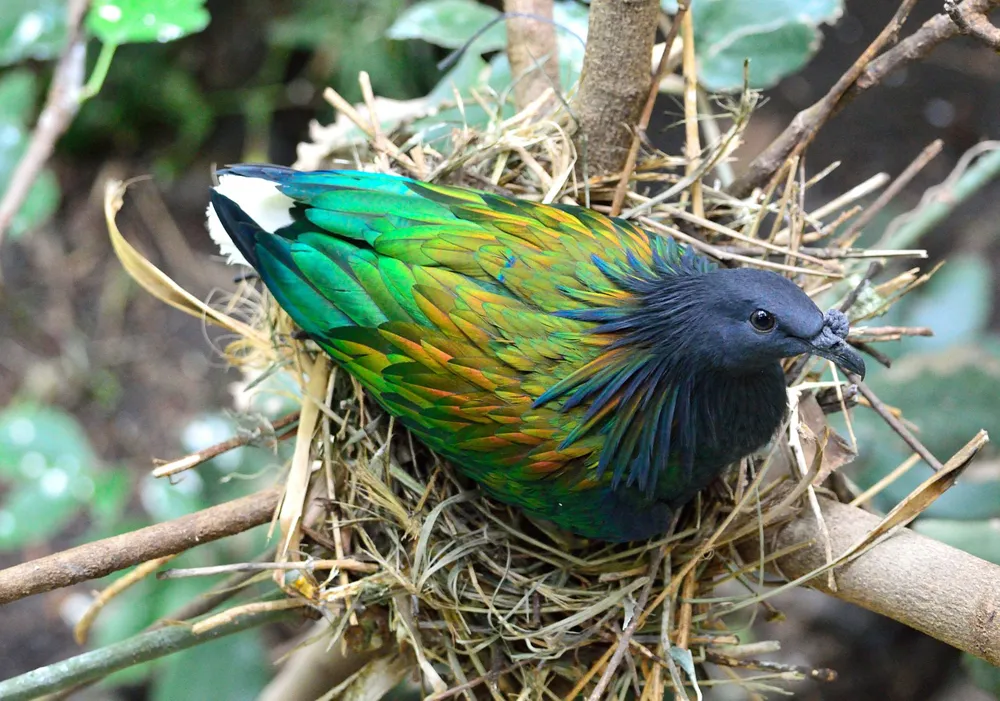
It's unclear why so many species sport iridescence colors, but a new study suggests that these shimmering shades may help animals confuse and escape from predators. To test this idea, a researcher trained quails to peck at virtual bugs on a touchscreen. The quails quickly learned how to nab the black bugs, but they had more trouble with the iridescent virtual bugs, the study found. [Read the full story on iridescent critters]
Shimmering dragonfly
Dragonflies are one type of insect with iridescent colors. It's possible that these shimmering hues make it harder for predators, such as birds, to catch prey. The researchers did the experiment in a controlled lab environment, but it's possible that the results translate to the wild, giving dragonflies an advantage over insects that don't have iridescent colors whenever predators are nearby. (Photo credit: Pixabay | Creative Commons)
The kingfisher, with its large head and pointed bill, is one of many birds that sport iridescent feathers. (Photo credit: Pixabay | Creative Commons)
Nicobar piegon
The iridescent Nicobar pigeon (Caloenas nicobarica) is native to the Nicobar Islands near the juncture of the Bay of Bengal and the Andaman Sea. Its also the closest living relative of the extinct dodo, according to a 2014 study in the journal BMC Evolutionary Biology. (Photo credit: Pixabay | Creative Commons)
Sign up for the Live Science daily newsletter now
Get the world’s most fascinating discoveries delivered straight to your inbox.
Peacock feathers
The peacock, famous for its extraordinary tail, is also a member of the iridescent club. It's unclear why some animals have iridescence, but scientists have suggested a number of ideas. For instance, iridescence may differentiate between different sexes and species. It may also enhance water repellence, reduce friction and help with thermoregulation. (Photo credit: Pixabay | Creative Commons)
Rainbow boa
The rainbow boa (Epicrates cenchria) lives up to its name: Its scales glint a variety of colors when light shines across it at different angles. (Photo credit: Pixabay | Creative Commons)
Stag beetle
Many stag beetles shimmer in an assortment of colors. It's possible that some of these beetles have evolved to have iridescent coloring, especially if it helps them escape predators, as the new study suggests. (Photo credit: Pixabay | Creative Commons)
Laura is the managing editor at Live Science. She also runs the archaeology section and the Life's Little Mysteries series. Her work has appeared in The New York Times, Scholastic, Popular Science and Spectrum, a site on autism research. She has won multiple awards from the Society of Professional Journalists and the Washington Newspaper Publishers Association for her reporting at a weekly newspaper near Seattle. Laura holds a bachelor's degree in English literature and psychology from Washington University in St. Louis and a master's degree in science writing from NYU.