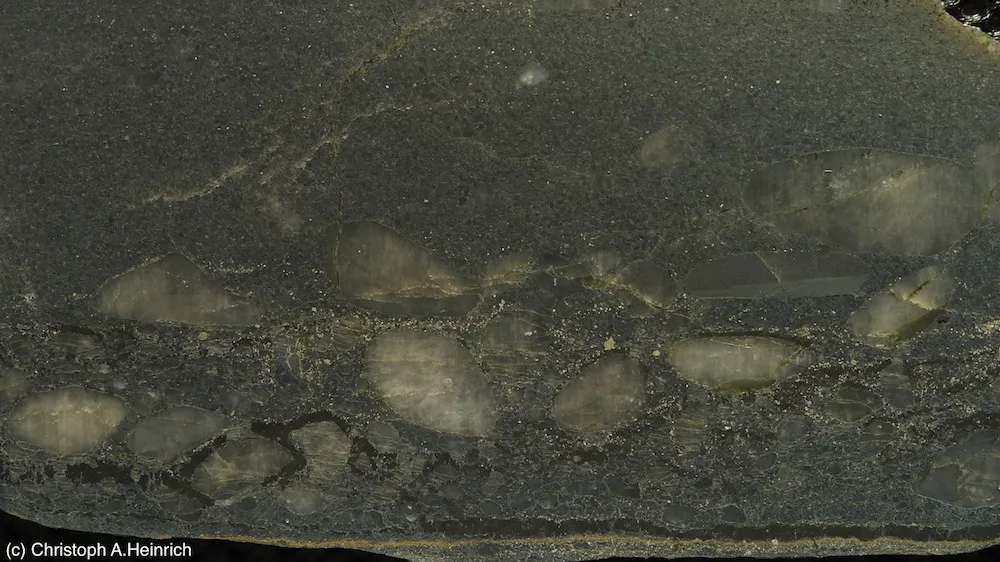
The source of Earth's biggest trove of gold may have been found: One scientist now points to a trio of agents working in concert: volcanic activity, ancient microbes and an oxygen-depleted atmosphere
The new theory may explain why there's a string of gold beds in the Witwatersrand basin, near Johannesburg, South Africa, that collectively make up 40 percent of all of the gold that has ever been, or ever will be, dug out of the ground, said study author Christoph Heinrich, a geologist at the ETH Zurich in Switzerland.
"The single biggest gold deposit in that string of deposits is still like three times bigger than the next biggest single gold deposit," called the Muruntau gold deposit, in the desert of Uzbekistan, Heinrich told Live Science. [Sinister Sparkle Gallery: 13 Mysterious & Cursed Gemstones]
Latest Videos From
Gold in those hills
Gold is a rare element in the universe that forms only in the hearts of violent star explosions called supernovae. The precious metal has been part of Earth since its birth 4.6 billion years ago, and while most of the Earth's gold is locked deep within the planet's core, the rest is largely dispersed throughout rocks at incredibly tiny concentrations of about one part gold per billion, Heinrich said.
But occasionally, a physical phenomenon causes the gold to become enriched in certain layers of rock. In the case of the Witwatersrand formation, up to 1 percent of the carbon-rich layers is made up of gold, Heinrich said.
Exactly how the gold deposit formed has been a mystery. Scientists originally thought that gold particles were mechanically deposited in the gravel of mountain streambeds, as is the case in California's Sierra Nevada mountains. But without a massive mountain range with lots of gold near Witwatersrand, this mechanism seemed to be an unlikely culprit for such a huge deposit.
As an alternative, Heinrich proposed that a set of circumstances collided to form the deposit sometime between 2.9 billion and 2.7 billion years ago. First, massive lava flows — similar to the Deccan Trap eruptions that coincided with the dinosaurs' extinction — belched sulfurous gas. The sulfur formed acid rain that ate at gold-containing rocks, sending bits of the rocks (and the gold) into the waterways. Without oxygen in the air, this rainwater sulfur didn't immediately bind to oxygen and become hydrogen sulfate, but instead formed a compound called hydrogen sulfide, which entered the rivers and streams. Hydrogen sulfide bound the gold and changed the water's ability to hold large amounts of gold, Heinrich said.
"From those conditions, the gold becomes quite soluble — you can actually dissolve it like salt and sugar in tea," Heinrich told Live Science.
This gold-laden water then crossed over beds of Archaea or primitive microbes. These microbial mats may have been living or dead at the time, but either way, they formed a thick layer of carbon. The chemical reaction between the carbon and the water solution caused the gold to settle out, creating the thin layers of gold interspersed with the carbon.
Controversial idea
But not everyone agrees with Heinrich's explanation. One researcher says volcanoes are unlikely to have played a role in the formation of the treasure trove of gold.
"I like the idea that the gold was precipitated, and I like the idea that the atmosphere was reducing," or depleted of oxygen, said Nic Beukes, a geologist at the University of Johannesburg who was not involved in the study. However, Beukes is less convinced that volcanic activity on land played a role in the gold deposit's formation, or that gold was carried in ancient rivers and lakes. About 100 million years separates most of the regional volcanic activity and the gold deposition, Beukes said.
In addition, newer evidence suggests the gold was deposited along a waterlogged shoreline, he said. But sulfur-laden rainwater would have been highly diluted if it fell into the ocean, rather than rivers and streams, meaning there wouldn't have been enough sulfur in the water to make gold soluble, Beukes told Live Science.
However, the gold could have settled out in a seawater lagoon after being carried there by rivers and streams, as long as the river water was not immediately diluted in the open ocean, Heinrich said.
And because these sediments are so ancient, the dating isn't very precise. Given the large date range, the volcanic activity and the gold deposition could have overlapped, Heinrich added.
The findings were published Feb. 1 in the journal Nature Geoscience.
Follow Tia Ghose on Twitter and Google+. Follow Live Science @livescience, Facebook & Google+. Originally published on Live Science.

 Live Science Plus