













Fracking Led to Ohio Earthquakes

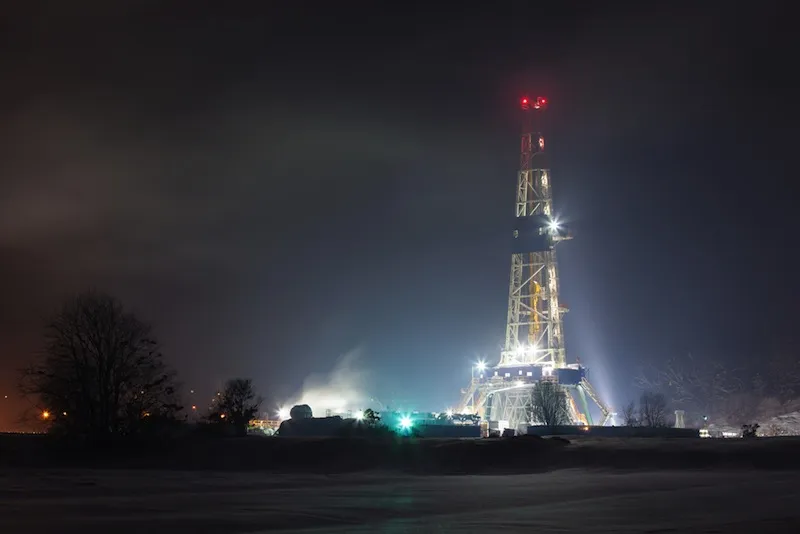
A hydraulic fracturing, or fracking, well in Ohio triggered scores of small earthquakes in March 2014, including one large enough to be felt in nearby towns, a new study confirms. The biggest quake, a magnitude 3, was one of the largest ever caused by fracking. State officials shut down the well two days after the earthquake hit.
Fracking involves the high-pressure injection of water, sand and chemicals into rock to break it up and release trapped oil and gas. In Ohio, fracking triggered earthquakes on a hidden fault in ancient crystalline rock beneath a natural gas well in the Utica Shale, according to the study, published today (Jan. 5) in the Bulletin of the Seismological Society of America.
No earthquakes were ever recorded in this region of Ohio before fracking started, and the shaking stopped after the well was shut down, said lead study author Robert Skoumal, a graduate student in seismology at Miami University in Ohio. Skoumal and other Miami University researchers identified 77 earthquakes with magnitudes ranging from 1 to 3 that occurred from March 4 to 12. [Top 10 Ways to Destroy Earth]
"The company happened to be unlucky because they were hydraulic fracturing near an unknown fault," Skoumal said.
The largest earthquake rattled nerves in eastern Ohio but did not cause any damage. "It could be felt, but this is a very small event," Skoumal said. "It did not pose any risk."
It's rare for fracking to cause earthquakes that people can feel. This is the fifth reported case tying fracking to felt earthquakes, and the second instance in Ohio. Fracking typically causes tiny tremors that are too small to be felt by people, usually smaller than about magnitude 1.
The majority of fracking-linked earthquakes in recent years — including those rocking Oklahoma, Arkansas and Colorado — are blamed on wastewater disposal wells, in which leftover drilling fluids are injected deep underground. The fluids unclamp faults, allowing rocks to slip.
Get the world’s most fascinating discoveries delivered straight to your inbox.
Fracking quakes
Skoumal connected fracking to Ohio's March 2014 earthquakes by comparing seismic records to publicly available drilling reports from the Ohio Department of Natural Resources (ODNR). It turned out the culprit was the two northeasternmost "legs" of a horizontal natural gas well drilled by Hilcorp Energy Co. in Poland Township, at the abandoned Carbon Limestone Landfill, according to the study results.
Earthquakes that started after drilling began outlined a small fault about a half-mile (about 1 kilometer) beneath two legs at well CCL2. (Multiple legs were drilled from the same well site.) Fracking at other well legs caused no earthquakes, Skoumal said. "It was a really isolated case," he said.
Skoumal distinguished between natural and manmade earthquakes with a technique he is developing that will help government and industry quickly pinpoint drilling-induced earthquakes. The technique, called earthquake fingerprinting, helps find tiny quakes that are typically hidden in the toddlerlike scribbles of seismometer recordings. A computer pulls out small tremors by treating the wiggles like fingerprints. The search pattern, or fingerprint, comes from the wigglelike seismograms of larger earthquakes that have already struck.
"It can identify signals that, to our eyes, would be just noise," Skoumal said. With more earthquake records, researchers get a clearer picture of whether shaking seems caused by industry, he said.
Looking at both the Poland Township case and an earlier earthquake swarm in Youngstown, Ohio, Skoumal said he saw a clear correlation in time and space with drilling activities.
Intensive shale gas drilling in Ohio has unleashed earthquakes from both fracking and injection wells. On Dec. 31, 2011, Youngstown experienced a magnitude-4.0 earthquake, the largest of 12 quakes clustered near an injection well in that area. Fracking-caused quakes in September and October of 2013 rattled Harrison County, according to a separate study.
The ODNR now requires that companies install seismometers when drilling within 3 miles (5 km) of known faults or near an area that has recently experienced earthquakes. The ODNR will stop drilling and evaluate a site if quakes occur.
Follow Becky Oskin @beckyoskin. Follow Live Science @livescience, Facebook & Google+. Originally published on Live Science.
