















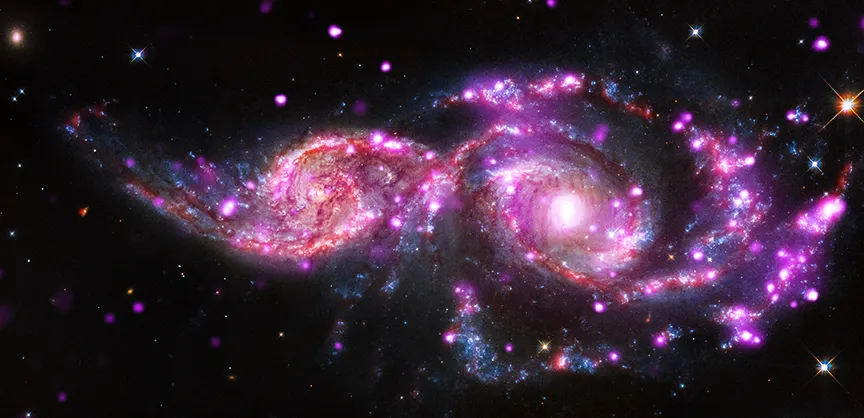
Two colliding galaxies are lit up like a Christmas tree in a dazzling new NASA photo.
The new image, which was released Thursday (Dec. 11), shows "ultra-luminous X-ray sources" (ULXs) studding the spiral galaxies NGC 2207 and IC 2163, which are grazing each other about 130 million light-years from Earth, in the constellation Canis Major.
The photo is a composite that combines data from three NASA spacecraft — the Chandra X-ray Observatory (X-ray light, colored pink); the Hubble Space Telescope (optical light, appearing as blue, white, brown and orange); and the Spitzer Space Telescope (infrared light, colored red), NASA officials said.
While the exact nature of ULXs isn't known for sure, astronomers think they're probably a special type of X-ray binary — a system in which a star circles either a super-dense stellar core called a neutron star or a stellar-mass black hole.
"The strong gravity of the neutron star or black hole pulls matter from the companion star. As this matter falls toward the neutron star or black hole, it is heated to millions of degrees and generates X-rays," NASA officials wrote in a description of the new photo.
"The black holes in some ULXs may be heavier than stellar-mass black holes and could represent a hypothesized, but as yet unconfirmed, intermediate-mass category of black holes," they added.
NGC 2207 and IC 2163 are active and exciting targets for astronomers. To date, researchers have counted 28 ULXs in the two galaxies, which have also been home to three supernova explosions in the last 15 years.
Get the world’s most fascinating discoveries delivered straight to your inbox.
Galaxy collisions are known to spawn intense bouts of star birth; shock waves generated during such interactions cause clouds of gas and dust to collapse, forming star clusters, researchers said. Indeed, NGC 2207 and IC 2163 are forming the equivalent of 24 new suns every year, compared to one to three suns per year in the Milky Way.
The ULXs in NGC 2207 and IC 2163 likely contain very young stars, perhaps just 10 million years old or so, researchers said. Earth's sun, in contrast, is 5 billion years old and is just about halfway through its life.
A study detailing these results has been accepted for publication in The Astrophysical Journal.
Follow Mike Wall on Twitter @michaeldwall and Google+. Follow us @Spacedotcom, Facebook or Google+. Originally published on Space.com.
