













X Prize Announces New Challenge: A 'Green' Car

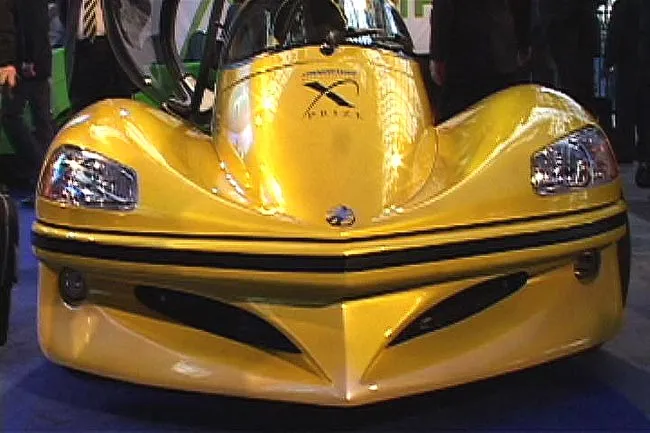
NEW YORK - And they're off! A new challenge to build an eco-friendly, efficient car - for a $10 million purse - began today with an announcement of the details of the Automotive X Prize at the New York Auto Show. The latest X Prize Foundation challenge for aspiring innovators is to design a "viable, clean and super-efficient" car that people actually want to buy and that will "help break our addiction to oil and stem the effects of climate change," according to the Foundation. So far, 64 international teams have signed up for the challenge, sponsored by Progressive Casualty Insurance Co. Their rolling inventions will compete for a $10 million prize in the culmination of the challenge: two long-distance stage races that reflect real driving conditions, to be held in 2009 – the Qualifying Race and the Grand Prize Final. "This is a race for the future; it is a race we must win," said Peter Diamandis, X Prize Foundation chief executive officer and chairman. In the races, the cars will have to hit a minimum speed and achieve a fuel efficiency of at least 100 miles per gallon of gasoline energy equivalent. They must also be ready for production on the market. No flashy concept cars please. "We're talking about real cars that can be brought to market in the real-term that people will want to buy," Diamandis said. The mileage requirement would limit the amount of greenhouse gases emitted by the cars to under 200 grams per mile. Currently, cars account for nearly one-fifth of U.S. greenhouse gas emissions. And American cars and light trucks are responsible for 45 percent of the carbon dioxide emitted by automobiles globally, the Foundation notes. The average fuel economy of American cars has declined in recent years, and while hybrids are commercially available, most entirely "green" prototypes from the main auto companies are years away from mass production. "This competition is an investment in the future of the automobile," said Glenn Renwick, Progressive's president and chief executive officer.
The competition will allow for two classes of green cars: a mainstream class (your traditional, four or more passenger, four-wheel deal) and an alternative class for more unusual designs (they must still seat at least two passengers, but can have any number of wheels). Mainstream cars must also have climate controls, an audio system and at least 10 feet of cargo space. They must be able to go from zero to 60 in 12 seconds and hit a minimum top speed of 100 mph. Alternative vehicles must hit at least 80 mph.
The cars proposed so far ranged from those that don't look too different from the ones you see on the highway today to more exotic designs, such as California-based Aptera's three-wheeled, two-seater electric hybrid design that is technically classified as a motorcycle as well as the all-electric, tandem two-seater from Spokane, Wash.-based Commuter Cars, which is only 39 inches wide.
Though most of the entries come from established companies and start-ups, there are a few universities and even one high school team vying for the prize. The West Philly Hybrid X team, based at the West Philadelphia High School Academy for Automotive and Mechanical Engineering, drove one of their creations for a previous green car competition into the event. They plan to make their X Prize entry a family-friendly hybrid sedan, which they describe as "a bad-ass, Earth-friendly car."
Both houses of Congress have praised the latest X Prize challenge for promoting innovation in the energy arena, passing resolutions congratulating the Foundation. "This prize promises to help harness the creative and entrepreneurial spirit of America’s best minds to one of our greatest problems: our over-reliance on foreign oil," said Senate Resolution sponsor Jeff Bingham (D-NM) in a statement. "It should be an exciting competition and it is certainly a worthy goal. I wish them the best of luck and look forward to seeing the innovations they inspire." Previous competitions run by the Santa Monica, Calif.-based nonprofit X Prize Foundation have included the $10 million Ansari X Prize to create the world's first private vehicle to space, the $10 million Archon X Prize for rapid human genome sequencing and the $30 million Google Lunar X Prize for sending a robot to the moon.
- Video: Vision of the X PRIZE
- Video: Progressive Prize Thinking
- 10 Technologies That Will Transform Your Life
- Top 10 Emerging Environmental Technologies
Get the world’s most fascinating discoveries delivered straight to your inbox.

Andrea Thompson is an associate editor at Scientific American, where she covers sustainability, energy and the environment. Prior to that, she was a senior writer covering climate science at Climate Central and a reporter and editor at Live Science, where she primarily covered Earth science and the environment. She holds a graduate degree in science health and environmental reporting from New York University, as well as a bachelor of science and and masters of science in atmospheric chemistry from the Georgia Institute of Technology.