













How the Greek Agora Changed the World

Each Monday, this column turns a page in history to explore the discoveries, events and people that continue to affect the history being made today.
It was the heart of the city – where ordinary citizens bought and sold goods, politics were discussed and ideas were passed among great minds like Aristotle and Plato.
Who knows where we'd be without the "agoras" of ancient Greece. Lacking the concept of democracy, perhaps, or the formula for the length of the sides of a triangle (young math students, rejoice!). Modern doctors might not have anything to mutter as an oath.
What went on at the agora went beyond the simple daily transactions of the market. The conversations that happened there and the ideas that they bore continue to affect us to this day, from the way scientists carry out their work to how we pass our laws.
The heart of public life
Nearly every city of ancient Greece had an agora – meaning meeting place – by about 600 B.C., when the classical period of Greek civilization began to flourish. Usually located near the center of town, the agora was easily accessible to every citizen, with a large central square for market stalls bound by public buildings.
The agora of Athens – the hub of ancient Greek civilization – was the size of several football fields and saw heavy traffic every single day of the week. Women didn't often frequent the agora, but every other character in ancient Greece passed through its columns: politicians, criminals, philosophers and traders, aristocrats, scientists, officials and slaves.
Get the world’s most fascinating discoveries delivered straight to your inbox.
Not only did the ancient Greeks go to the agora to pick up fresh meat and some wool for a new robe, but also to meet and greet with friends and colleagues. Akin to the modern high-powered lunch, much business got done in the casual setting.
High voter turnouts
Some of the world's most important ideas were born and perfected within the confines of the Athenian agora including, famously, the concept of democracy.
Regular Athenian citizens had the power to vote for anything and everything, and were fiercely proud of their democratic ways. No citizen was above the law – laws were posted in the agora for all to see – or was exempt from being a part of the legal process. In fact, Athenians considered it a duty and a privilege to serve on juries. Both the city law courts and senate were located in the agora to demonstrate the open, egalitarian nature of Athenian life.
The Athenian democratic process, whereby issues were discussed in a forum and then voted on, is the basis for most modern systems of governance.
Ultimate brainstorm session
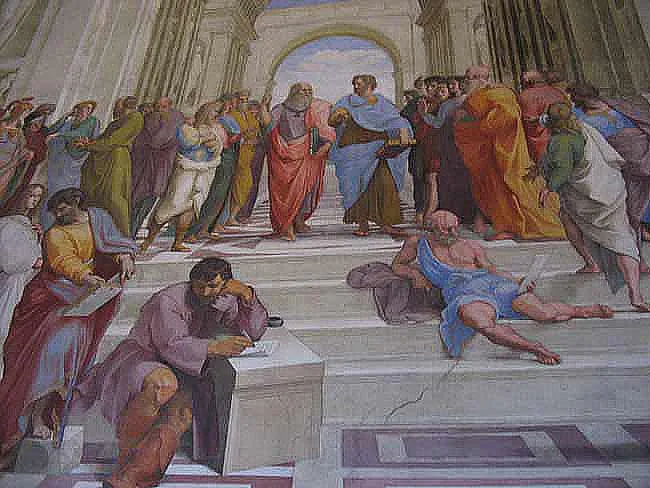
Scientific theory also got its start in the agora, where the city's greatest minds regularly met informally to socialize. Socrates, Plato and Aristotle all frequented the Athenian agora, discussed philosophy and instructed pupils there.
Aristotle, in particular, is known for his contributions to science, and may have developed his important theories on the empirical method, zoology and physics, among others, while chatting in the agora's food stalls or sitting by its fountains.
Hippocrates, the father of modern medicine and its Hippocratic Oath, and Pythagoras, a mathematician who developed the geometric theory of a triangle's sides, were both highly public figures who taught and shared ideas in their own hometown agoras.
- Last Week: How Qin Shi Huang Changed the World
- Next Week: How the Battle of Actium Changed the World
- Gallery: The Seven Ancient Wonders of the World
- Top 10 Ancient Capitals
